Showing posts with label REDD. Show all posts

Friday, December 11, 2009

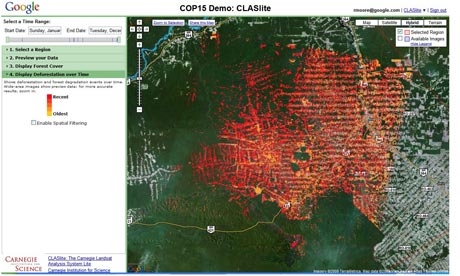
Google: Google unveils breakthrough technology to monitor deforestation


New REDD monitoring system out of Google.

Guardian:
Tracking the destruction of the world's forests is to become much easier for scientists and forest managers, thanks to a software tool unveiled by search-engine giant Google's philanthropic arm today.

The software, which uses Google's computing resources to extract scientific information from decades of satellite images of forests, was demonstrated at the UN climate conference in Copenhagen. "We hope this technology will help stop the destruction of the world's rapidly disappearing forests," said a statement on the Google.org blog.

"Emissions from tropical deforestation are comparable to the emissions of all of the EU, and are greater than those of all cars, trucks, planes, ships and trains worldwide. According to the Stern Review – the report prepared for the British government in 2006 on the economics of climate change by Lord Nicholas Stern – protecting the world's standing forests is a highly cost-effective way to cut carbon emissions and mitigate climate change."

The UN mechanism to reduce deforestation is called Reducing Emissions from Deforestation and Forest Degradation in Developing Countries (Redd), a system whereby richer countries would provide financial incentives to protect forests in poorer nations. For Redd to be successful, however, countries need ways to accurately monitor and report on the state of their forests.

In Google.org's prototype software, environmental authorities or NGOs interested in monitoring forests start with satellite images of their area and track how the size and shape of the tree cover has changed over time. The software can processes the images to extract useful scientific and tracking information about how much the forests have changed.

For the analysis, the Google.org team worked with Greg Asner of Carnegie Institution for Science and Carlos Souza of Imazon. Technology developed by Asner and Souza is used in Latin America to track changes in forest cover – but mainstream use of the models has been slow due to lack of access to high-quality satellite images and the computer power needed to carry out the analysis.

Google.org's solution is to enhance the Asner and Souza models using its own computing power. "What if we could gather together all of the earth's raw satellite imagery data – petabytes of historical, present and future data – and make it easily available on this platform? We decided to find out, by working with Greg and Carlos to re-implement their software online, on top of a prototype platform we've built that gives them easy access to terabytes of satellite imagery and thousands of computers in our data centres," it wrote.

Colby Loucks, deputy director of the conservation science program at WWF-US said: "A cost-effective and transparent approach for monitoring deforestation is needed to help pave the way for a global Redd program. If Google's system can be expanded to cover forests globally and access near real-time imagery, it can potentially be a powerful tool that helps tropical countries monitor forest loss."

Monday, November 30, 2009

NYtimes: The Road to Copenhagen - Tree Harvester Offers to Save Indonesian Forest


Ok, so I admittedly have been slacking on posting updates from the whole "Road to Copenhagen" process but frankly there is just too much happening to really make sense of it and there are daily BREAKING NEWS that aren't that interesting, such as Obama setting emissions targets, the African delegation walking out of talks, the Chinese fucking around, etc.

Anyway, I'm gonna try to post more interesting snippets and MAJOR things happening in Copenhagen over the next few weeks. Hopefully we'll get a robust internationally binding treating, but it's a long shot. Till then, check out some of the international efforts to help mitigate climate change.

This article should highlight some of the difficulties of the climate negotiations, and accounting for what should be eligible and ineligible for carbon credits.

NYtimes:

TELUK MERANTI, Indonesia — From the air, the Kampar Peninsula in Indonesia stretches for mile after mile in dense scrub and trees. One of the world’s largest peat swamp forests, it is also one of its biggest vaults of carbon dioxide, a source of potentially lucrative currency as world governments struggle to hammer out a global climate treaty. The vault, though, is leaking.

Canals — used legally and illegally — extend from surrounding rivers nearly into the peninsula’s impenetrable core. By slowly draining and drying the peat land, they are releasing carbon dioxide, contributing to making Indonesia the world’s third biggest emitter of greenhouse gases, after China and the United States.

The leaks were evident to a family of fishermen from this village, just south of the peninsula, as they paddled up a creek in a dugout canoe.

“I can tell the peat land’s leaking because the water here is getting browner and more acidic,” said Amiruddin, 31, who like many Indonesians uses only one name, as his wife, Delima, 29, scooped up the creek’s coffee-colored water to drink.

Forests like the one on the Kampar Peninsula are at the center of a growing battle over the shape of a new climate treaty and efforts to curb the destruction and degradation of forests. Though countries are expected to reach only a broad agreement at next month’s summit meeting in Copenhagen, governments, scientists, businesses and environmentalists are already arguing over what kinds of forests should qualify as carbon reducers and what kinds of projects should be rewarded financially.

The arguments over the Kampar have become particularly heated, not just because of its ecological importance, but because, so far, the most detailed plan to stop the leaks from the peat land comes from an unlikely source: a giant paper and pulp company that, according to its critics, has been one of the driving forces of deforestation in Indonesia. The company, Asia Pacific Resources International Limited, or April, says it wants to create a ring of industrial tree plantations around the peninsula’s core to preserve it.

What is more, it hopes to receive carbon credits for doing so under a United Nations program to reward nations for conserving forests and reforesting degraded ones. The program, Reducing Emissions From Deforestation and Forest Degradation, or REDD, is expected to be part of a new climate treaty. Unlike the 1997 Kyoto Protocol, a new treaty is expected to tackle deforestation, which alone accounts for 20 percent of the world’s greenhouse gas emissions. Halting deforestation in tropical forest nations like Indonesia and Brazil, the world’s fourth biggest emitter, is considered crucial to reining in global warming.

Developing nations that preserve forests would be paid with carbon credits that they could sell to industrialized nations seeking to meet emissions reduction targets. Though the program’s specifics will probably take months or years to be worked out, more than a dozen projects of the United Nations program are already under way in Indonesia, backed by such diverse entities as conservation groups, the Australian government and Merrill Lynch, in addition to paper and pulp companies.

Environmental groups say the paper and pulp companies, after years of despoiling Indonesia, should not be rewarded under the program.

“They are the ones that did the damage,” said Michael Stuewe, an expert on Indonesia at the World Wildlife Fund. “Now they’re saying: ‘We were bad boys. Now we’re good. So give us the money.’ ”

The companies argue that the United Nations program could provide them with the financial incentives to preserve forests even as they expand their operations, a goal supported by the Indonesian government, which sees the paper and pulp industry as a mainstay of the country’s economic development.

“We could perhaps reduce the annual Indonesian emissions by 5 percent with this one project,” said Jouko Virta, April’s president of global fiber supply, referring to the company’s plan to ring the peninsula’s core. “It’s so significant. One project.”

Everyone agrees, at least, on the importance of saving the Kampar Peninsula, a nearly one-million-acre peat bog on the equator inhabited by Sumatran tigers, bears, monkeys, crocodiles and other wildlife.

Most of the peninsula remains free of humans, though small fishing camps can be found up its creeks. More significantly, illegal loggers can be seen operating in bases set up along some canals and creeks. And east of here, near a village called Pulau Muda, more than a dozen houses flank a long canal jutting into the peninsula, in what appears to be the biggest human settlement on the Kampar.

Made up of decomposed trees and plants, sometimes as deep as 50 feet, the waterlogged land stores billions of tons of carbon dioxide. But once drained or cleared, the peat land releases many times more carbon dioxide than the deforestation of rain forests. Most experts believe that, as with rain forests, the protection of peat swamp forests will be eligible for carbon credits under the United Nations program.

The Kampar Peninsula is one of the last tracts of green left in central Sumatra, where forests have been cleared to make way for palm oil plantations and industrial tree plantations, especially those belonging to April and its chief rival, Asia Pulp and Paper, both owned by Indonesian conglomerates. According to the World Wildlife Fund, here in Riau, the province where the two companies have their main mills and plantations, two-thirds of the area’s forests have disappeared in the past quarter century.

Illegal loggers have also clear-cut vast chunks of forest. Migrants often slash and burn land for farming, sometimes inside national parks; like people elsewhere in Indonesia, they are often encouraged by local governments seeking to populate areas for economic or political reasons, in defiance of officials from the understaffed Forestry Ministry.

April, which, with its partners, has government-issued concessions across a third of Kampar, says its ring of acacia plantations around the core will block off any such encroachment, though it says it needs to acquire more land to complete the circle. On plantations already in operation, the company uses a sophisticated network of canals and dams that minimizes leakage from the peat land, environmental groups acknowledge.

If April acquired control over the core, it could be paid for protecting it. The company says it believes that it can be, at the very least, rewarded for the ring, about half of which would be turned into acacia plantations and half left as natural forests or what it calls “conservation areas.”

“The carbon we are storing in the conservation areas could be financed through REDD,” Mr. Virta said in an interview at April’s 4,300-acre mill, about two hours west of here by car.

Agus Purnomo, who leads the government’s National Council on Climate Change, said it would take months or years of negotiations after next month’s climate conference to determine whether April’s ring would be entitled to carbon credits.

Much will depend on whether an agreement includes stipulations against the conversion of natural forests into industrial tree plantations. Indonesia, like other countries with paper and pulp industries, counts industrial tree plantations as forests.

Environmental groups caution against any project of the United Nations program involving the conversion of natural forests into industrial tree plantations. Bill Barclay, policy director at the Rainforest Action Network, said the priority in Indonesia should be to “halt further conversion of natural forests” and “further draining of peat lands.”

But that kind of argument finds little traction in a nation with an economy that is still developing.

Mr. Purnomo, of the country’s climate change council, said government officials were worried that Indonesia’s ranking as the world’s third biggest emitter of greenhouse gases would increase pressure to reduce emissions.

“Are we going to remain underdeveloped because of that?” he asked.

Since starting operations on a new concession near here in September, April has brought jobs to Teluk Meranti. As part of its community outreach, it has brought a new generator to increase the supply of electricity and construction material to renovate two mosques. Still, Teluk Meranti had yet to buy April’s vision of the future. Villagers remained overwhelmingly opposed to the company’s presence here, opponents and supporters of the company said.

“We don’t know what we’ll get,” said Firdaus, a 39-year-old man operating a makeshift convenience store. “What rights do we have?”

He was unaware of April’s ring project. But, yes, he had heard of the importance of peat from environmental groups. “We were told,” he said, “to protect the peat for the climate.”
Friday, October 2, 2009

Economist: Last gasp for the forest

Economist:

A new climate treaty could provide a highly effective way to reduce carbon emissions by paying people to not cut down forests

IN THE south-eastern corner of the Brazilian state of Amazonas, in the municipality of Novo Aripuanã, there is thick forest cover—for now. But as new, paved highways are driven into the trees, illegal loggers inevitably follow. At the current rate of deforestation, around one-third of the forest in Amazonas will have been lost by 2050, releasing a colossal 3.5 billion tonnes of carbon dioxide into the atmosphere.
href="http://media.economist.com/images/20090926/3909ST1.jpg">

Novo Aripuanã is the site of a novel response to this threat: the Juma Sustainable Development Reserve, an area of 600,000 hectares (1.2m acres) bordered by two highways. This is a nature reserve with an unusual twist: local people will be paid to prevent the trees from being cut down. Each family in the area has been issued with a debit card. Regular inspections will ensure that the trees are still standing: as long as they are, families will have 50 reais ($28) a month credited to their accounts.

These funds come from the rich world, where governments and companies that cannot reduce their own emissions cheaply are prepared to pay others to reduce emissions on their behalf (as “carbon offsets”). Not cutting down trees in endangered areas prevents emissions that would otherwise have occurred, which gives untouched forest huge financial value—and provides people who live in the forest with an incentive to preserve it.
Still Pictures
Still Pictures


This idea is known as “avoided deforestation” or “reducing emissions from deforestation and degradation” (REDD). At the moment REDD is not so much a plan as a collection of proposals and some working schemes, like Juma. The fate of the forests in Brazil, Indonesia, the Philippines (pictured above) and elsewhere around the world could hang on the success of this approach. But there will need to be substantial international commitments to reduce global emissions to create demand for the carbon offsets that REDD schemes can provide. This means a lot hangs on a deal being struck in December in Copenhagen, where countries will meet to negotiate a new climate treaty.

Burning problems

Amid concern that progress towards a new treaty is slipping, Ban Ki-moon, the secretary-general of the United Nations, hosted a summit in New York this week to encourage nations to agree to carbon-reducing policies. REDD was high on the agenda, and governments and the private sector were urged to start investing in such schemes. There has also been talk of wrapping up carbon offsets into “forest bonds” to interest pension funds.

Preventing deforestation is potentially one of the simplest ways to reduce global emissions. At the moment, carbon emissions from deforestation account for some 18% of global greenhouse-gas emissions, more than all the world’s trains, cars, lorries, aeroplanes and ships combined. Reducing deforestation and land-degradation will be vital if temperature increases are to be kept to within safe levels (generally assumed to mean no more than about a 2°C increase). Some argue it would be a quicker and cheaper way of reducing emissions than many alternatives, such as weaning the world’s vehicle fleet off fossil fuels, forcing people to cut back on energy use or switching to low-carbon forms of power generation, such as wind farms and nuclear power. All those things will be necessary too, but they will take a long time, will require new technologies and cause controversies of their own.

Paying people to not chop down trees looks easy by comparison. It does not depend on any elaborate or costly new technology and is likely to be able to garner the required political support. Achim Steiner, the head of the UN’s environment programme, thinks avoided deforestation should be an easy thing to sell. As well as reducing carbon emissions, keeping forests standing also protects soil from erosion, improves the quality of water, helps regulate rainfall and ensures biodiversity. “How on earth can we not afford to make this work?” he asks.
Still Pictures
Still Pictures

Learning in the forest

But if it is to work, REDD must address the failings of the UN’s Clean Development Mechanism (CDM), which forms part of the Kyoto protocol, the 1997 treaty that aims to curb greenhouse gases. Since 2006, the CDM has allowed developing countries to sell carbon offsets, known as credits, for adopting green technology: switching an entire village to energy-saving light bulbs, for example, or planting lots of trees. The CDM has been criticised, however, for allowing countries to sell credits even for dubious things like building dams. There are also concerns about enforcement. And the Kyoto rules do not allow countries to sell offsets from avoided-deforestation schemes. Planting new trees qualified, but refraining from cutting down existing ones did not.

REDD raises further concerns of its own. One of the main criticisms of it is that some rich countries might, in effect, outsource the tricky business of reducing carbon emissions to the developing world, by buying carbon offsets and continuing with business as usual at home. Some also wonder if the promised amount of carbon reduction could be so large. Gilberto Câmara, head of Brazil’s National Institute for Space Research (which monitors deforestation from space), thinks that REDD’s capacity to deliver global emissions cuts is being oversold. Based on his analysis of Brazil, which accounts for 40% of the world’s deforestation, he says there is no way the world can cut 18% or so of emissions through avoided deforestation. This figure is based on outdated estimates of the rate of deforestation, which has fallen dramatically in Brazil in recent years, he says.

This highlights another problem with REDD: it is hard to say how much deforestation there would have been anyway. Benchmarking REDD schemes against existing data, which can be out of date with higher rates of attrition, would give an exaggerated impression of their effectiveness, overstating the volume of emissions that had been prevented and causing rich countries to pay too much.

Nicholas Stern, a British economist and author of a report for the British government which put avoided deforestation on the climate agenda in 2007, says the exact amount by which emissions can be reduced is not terribly important. “It actually doesn’t matter whether it is 15% or 20%—the point is that it is big,” he says. What if Dr Câmara is right and avoided deforestation can reduce emissions only by, say, 10%? “I suspect it is not that low, but 10% is still a big slice,” says Lord Stern. “The point is to get the mechanisms going and the funding at a serious level.”

A further difficulty is that countries that have already taken effective action to prevent deforestation, such as Costa Rica, will be unable to benefit from a REDD scheme; it would, paradoxically, end up rewarding the worst offenders, since they would have the greatest scope to mend their ways, and get paid to do so. Various proposals have been put forward to pay retrospective rewards to such well-behaved countries.

Provided these problems can be overcome, what would REDD cost? Again, hard and fast figures are difficult to come by. The cost of setting up and running REDD schemes is unclear, and successful efforts to reduce deforestation would probably drive up timber prices, which might then make it necessary to pay more to prevent deforestation. Estimates for the cost of halving the rate of deforestation (and therefore reducing global emissions by as much as 9%) range from $7 billion to $28 billion a year. These costs do not include the initial set-up process, during which appropriate enforcement mechanisms would need to be put in place in leafy-but-dodgy countries.

If avoided deforestation is to work on a global scale, it will need to involve Indonesia and Congo, countries where corruption and mass deforestation go hand in hand. So REDD projects will require reporting, auditing and monitoring mechanisms. The advent of low-cost satellite imagery will help, but all this will still be expensive.

Seeing the wood

Assuming world leaders cut emissions by 20-40% relative to 1990 levels, however, the scale of the investments required would be about right, according to the International Institute for Environment and Development. This British think-tank says the global carbon market will be worth $118 billion a year, so if 10% of the reduction in emissions was achieved by purchasing REDD offsets, forest-carbon credits will be worth $11.8 billion a year.

The world has rallied around the idea of REDD with remarkable speed. The UN, the World Bank and governments in several countries, including Australia, Britain and particularly Norway, have already stumped up around $800m over the past two years to get REDD projects going. Benoit Bosquet, head of the World Bank’s Forest Carbon Partnership Facility, says early funding is important to allow organisers to get started in anticipation of a new global climate agreement.

Even if the world fails to reach a deal in Copenhagen, REDD schemes like the one in Juma will not grind to a halt. Many countries, notably America, are expected to rely heavily on the purchase of forest-carbon credits as part of their efforts to reduce emissions.

One way to do this is for governments and companies in particular countries to fund REDD projects in other countries directly. The drawback of this approach is that instead of bringing into being a truly international market for carbon credits, it looks rather more like traditional bilateral aid. Such projects would also be vulnerable to political manipulation. For example, if America started bilaterally financing REDD projects it is easy to imagine that the State Department would insist on having a say over which countries should receive funds and which should not. The result could be a kind of arboreal Washington consensus, with an approved set of tree-related economic-policy prescriptions

Another disadvantage is that different schemes will end up being subject to different rules, regulations and standards, so it will be difficult to compare them. If private-sector investors are to provide capital for REDD schemes, they would much prefer an international trading scheme where credits are fungible across the entire market. Abyd Karmali, head of carbon emissions at Bank of America Merrill Lynch, says such a scheme would set a harmonised standard for forest-carbon credits and might include rules for profit-sharing with indigenous communities or local landowners, monitoring and verifying credits and protecting biodiversity. Without such standards, he says, the result could be “sustainability arbitrage”, where project developers and companies flock towards less sustainable schemes that offer cheaper credits.

There are also concerns about market-based schemes. Even though markets could provide much-needed finance for REDD schemes, many people are uncomfortable that they could also yield big profits for investors and landowners. In China, a market-based scheme to encourage companies to phase out a powerful greenhouse gas, HFC-23, produced such enormous windfall profits for some companies that the government felt it necessary to impose a 65% tax, with the proceeds invested in green development projects.

It seems likely, however, that REDD will start off as a series of funded projects, with a market in forest-carbon credits emerging in a few years’ time, depending on what happens at the Copenhagen meeting. Many people expect that ultimately both approaches will co-exist.

However they end up working, REDD schemes will still face the question of how to distribute the money they produce. Governments could launch national initiatives to prevent deforestation, selling credits and directing the proceeds to the activities it believes are effective. One advantage of this country-level approach is that any “leakage” of deforestation (where a forest protected in one area shifts deforestation to another) would be easier to control. But governments will need to distribute some of the money on the ground—especially if the locals feel they have every right to cut down their trees.

In Juma, in addition to the payments made directly to local people, proceeds from the scheme also support investment in schools, hospitals, transport, communications and helping people find new, sustainable sources of income. All of this makes REDD look very much like traditional development aid. But Mr Karmali says he would not want to get involved with any REDD project that did not involve local communities and environmental groups. “We can’t make the mistake of thinking we have all the answers,” he says.

Watching carefully

Preventing deforestation does not simply involve close monitoring of forests themselves. Mr Bosquet of the World Bank thinks the forces driving deforestation “are mostly outside the forest sector and are the big challenge for REDD.” Dr Câmara points out that in Brazil 90% of deforestation is illegal encroachment driven by the desire to make money from timber and agricultural products grown on cleared land, such as soyabeans. Rather than paying money to criminals, he says, international traders should refuse to buy timber, soyabeans and beef from deforested land. A number of schemes try to certify that products such as timber or palm oil have been produced without causing deforestation. But so far the results have been disappointing: European consumers are reluctant to pay premium prices for goods made from certified timber, for example.

Palm oil, much of which is produced on land that was once virgin rainforest in Indonesia, is a particular problem. According to a report by McKinsey, a consultancy, if the present rate of deforestation continues, Indonesia will lose 1.1m hectares of forest every year until 2030. A plan to certify palm oil seems unlikely to help. The idea that air travel has environmental consequences is now widely understood, but the environmental consequences of palm-oil-based toiletries are not. Even a big multinational such as Unilever says it can do little to insist that its suppliers do not use palm oil from deforested land, since the power in the market rests with the sellers.

Deforestation is an integrated and multidisciplinary problem, says Mr Bosquet. That means preventing it may involve adopting different strategies in different countries. In some parts of the world, such as Indonesia, this might mean launching efforts to increase agricultural productivity and the use of marginal land in order to reduce the pressure for forest conversion. In other parts of the world it might involve certification or helping people find alternative ways to earn a living.
AFP
AFP

Last one standing

Land tenure is another big flashpoint for REDD. There are fears that putting a value on forests will lead to land-grabs in areas where property rights are poorly defined and not well protected. In Africa, for example, governments claim ownership of 98% of the forest, but making REDD work will involve recognising the rights of those who live in the forest too. If that does not happen, there is every reason to fear large-scale corruption and human-rights abuses, because it will be far cheaper and quicker to clear people from the forests than to work out a sustainable way for them to stay.

Even though governments have yet to introduce legislation to govern the trade in forest-carbon credits, some private-sector investors have not been content to wait. This impatience brings risks. In Papua New Guinea, landowners have been hoodwinked into paying to get involved in non-existent deals that promised huge returns from “sky money”. The local World Wildlife Fund office has even been asked by landowners how the carbon from burning trees will be captured and transported to the capital. International negotiators decry the behaviour of “carbon cowboys”, but they have to recognise that private capital can move a lot faster than plodding national and international legislation.

Overshadowing all these discussions is the spectre of the CDM, which has been bedevilled by its lack of transparency and the difficulty of proving that its carbon offsets are genuine. REDD is a big idea that will work only if all these smaller problems are sorted out. It probably will help to prevent deforestation and to reduce carbon emissions, though perhaps by less than some people hope. But it has the potential to tackle such a big chunk of global emissions, and deliver so many other environmental benefits, that it is worth trying.

Making it work

There are risks for forest dwellers, who must rely on outsiders both to ensure that their rights are protected and to provide an alternative path for economic development. But although REDD poses risks, the alternative—in which deforestation continues as usual—presents even greater long-term environmental and economic dangers, because the world’s poor will bear the brunt of climate change.

Doing nothing, in short, would be more dangerous than giving REDD a try. Kevin Conrad, Papua New Guinea’s climate ambassador, says financial systems must begin to take account of environmental values “if our economies are to survive”. Given that the basic principle of REDD is to establish a financial link between those who will benefit from preserving forests and those who must ensure the forests’ survival, it is an economically sound idea. The question is whether the world has the determination to create a system that will work. Some, like the UN’s Mr Steiner, say that it isn’t rocket science. Others, though, wish it were that simple.


Thursday, September 24, 2009

ClimateWire: A plan to save rainforests gains international momentum

I haven't reported much on the G20 and Obama's climate speech (mostly because there is nothing to report), but here is a pretty decent summary on the status of REDD (Reducing Emissions from Deforestation and Degradation) in the climate negotiations. A few of my EDF colleagues are quotes.

E&E News:

Jessica Leber, E&E reporter

The scene was one for the history books. Kevin Conrad, representing the small tropical nation of Papua New Guinea, stood up at the 2007 climate negotiations in Bali, Indonesia. He gave the United States two options: Either lead or "get out of the way." The dramatic moment broke a deadlock at the time.

Today, some analysts believe that a plan to save the world's rainforests, championed then by Conrad in Bali, could again carry the day -- this time at international climate talks in Copenhagen in December aimed at drafting a replacement to the Kyoto Protocol.

While the United States and China continue to hedge on their broader commitments to reduce greenhouse gas emissions, negotiators have made steady progress on the plan, known by its acronym REDD, which stands for Reducing Emissions from Deforestation and Forest Degradation.
Rainforest canopy
Before: Because of the lush Amazon rainforest's carbon dioxide-storing capability, preserving it is regarded as essential to reducing the threat of climate change.

The underlying concept seems simple at first glance. Industrialized countries pay to lock carbon into developing nations' forests. The money, if directed as intended, would provide a long-absent motive for local landowners and indigenous populations to abstain from clear-cutting their trees to create ranches, plantations and farms. Conservationists hope it will save the rainforests where decades of other efforts have fallen short.

"We have to value forests when they are alive and standing. Presently, we only value them when they're dead," Conrad told reporters yesterday. He spoke after a high-level meeting at the United Nations yesterday, attended by Secretary-General Ban Ki-moon and key world leaders.
A deal with appeal to rich and poor nations

Those who have watched REDD's development since it was first placed on the international agenda by Papua New Guinea in 2005, say that it may provide the best hope for a concrete deal that includes nations both rich and poor.

"I regard it as having the potential to be at center stage in Copenhagen as a mechanism for breaking logjam and enabling an overall agreement," said Annie Petsonk, international counsel for the Environmental Defense Fund. She said yesterday's meeting was encouraging because many prominent leaders attended and declared the importance of REDD in the broader framework.

REDD is powerful because it is one of the quickest and cheapest available options for slowing the trajectory of rising temperatures in the atmosphere. Deforestation causes nearly 20 percent of global greenhouse gas emissions, the equivalent of the world's entire transport sector. Indonesia and Brazil are, respectively, the world's third- and fourth-largest emitting nations. In Brazil, deforestation is responsible for 70 percent of emissions.

"Protecting tropical forests is one of the most affordable ways to reduce climate pollution," Glenn Hurowitz, Washington director of the nonprofit Avoided Deforestation Partners.

According to figures cited at the U.N. meeting, a ballpark of $22 billion to 36 billion dollars of global investment in REDD by 2015 -- a relatively small amount in the grand climate financing scheme -- could cut global deforestation rates by a quarter.

That low cost is a big carrot for the United States. At a bargain price of about $5 a ton, REDD credits could either slash expenses in meeting emissions targets or afford lawmakers the flexibility to propose more lofty aims. For example, the cost of the climate legislation passed by the House, sponsored by Reps. Henry Waxman (D-Calif.) and Edward Markey (D-Mass.), would rise by 89 percent without its international offset options, most of which would come from tropical forest projects, U.S. EPA estimated.
So far, the U.S. and other big emitters sit on their wallets

But at the United Nations yesterday, big emitters, including the United States, backed away from offering firm financing to fund REDD goals, echoing deadlocks seen elsewhere in the negotiations. "Developing nations are willing to lead, provided they work in partnership with developed nations and receive the required financial and technical support," said Secretary-General Ban.

Those very developing nations also lamented the lack of progress. "There isn't adequate financing currently on the table," said Guyanese President Bharrat Jagdeo. The president said that he and others were expending precious political capital championing a cause that could potentially slow their development, while Western nations refused to do the same.

And a focus on the potential pitfalls of REDD, rather than its benefits, means that it is not receiving the attention it needs to be included prominently in a Copenhagen agreement, he said.

But embedded in those pitfalls are other open questions that have yet to be resolved beyond the issue of cold, hard cash: namely, how and to whom that money will be delivered, who will claim credit and responsibility for the carbon output avoided, and how it all fits into a broader climate deal.

Brazil and the United States are the two countries with perhaps the most at stake in the answers. High-level leaders of the former were notably absent from yesterday's meeting and U.S. Secretary of State Hillary Rodham Clinton, on the program to attend, did not come due to a scheduling conflict.
Brazil has sovereignty worries

For years, Brazil's leaders, fearful of ceding sovereignty over its own lands, opposed any discussion of tropical deforestation in climate negotiations. But since 2003, the country has reversed that attitude and has also promised to slash its forestry emissions by an impressive 80 percent by 2020, with the help of a $1 billion investment from Norway.
Deforestation
After: "Slash and burn" farming techniques turn forests into ash and rubble for relatively short-term economic gains.

The Amazon nation, however, has big reservations about sharing the fruits of its efforts by offering credits on a market, which could ultimately give the United States a free pass to make fewer of its own sacrifices. Instead, it wants to receive most of its funds outright to meet its own goals, although even that stance is slipping as powerful state leaders push Brazil's leadership for access to open markets, said Hurowitz of Avoided Deforestation Partners.

Less powerful countries are also pushing back. The Coalition for Rainforest Nations, a bloc of 32 countries, including Indonesia and Guyana, wants developed nations to fund two successive REDD start-up phases. These would help individual countries build the capacity to create, measure and verify legitimate forest carbon projects, according to Federica Bietta, deputy director of the coalition, which Conrad heads.

Ultimately, the coalition envisions a third phase, one that is key to the United States: credits sold to the market to offset buyers' emissions. This market approach, the coalition believes, would make it harder for a few countries to monopolize the wealth.

And African nations in the Congo Basin, which have so far maintained more of their forests, don't want to be left out of the pool. That may eventually require a different payment plan to reward landowners despite their low historic deforestation rates. "The Copenhagen process must not leave precious forests like the Congo Basin unprotected just because it is not so-called 'high risk,'" wrote Denis Sassou Nguesso, president of the Republic of the Congo, in an op-ed in the Boston Globe this week.

Such insurance will also prevent loggers and ranchers from getting visas and moving to new nations where they can still slash and burn. This is a prospect several small island nations, slated to disappear off the map as sea level rises, fear the most.
A game changer for negotiations

In the end, the power of progress on REDD is also in how it could change the negotiating dynamic.

Depending on its structure, a forest payment plan could allow major emitters, such as Brazil, to adopt binding emissions targets financed in part by international funds. Smaller nations, such as Papua New Guinea and many African countries, meanwhile, could use the aid to prove they are contributing what they can to global goals.

And because U.S. businesses so desperately want the cost savings of offset credits, the scheme gives tropical nations leverage to push the United States to adopt more stringent emissions targets. Brazil, for example, has signaled that it plans to do exactly this, said Hurowitz. That dynamic tension could even nudge along a U.S. deal with China, said Environmental Defense Fund counsel Petsonk.

Despite all the talk, however, there have been few projects of substantial size that would now measure up to what everyone involved promises will be stringent integrity standards.

Although both the United Nations and the World Bank have raised millions of dollars to prepare nations to stem the tide of carbon leaving their forests, these funds have not yet been filled, and billions more will ultimately be needed, said the Coalition for Rainforest Nations' Bietta. Hurowitz said that some countries may be willing to commit to REDD funding before Copenhagen, while others -- like the United States -- will be loath to get ahead of domestic legislation.

The pending U.S. legislation does look promising. The Waxman-Markey bill would offer 5 percent of annual emissions revenues to fund extra emissions reductions through tropical forest projects, and would also permit up to 2 billion tons a year of offsets. And yesterday, dozens of prominent U.S. ecologists wrote to President Obama, urging him to definitively link tropical forest conservation with his global climate mission.

But as with the broader negotiations, progress is slow. "So far, it's all talk. There is no REDD," said the Environmental Defense Fund's tropical forest policy director, Steve Schwartzman. But he said efforts to change that over the next few months look promising. "You can really see some light at the end of the tunnel."

Monday, August 24, 2009

NYtimes: In Brazil, Paying Farmers to Let the Trees Stand

NYtimes:
In Brazil, Paying Farmers to Let the Trees Stand

QUERENCIA, Brazil — José Marcolini, a farmer here, has a permit from the Brazilian government to raze 12,500 acres of rain forest this year to create highly profitable new soy fields.

But he says he is struggling with his conscience. A Brazilian environmental group is offering him a yearly cash payment to leave his forest standing to help combat climate change.

Mr. Marcolini says he cares about the environment. But he also has a family to feed, and he is dubious that the group’s initial offer in the negotiation — $12 per acre, per year — is enough for him to accept.

“For me to resist the pressure, surrounded by soybeans, I’ll have to be paid — a lot,” said Mr. Marcolini, 53, noting that cleared farmland here in the state of Mato Grosso sells for up to $1,300 an acre.

Mato Grosso means thick forests, and the name was once apt. But today, this Brazilian state is a global epicenter of deforestation. Driven by profits derived from fertile soil, the region’s dense forests have been aggressively cleared over the past decade, and Mato Grasso is now Brazil’s leading producer of soy, corn and cattle, exported across the globe by multinational companies.

Deforestation, a critical contributor to climate change, effectively accounts for 20 percent of the world’s carbon dioxide emissions and 70 percent of the emissions in Brazil. Halting new deforestation, experts say, is as powerful a way to combat warming as closing the world’s coal plants.

But until now, there has been no financial reward for keeping forest standing. Which is why a growing number of scientists, politicians and environmentalists argue that cash payments — like that offered to Mr. Marcolini — are the only way to end tropical forest destruction and provide a game-changing strategy in efforts to limit global warming.

Unlike high-tech solutions like capturing and sequestering carbon dioxide or making “green” fuel from algae, preserving a forest yields a strikingly simple environmental payback: a landowner reduces his property’s emissions to zero.

Yvo de Boer, executive secretary of the United Nations Framework on Climate Change, said that deforestation “absolutely” needed to be addressed by a new international climate agreement being negotiated this year. “But people cut down trees because there is an economic rationale for doing it, and you need to provide them with a financial alternative,” he said.

Both the most recent draft of the agreement and the climate bill passed by the House in late June in the United States include plans for rich countries and companies to pay the poor to preserve their forests.

The payment strategies may include direct payments to landowners to keep forests standing, as well as indirect subsidies, like higher prices for beef and soy that are produced without resorting to clear-cutting. Deforestation creates carbon emissions through fires and machinery that are used to fell trees, and it also destroys the plant life that helps absorb carbon dioxide emissions from cars and factories around the globe.

But getting the cash incentives right is a complex and uncharted business. In much of the developing world, including here, deforestation has been tied to economic progress. Pedro Alves Guimarães, 73, a weathered man sitting at the edge of the region’s River of the Dead, came to Mato Grosso in 1964 in search of free land, pushing into the jungle until he found a site and built a hut as a base for raising cattle. While he regrets the loss of the forest, he has welcomed amenities like the school built a few years ago that his grandchildren attend, or the electricity put in last year that allowed him to buy his first freezer.


Also, environmental groups caution that, designed poorly, programs to pay for forest preservation could merely serve as a cash cow for the very people who are destroying them. For example, one proposed version of the new United Nations plan would allow plantations of trees, like palms grown for palm oil, to count as forest, even though tree plantations do not have nearly the carbon absorption potential of genuine forest and are far less diverse in plant and animal life.

“There is the capacity to get a very perverse outcome,” said Sean Cadman, a spokesman for the Wilderness Society of Australia.

Global as well as local economic forces are driving deforestation — Brazil and Indonesia lead the world in the extent of their rain forests lost each year. The forests are felled to help feed the world’s growing population and meet its growing appetite for meat. Much of Brazil’s soy is bought by American-based companies like Cargill or Archer Daniels Midland and used to feed cows as far away as Europe and China. In Indonesia, rain forests are felled to plant palms for the palm oil, which is a component of biofuels.

Brazil has tried to balance development and conservation.

Last year, with a grant from Norway that could bring the country $1 billion, it created an Amazon Fund to help communities maintain their forest. National laws stipulate that 80 percent of every tract in the upper Amazon — and 50 percent in more developed regions — must remain forested, but it is a vast territory with little law enforcement. Soy exporters officially have a moratorium on using product from newly deforested land.

Here in Mato Grasso, 700 square miles of rain forest was stripped in the last five months of 2007 alone, according to Brazil’s National Institute for Space Research, which tracks vanishing forests.

“With so much money to be made, there are no laws that will keep forest standing,” John Carter, a rancher who settled here 15 years ago, said as he flew his Cessna over the denuded land one day this summer.

Until very recently, developing the Amazon was the priority, and some settlers feel betrayed by the new stigma surrounding deforestation. Much as in the 19th-century American West, the Brazilian government encouraged settlement through homesteaders’ benefits like cheap land and housing subsidies, many of which still exist today.

“It was revolting and sad when the world said that deforestation was bad — we were told to come here and that we had to tear it down,” said Mato Grosso’s secretary of agriculture, Neldo Egon Weirich, 56, who moved here in 1978 and noted that to be eligible for loans to buy tractors and seed, a farmer had to clear 80 percent of his land.

He is proud to have turned Mato Grosso from a malarial zone into an agricultural powerhouse. “Mato Grosso is under a microscope — we know we have to do something,” Mr. Weirich said. “But we can’t just stop production.”

Even today, settlers around the globe are buying or claiming cheap “useless” forest and transforming it into farmland.

Clearing away the trees is often the best way to declare and ensure ownership. Land that Mr. Carter has intentionally left forested for its environmental benefit has been intermittently overtaken by squatters — a common problem here. In parts of Southeast Asia, early experiments in paying landowners for preserving forest have been hampered because it is often unclear who owns, or controls, property.

There are various ideas about how to rein in deforestation.

Mr. Carter has started a landowners’ environmental group, called Aliança da Terra, whose members agree to have their properties surveyed for good environmental practices and their forests tracked by satellite by scientists at the Amazon Institute for Environmental Research (IPAM), ensuring that they are not cultivating newly cleared land. Mr. Carter is currently negotiating with companies like McDonalds to purchase only from farms that have been certified.

The United Nations program, called Reducing Emissions from Deforestation and Forest Degradation or REDD, will reward countries that preserve forests with carbon credits that can be sold and turned into cash for forest owners through the global carbon market. The United Nations already gives such credits for cleaning factories and planting trees. Carbon credits are bought by companies or countries that have exceeded their emissions limits, as a way to balance their emissions budget.

Daniel Nepstad, a scientist at the Woods Hole Research Center, has mapped out large areas of the Amazon “pixel by pixel” to determine the land value if it was converted to raise cattle or grow soy, to help determine how much landowners should be paid to conserve forest. Most experts feel that landowners will accept lower prices as they realize the benefits of saving forest, like conserving water and burnishing their image with buyers.

Mr. Weirich, the agriculture secretary, said he was skeptical about that. But he, too, senses that there may for the first time be money in forest preservation and has recently decided to be certified by Aliança da Terra.

“We want to adopt practices that will put us ahead in the market,” he said.

The initial offer Mr. Marcolini has from the environmental group is perhaps not enough to save the forest here. But, he said, if his land was in a more remote part of the Amazon, with less farming potential, “I’d take that offer and run with it.”

Friday, June 12, 2009

Economist: Seeing REDD in the Amazon


Economist:

Saving rainforests needs both property rights and payments

FORESTS lock up a lot of carbon. Cutting them down accounts for around 20% of the world’s emissions of greenhouse gases. On paper, halting deforestation should be the simplest way to cut emissions. Achieving a similar reduction by building wind turbines or nuclear-power stations, or by mandating more fuel-efficient cars and buildings, would take years and cost billions. In practice, however, halting deforestation is hard: much of the world’s rainforest has already succumbed to loggers and farmers. That is because it is difficult to align the interests of people who live in forests (now 20m in the Brazilian Amazon) with those of the rest of humanity.

The best way of doing so involves a mixture of two ideas: establishing clear property rights over land and paying its owners not to cut down trees. If these policies are to work anywhere, it will be in Brazil, which possesses 60% of the world’s greatest tropical forest. Brazil has powerful motives for preserving the Amazon. Deforestation does terrible damage to the reputation of a country that is a pioneer in renewable energy. It also puts at risk the Amazon rain factory that enables Brazil to be one of the world’s biggest agricultural exporters.

Brazil now has a sophisticated system for monitoring deforestation from satellites and aeroplanes. It has set aside some 40% of the Amazon as national parks or Indian reserves. It has laws that restrict deforestation in the rest. The problem is enforcing those laws over a vast area where many of the inhabitants dislike the rules (see article). The first step is a proper land registry to confirm who owns what. Some 15-25% of the Amazon is private property, which is supposed to be kept 80% forested (though often is not). Most of the rest is nominally federal land, but in practice is up for grabs: title deeds are forged, people are killed and deforestation accelerates because of competing claims. Some farmers even clear trees as a way to solidify land claims: fines from Brazil’s environmental agency can create a paper trail that acts as proof of ownership.

A law approved this month by Brazil’s Congress aspires to end this mess—but at a price. It would grant title to all landholdings up to 1,500 hectares (3,700 acres) occupied before 2005 in the Amazon, comprising an area the size of France, and ban further land claims. The law entrenches injustice: it risks rewarding people who used violence to obtain land, including large landholders who occupy almost 90% of the area under discussion. Brazilian greens want to limit the measure to smaller plots, and to ban their resale for ten years.

Yet that risks defeating the object. Better for the government to complement this attempt to end battles over privately owned land with a decision to take the rest of the Amazon into public ownership, as parks or reserves. Countries with rainforests also need to have due regard for their preservation and for the Indians who live in them when allowing mining and oil exploration. The lack of such procedures was behind a bloody clash in Peru this month (see article).

Lay down that axe and you will get cash

At the moment it makes economic sense to cut down trees: those who do so can sell the timber and turn the land into farms or ranches. So the second idea for saving forests lies in changing economic incentives by paying people not to chop down trees—an idea known in the ghastly jargon of climate-change diplomacy as “reduction of emissions from deforestation and degradation” (REDD). Since many rich countries felled their forests as they developed it seems fair that they should pay some of the cost of this.

There are difficulties, though. One is that “avoided deforestation” is hard to define and quantify. Another, raised by officials in Europe who have chosen not to include REDD in the European carbon-trading scheme, is that the carbon market would be flooded with deforestation credits that will push down the price. Companies would then buy cheap credits and continue doing business as usual rather than cutting their own emissions. Further tricky issues abound: who should have the right to sell credits? How should the money be split between central governments, local governments and indigenous people? And should the money be paid in perpetuity?

REDD schemes will require careful monitoring to ensure that forests really are left intact and that carbon credits for an area are not claimed more than once. Murky goings-on in Papua New Guinea, one of the leading advocates of REDD, highlight such worries (see article).

Even so, it is worth trying, simply because avoiding deforestation is so effective in slowing carbon emissions. So REDD deserves a place in the world climate treaty to be negotiated in Copenhagen in December, to replace the Kyoto treaty when it expires in 2012. As with other forms of carbon credit, today’s voluntary and experimental REDD schemes will need to be replaced by more rigorously accredited and monitored schemes. But they have a chance of working only if the countries in which they operate define forest land rights clearly. Brazil’s flawed attempt to do this is a step forward.