Showing posts with label Pirates. Show all posts

Friday, January 8, 2010

Economist: Somalia's pirates - A long war of the waters


We at the IIIrd World have been covering the issue of Somali piracy since it first became a major international issue last year. Here are some of the latest developments on the international efforts to control and understand them.

Economist:

TWO years ago Somalia’s weak transitional government agreed to let foreign navies chase pirates into its territorial waters. Since then, the sea off Somalia’s coast has seen an increasing number of warships mainly from rich countries trying—with partial success—to fend off pirates from the poorest. Ships steaming along maritime corridors in convoys are safer than they were. So the pirates are being forced to venture ever farther out into the Indian Ocean to seize their booty. This means that the remoter reaches are still very dangerous.

Many of the world’s most powerful navies are involved. The French and American ones have killed Somali pirates while freeing their own citizens. For the past year the European Union has deployed its first-ever joint naval force, named Operation Atalanta, to protect ships passing in and out of the Red Sea on their way from or to the Suez canal. Russia has an active anti-piracy mission, helping, among other things, to revive its rusting navy. China has asked if it could set up a naval base in Kenya or elsewhere in the region to support its anti-piracy patrols. The Japanese and South Koreans have sent warships to protect ships carrying their cars. India, Malaysia, Indonesia and South Africa have also joined the anti-piracy fray.

Yet the pirates are still hijacking ships and receiving ransoms with apparent impunity. In the past fortnight they have captured four more big ships. Two of them, the Singaporean-flagged Pramoni and the British-flagged St James Park, both tankers carrying chemicals, were nabbed under the nose of the foreign navies patrolling the Gulf of Aden.

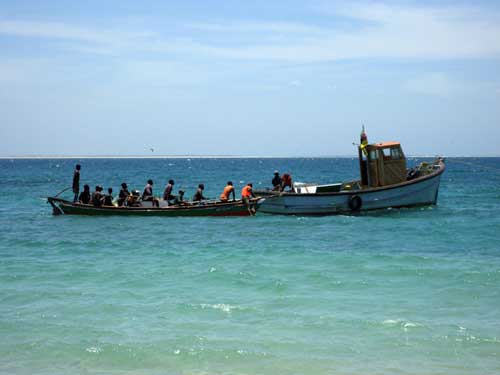
The pirates’ methods remain rudimentary. They use hijacked tuna-fishing boats or local dhows as the mother ship, then launch attacks from skiffs, usually at dawn or dusk. They hold the crews hostage with machine-guns and semi-automatic pistols, then force the captain to anchor off the northern part of Somalia’s coast for several weeks until a ransom is paid.

The patrolling navies say they have begun to do better. Yet the number of recorded hijackings rose from 32 in 2008 to 42 in 2009. The average ransom paid by shippers also rose, from $1m to $2m. If unpublicised pay-offs are included, some by Spain’s government, the pirates probably earned around $100m last year. That must be shared with their financial backers, especially in Lebanon, Somalia and the United Arab Emirates. Well-organised criminal gangs in Yemen also help.

To avoid the patrols, the pirates’ geographical range has increased sharply (see map). Shippers must pay extra insurance premiums, even if they ply a course far from Somalia’s waters. A Greek-owned freighter, Navios Apollon, was captured by Somalis on December 28th, fully 370km (200 nautical miles) east of the Seychelles, which is more than 1,300km from Somalia.

Plainly there is no purely naval way to stop the pirates. Somalia’s coast is more than 3,000km long. They seem unafraid of the warships. If accosted, the pirates usually dump their guns and grapple-hooks in the sea. The patrolling navies are reluctant to arrest them because of the legal complexities. On the rare occasions when pirates are taken aboard, they are usually given medicine, water and enough fuel to go back to Somalia. Within days they will set off again to seek their prey.

The EU has signed a deal with Kenya to imprison captured pirates. But there are concerns that Kenya is asking for too many favours in return for embarking on what is bound to be a messy legal process. If the EU and other concerned countries could get the governments of Tanzania, the Seychelles and other countries in the region to agree to prosecute pirates in their own courts, the legal deterrent against them would be stronger.

The pirates’ main advantage is the lawlessness of Somalia which has long been enmeshed in a civil war. Western governments fear that if they were to send their security forces to attack towns such as Haradheere, a pirate haven, the Islamist fighters of the Shabab militia, which controls much of south and central Somalia and is linked to al-Qaeda, might be strengthened.

Besides, the pirates could yet prove to be odd allies in stopping the Islamists from spreading their jihadist net. The Shabab considers piracy for profit unIslamic. The militants violently disapprove of the pirates’ boozing and whoring. The pirates and the Shabab could yet fight each other, which might benefit everyone else. So far, however, the pirates’ wealth protects them at home. Somalia is one of the world’s poorest countries, yet a low-ranking pirate can probably earn at least $20,000 a year.

The EU says its naval force’s main mission is to protect freighters carrying the food aid on which Somalis have depended for the past five years, and has thus staved off a full-blown famine. Its next priority is to “deter and disrupt” piracy in general. The warships may also deter illegal fishing in Somali waters and the dumping of toxic waste. But they are a small force in a big sea. At last count, there were seven patrolling vessels from six EU countries.

In any event, some shipping people privately say that the effects of piracy have been exaggerated. It may still be cheaper and more convenient to pay higher insurance fees and risk being attacked by pirates than to incur the extra cost of diverting vessels around the Cape of Good Hope.

The International Maritime Bureau in London says that last year 22,000 ships passed safely through waters in range of Somali pirates, whereas actual attacks were in the low hundreds. The bureau also reckons that, as ships take more precautions, the pirates’ success rate will drop.

Most ships now steam along narrow corridors at night and at full speed. In the Gulf of Aden they are usually in a convoy. Many raise the height of the freeboard (between the waterline and the deck) to make it harder for pirates to haul themselves up the side. Others are poised to use sirens and fire hoses. Some American-flagged vessels now have security guards, though it is generally agreed that they should remain unarmed, otherwise the violence and deaths would probably increase.

Plainly, the problem is far from solved. As ransoms go up and get paid, pirates will think it worth taking the risk. Above all, they are sure to persist as long as most of Somalia, including its ports along the coast, remains an ungovernable hell.

Wednesday, June 24, 2009

Pirates in Somalia: Arrrrr They Helping or Hurting Conservation?


Nature Conservancy:

Piracy off the coast of Somalia may lack the romance of “Pirates of the Caribbean,” yet daily media reports still serve up a steady diet of adventure on the high seas — from rag-tag buccaneers wielding assault rifles and rocket launchers to captive sailors being rescued.

Some reports cite experts who trace today’s piracy to environmental causes. The first pirates, they say, originally were Somali fishermen who turned vigilante when their livelihoods were decimated by rampant toxic waste dumping and illegal fishing from foreign ships.

If nothing else, this point suggests layers of complexity that a mass of sensationalistic reporting routinely misses. One key issue that is barely being addressed is what will happen to Somalia’s marine environment, especially fisheries, as a consequence of this ongoing conflict.

To my mind, the two bottom-line questions are these:

Does the threat of piracy drive fishing elsewhere and, therefore, reduce pressure on the region’s fisheries?
Or does the piracy foster a lawless environment in which fisheries are wantonly plundered?
Two Nature Conservancy partnerships in eastern Africa — not to mention a wealth of historical lessons — suggest at least partial answers. In northern Kenya and in Mozambique, we know that a lack of security means greater peril to habitats and animals. That’s why our work in both places includes direct support to our partners’ security efforts.

Few places on Earth rival the richness of life you find in the rangelands of northern Kenya, where herds of elephant roam the savannas, along with endangered Grevy’s zebra and black rhino. Lack of security here leads to poaching, cattle raiding and tribal conflict over resources such as land, water, livestock and wildlife. Our local partners provide anti-poaching and law-enforcement patrols that both guard wildlife and bring peace and stability to communities.

In northern Mozambique, lack of security emboldens international trawlers that pillage no-fishing zones and poachers who rob eggs from turtle and sooty tern nests. Our work here includes supporting local communities’ efforts to control illegal and destructive fishing and poaching. Security, again, is central here to protecting some of Africa’s richest coral reefs and coastal habitats and ensuring sustainable fisheries.

If pirates were suddenly to appear in Mozambique, they would probably target commercial vessels and thus drastically reduce fishing pressure in the near term. The resulting security issues, however, would likely force us to reduce our investment — meaning no (or fewer) community fishing guards patrolling the waters. Even if we assume the pirates eventually would be vanquished, a conservation vacuum would remain and marine diversity could suffer indefinitely.

So while questions remain about the short-term vs. long-term consequences, it’s only logical that piracy will profoundly affect Somalia’s marine diversity. Some have said that security won’t return to the sea until a stable government returns to the land. And certainly any hopes we have for investing in conservation for the long haul and achieving ultimate goals such as sustainable fisheries depend on certain conditions. Chief among these are stable governance and some sense of law and order.

Still, does a period of insecurity deter, say, trawling and fishing enough to produce some benefit (however fleeting) to nature?

I can’t help but wonder.

Matt Brown is the director of conservation for The Nature Conservancy in Africa.

Time Magazine: How Somalia's Fishermen Became Pirates


Time:

Amid the current media frenzy about Somali pirates, it's hard not to imagine them as characters in some dystopian Horn of Africa version of Waterworld. We see wily corsairs in ragged clothing swarming out of their elusive mother ships, chewing narcotic khat while thumbing GPS phones and grappling hooks. They are not desperate bandits, experts say, rather savvy opportunists in the most lawless corner of the planet. But the pirates have never been the only ones exploiting the vulnerabilities of this troubled failed state — and are, in part, a product of the rest of the world's neglect. (Read "No Surrender to Thugs.")

Ever since a civil war brought down Somalia's last functional government in 1991, the country's 3,330 km (2,000 miles) of coastline — the longest in continental Africa — has been pillaged by foreign vessels. A United Nations report in 2006 said that, in the absence of the country's at one time serviceable coastguard, Somali waters have become the site of an international "free for all," with fishing fleets from around the world illegally plundering Somali stocks and freezing out the country's own rudimentarily-equipped fishermen. According to another U.N. report, an estimated $300 million worth of seafood is stolen from the country's coastline each year. "In any context," says Gustavo Carvalho, a London-based researcher with Global Witness, an environmental NGO, "that is a staggering sum."

In the face of this, impoverished Somalis living by the sea have been forced over the years to defend their own fishing expeditions out of ports such as Eyl, Kismayo and Harardhere — all now considered to be pirate dens. Somali fishermen, whose industry was always small-scale, lacked the advanced boats and technologies of their interloping competitors, and also complained of being shot at by foreign fishermen with water cannons and firearms. "The first pirate gangs emerged in the '90s to protect against foreign trawlers," says Peter Lehr, lecturer in terrorism studies at Scotland's University of St. Andrews and editor of Violence at Sea: Piracy in the Age of Global Terrorism. The names of existing pirate fleets, such as the National Volunteer Coastguard of Somalia or Somali Marines, are testament to the pirates' initial motivations.

The waters they sought to protect, says Lehr, were "an El Dorado for fishing fleets of many nations." A 2006 study published in the journal Science predicted that the current rate of commercial fishing would virtually empty the world's oceanic stocks by 2050. Yet, Somalia's seas still offer a particularly fertile patch for tuna, sardines and mackerel, and other lucrative species of seafood, including lobsters and sharks. In other parts of the Indian Ocean region, such as the Persian Gulf, fishermen resort to dynamite and other extreme measures to pull in the kinds of catches that are still in abundance off the Horn of Africa. (Read about illegal wildlife trade.)

High-seas trawlers from countries as far flung as South Korea, Japan and Spain have operated down the Somali coast, often illegally and without licenses, for the better part of two decades, the U.N. says. They often fly flags of convenience from sea-faring friendly nations like Belize and Bahrain, which further helps the ships skirt international regulations and evade censure from their home countries. Tsuma Charo of the Nairobi-based East African Seafarers Assistance Programme, which monitors Somali pirate attacks and liaises with the hostage takers and the captured crews, says "illegal trawling has fed the piracy problem." In the early days of Somali piracy, those who seized trawlers without licenses could count on a quick ransom payment, since the boat owners and companies backing those vessels didn't want to draw attention to their violation of international maritime law. This, Charo reckons, allowed the pirates to build up their tactical networks and whetted their appetite for bigger spoils.

Beyond illegal fishing, foreign ships have also long been accused by local fishermen of dumping toxic and nuclear waste off Somalia's shores. A 2005 United Nations Environmental Program report cited uranium radioactive and other hazardous deposits leading to a rash of respiratory ailments and skin diseases breaking out in villages along the Somali coast. According to the U.N., at the time of the report, it cost $2.50 per ton for a European company to dump these types of materials off the Horn of Africa, as opposed to $250 per ton to dispose of them cleanly in Europe.

Monitoring and combating any of these misdeeds is next to impossible — Somalia's current government can barely find its feet in the wake of the 2006 U.S.-backed Ethiopian invasion. And many Somalis, along with outside observers, suspect local officials in Mogadishu and in ports in semi-autonomous Puntland further north of accepting bribes from foreign fishermen as well as from pirate elders. U.N. monitors in 2005 and 2006 suggested an embargo on fish taken from Somali waters, but their proposals were shot down by members of the Security Council.

In the meantime, Somali piracy has metastasized into the country's only boom industry. Most of the pirates, observers say, are not former fishermen, but just poor folk seeking their fortune. Right now, they hold 18 cargo ships and some 300 sailors hostage — the work of a sophisticated and well-funded operation. A few pirates have offered testimony to the international press — a headline in Thursday's Times of London read, "They stole our lobsters: A Somali pirate tells his side of the story" — but Lehr and other Somali experts express their doubts. "Nowadays," Lehr says, "this sort of thing is just a cheap excuse." The legacy of nearly twenty years of inaction and abuse, though, is far more costly.

Tuesday, May 26, 2009

Economist: An awkward absence


Economist:
YOU do not see many milestones on the floor of the ocean, but one was passed this week. May 13th was the deadline for the submission of new claims to the seabed, and from pole to pole coastal states have been asserting ownership of vast chunks of continental shelf in a rush for territory unrivalled since the scramble for Africa at the end of the 19th century. The treasure this time is not ivory or cocoa beans but petroleum, or at least the promise of it, and perhaps amazing fuels and wonder drugs, as well as gold, silver and other minerals. The claims will now be accepted or rejected by a United Nations commission, but one big maritime power will, by choice, be absent: the United States. It should not be.

Unlike 156 other countries, America has never ratified the 27-year-old UN Convention on the Law of the Sea, under which this carve-up is taking place. That is no worse than unfortunate: the deadline applies only to states that acceded to the treaty more than ten years ago and America still has time to make its claims. But first it will have to ratify the treaty. This the Obama administration, like its two most recent predecessors, wants to do, as probably does most of the Senate, which must provide its advice and consent. A determined minority, however, wants to block it, and finding the time for the necessary procedure may prove difficult.

America’s original objections to the treaty related to the requirement that its companies should share technical information with poor countries. The treaty was changed to meet those complaints. Now the objectors say it would lead to a loss of sovereignty. In fact it would do the opposite, since it would allow America to claim sovereign rights over both the exclusive economic zone that extends 200 nautical miles (370km) from its shores and also its share of the continental shelf beyond that, so long as certain geophysical criteria were satisfied.

The treaty does other useful things. It provides the right of passage by sea for all countries’ armed forces, and for almost all shipping through other states’ territorial waters if the passage is innocent. An absolute right of passage is given in international straits and certain archipelagoes, such as Indonesia. Such provisions can only benefit American national security.

And just as America needs the treaty, so the treaty needs America. The sea is badly in need of better management. It is overfished, chiefly, it is true, in coastal waters, but also in the great expanses that belong to no state. The sea is increasingly used as a rubbish bin, filled with poisons, plastics and other pollutants. Parts of it are infested with pirates. All of it is growing alarmingly acidic, as the carbon dioxide spewed out by modern activities finds its way into the briny. And much of the CO2 that causes this problem derives from oil and gas made less scarce by the reserves now recoverable from below it.

Scope for slip-ups in the Arctic

Nowhere is this last paradox more apparent than in the Arctic, where global warming means melting ice, which in turn means easier access to huge quantities of petroleum, most of it offshore. At the same time the once-icy Arctic may be opening up to shipping through the North West Passage, bringing the possibility of collisions, oil spills and other environmental horrors in a particularly vulnerable part of the world. For the people—and animals—who live in the polar region, even the law-of-the-sea treaty, fashioned in an era unconcerned about global warming, may provide inadequate safeguards.

The treaty is certainly not going to solve all the troubles afflicting the oceans, nor settle all the world’s maritime disputes. But it can help. To be effective, though, it needs America. Ratification has waited too long. The Senate should press ahead.

Monday, April 20, 2009

WP: Somalia's Godfathers: Ransom-Rich Pirates - Coastal Villagers Find Blessings And Ruin at Hands of Sea Robbers


NAIROBI -- The young Somali couple had plans. Ilka Ase Mohamed and the love of his life, tall, bright-eyed Fatima Mukhtar, were going to leave their little fishing town of Harardhere, attend university and, when Mohamed had enough cows for a dowry, get married.

But a little over a year ago, the woman Mohamed still calls "my beloved girl" was betrothed to a Somali pirate who wears a black cowboy hat, drives a Land Cruiser and paid $50,000 cash in what Mohamed described as a soulless deal with her mother.

"This man was like a small king who came to Harardhere," said Mohamed, 23. "He was dressed like a president. So many people attended him. I got so angry -- I said, 'Why do they accept this situation? You know this is pirate money!' "

The story of Mohamed, Fatima and the brazen Somali pirate -- based on an interview with Mohamed after he moved to Kenya -- underscores how entrenched piracy and its flashy new-money culture have become in the tiny, worn-out fishing villages that dot Somalia's coast.

As the world's most powerful navies patrol the vast shipping lanes of the Indian Ocean and the Gulf of Aden, Somali pirates are commanding millions in ransom for the massive cargo vessels they seize. Even since a U.S. show of force last week, when Navy snipers killed three pirates and freed an American captain being held hostage, pirates have seized several more ships with dozens of hostages.

Given the challenge of patrolling more than a million square miles of ocean, attention is turning toward fighting piracy from the Somali shore, where ransoms that totaled about $50 million last year are pouring into fishing villages such as Harardhere, and well-armed pirates are overwhelming what little local authority exists in a country that has been without a functioning central government since 1991......continued...

Monday, April 13, 2009

NYtimes: Somali Pirates Tell Their Side: They Want Only Money


The Somali pirates who hijacked a Ukrainian freighter loaded with tanks, artillery, grenade launchers and ammunition said in an interview on Tuesday that they had no idea the ship was carrying arms when they seized it on the high seas. “We just saw a big ship,” the pirates’ spokesman, Sugule Ali, said in a telephone interview. “So we stopped it.” The pirates quickly learned, though, that their booty was an estimated $30 million worth of heavy weaponry, heading for Kenya or Sudan, depending on whom you ask. In a 45-minute interview, Mr. Sugule spoke on everything from what the pirates wanted (“just money”) to why they were doing this (“to stop illegal fishing and dumping in our waters”) to what they had to eat on board (rice, meat, bread, spaghetti, “you know, normal human-being food”).

He said that so far, in the eyes of the world, the pirates had been misunderstood. “We don’t consider ourselves sea bandits,” he said. “We consider sea bandits those who illegally fish in our seas and dump waste in our seas and carry weapons in our seas. We are simply patrolling our seas. Think of us like a coast guard.”

http://www.nytimes.com/2008/10/01/world/africa/01pirates.html?_r=1&ref=world&oref=slogin

Also, on TreeHugger: How Overfishing Almost Got Capt. Phillips Killed by Pirates

WP: Kill the Pirates


Washington Post: With the rescue of American Richard Phillips from the hands of pirates yesterday, there was a blip of good news from the Indian Ocean, but it remains a scandal that Somali pirates continue to routinely defeat the world's naval powers. And worse than this ongoing demonstration of cowardice is the financing of terrorists that results from the huge ransom payments these pirates are allowed to collect. It is naive to assume that the millions paid annually in ransom to pirates merely enables them to purchase villas and fancy automobiles. Somalia is a country without government, where anarchy is being exploited by terrorist organizations. Although the threat that pirates pose to commercial ships is increasingly known, little is being done to combat it. And we must consider the bigger picture: Terrorists are far more brutal than pirates and can easily force pirates -- petty thieves in comparison -- to share their ransom money.....http://www.washingtonpost.com/wp-dyn/content/article/2009/04/12/AR2009041202262.html

The bigger question should be how to stop the root cause of the poverty and lawlessness from which this piracy is born. Could it be a failed state that and neglected people that have been living in wild west conditions since the 90s? Untold numbers of innocent people live in poverty in Somalia with no hope of raising themselves out of their situation within their own borders. Foreign aid missions cannot function there without a functioning government, and the most lucrative source of income is piracy. I'd be willing to be that the top echelon of Somalian intellects work in piracy, simply because it is the most entrepreneurial business around. Do I have a solution? No. But I don't think simply patrolling the coast will solve all the problems. That is like sending more cops into a riot, instead of asking why the people are angry.

Thursday, April 9, 2009

Huffington Post: Johann Hari - You Are Being Lied to About Pirates


"Who imagined that in 2009, the world's governments would be declaring a new War on Pirates? As you read this, the British Royal Navy - backed by the ships of more than two dozen nations, from the US to China - is sailing into Somalian waters to take on men we still picture as parrot-on-the-shoulder pantomime villains. They will soon be fighting Somalian ships and even chasing the pirates onto land, into one of the most broken countries on earth. But behind the arrr-me-hearties oddness of this tale, there is an untold scandal. The people our governments are labeling as "one of the great menace of our times" have an extraordinary story to tell -- and some justice on their side."

http://www.huffingtonpost.com/johann-hari/you-are-being-lied-to-abo_b_155147.html

K'Naan on Somali Pirate Situation