Showing posts with label Global Warming. Show all posts

Tuesday, December 8, 2009

NYtimes: No Slowdown of Global Warming, Agency Says


Here is a shocker: Global warming is real, and an acceleration of our emissions is resulting in an acceleration of the warming. Dinosaurs also predate mankind, and the H1N1 vaccine doesn't kill you.

NYtimes:

COPENHAGEN — Despite recent fluctuations in global temperature year to year, which fueled claims of global cooling, a sustained global warming trend shows no signs of ending, according to new analysis by the World Meteorological Organization made public on Tuesday.

The decade of the 2000s is very likely the warmest decade in the modern record, dating back 150 years, according to a provisional summary of climate conditions near the end of 2009, the organization said.

The period from 2000 through 2009 has been “warmer than the 1990s, which were warmer than the 1980s and so on,” said Michel Jarraud, the secretary general of the international weather agency, speaking at a news conference at the climate talks in Copenhagen.

The international assessment largely meshes with an interim analysis by the National Climatic Data Center and NASA in the United States, both of which independently estimate global and regional temperature and other weather trends.

Mr. Jarraud also said that 2009, with some uncertainty because several weeks remain, appears to be the fifth warmest year on record.

Addressing questions about the reliability of climate data after the unauthorized release of e-mail messages and files from a British climate research unit that provides data to the global weather group, he said there was no evidence that the various independent estimates showing a warming world were in doubt.

The news conference early Tuesday came after the European Commission reacted to a decision by the United States Environmental Protection Agency to pave the way for federal limits on emissions of carbon dioxide, saying it should give further weight to negotiations under way here aimed at crafting a new global agreement to curb greenhouse gases.

The so-called endangerment finding by the E.P.A. was “an important signal by the Obama administration that they are serious about tackling climate change and are demonstrating leadership,” a spokesman from the European Commission said. The finding “gives new momentum following their announcement of cuts,” he said.

Political leaders in Copenhagen welcomed the ruling, but they were quick to press the Obama administration to do more now to sweeten its offer.

Andreas Carlgren, the environment minister of Sweden, the country that currently holds the rotating presidency of the European Union, said in an e-mail message on Tuesday morning that the ruling “shows that the United States can do more than they have put on the table.”

Connie Hedegaard, the Danish politician who was elected on Monday as president of the conference, said in an e-mail message on Tuesday morning that the ruling in the United States “is a helpful step, as it could provide a larger degree of flexibility in the negotiations.” So far President Obama has signaled a cut emissions by about 17 percent by 2020 compared with 2005 levels. The White House also has indicated that the United States would contribute to a fund to tackle climate change.

The gathering of more than 190 nations in Copenhagen opened on Monday with appeals for urgent action from the United Nations and from officials of countries endangered by warmer temperatures, rising sea levels and other damage such as melting glaciers.

As the climate meeting got under way on Tuesday morning, inside the vast blocks that make up the conference center, environmental groups already were chanting in favor of preservation of forests and handing out symbolic cardboard cutouts labeled as carbon dioxide in the central area.

Representatives from governments said there would be further ceremonial events before the hard negotiating begins, later on Tuesday.

A major reason that hopes have risen in recent weeks is the expectation that Mr. Obama — who plans to attend closing days of the conference next week — will formally commit the United States to making cuts in greenhouse gases. The United States declined to ratify the Kyoto Protocol, a previous agreement on curbing greenhouse gases, because of strong opposition in the Senate and from the Bush administration.

The refusal to ratify the Kyoto protocol has left a lingering mistrust of the United States in other parts of the world. The finding by the E.P.A. is expected to allow President Obama to tell delegates in Copenhagen that the United States is moving aggressively to address the problem even while Congress remains stalled on broader legislation to curb global warming legislation.

Senator Barbara Boxer, Democrat of California and chairwoman of the Senate Environment and Public Works Committee, said that in light of the ruling, “the president’s appearance in Copenhagen will carry even more weight, because it shows that America is taking this issue very seriously and is moving forward.”

Over the next two weeks, the nations gathered in Copenhagen will try to reach what has so far been elusive common ground on the issue of climate change.

Delegates will try to hammer out some of the most vexing details attending the pursuit of a global climate deal. These include broad cuts in greenhouse gas emissions, particularly from big polluters like the United States and China, and a commitment from wealthy nations to deliver what could ultimately be hundreds of billions of dollars in financing to poor countries, which argue that they are ill equipped to deal with a problem they did little to create.

Several countries announced new emissions goals in the days leading to the meeting here, including China, Brazil, the United States and more recently India and South Africa. But many conference participants have noted that these commitments remain far too low to keep rising temperatures in check over coming decades.

The pledges so far are “not going to get us as far we need to go, to really stay within the two-degree limit,” Koko Warner, an observer with the United Nations University in Bonn, Germany, said Monday, referring to scientists’ recommendations that temperature increases be capped at two degrees Celsius (3.6 degrees Fahrenheit) above pre-industrial levels.

“We don’t want to admit it, because the consequences are so bad,” she said.


Timeline of Global Warming

Tuesday, June 16, 2009

Government Study Warns of Climate Change Effects in the US


Greenwire:

Climate change already is affecting the United States, changing everything from weather patterns to wildlife migrations, according to a report from 13 federal agencies and the White House.

Global warming will become more severe in coming years, affecting the nation's farms, forests, coastlines, floodplains, natural resources, transportation and public health, according to the report to be released today by the U.S. Global Change Research Program.

The study blames climate change for droughts in the Southwest and more intense heat waves in the Northeast, as well as eroding ocean coastlines caused by melting Arctic ice.

"What we would want to have people take away is that climate change is happening now, and it's actually beginning to affect our lives," said Thomas R. Karl, director of the National Climatic Data Center at the National Oceanic and Atmospheric Administration and a principal author of the report. "It's not just happening in the Arctic regions, but it's beginning to show up in our own backyards."

The program is required under a 1990 law to report every decade on natural and human-caused effects on the environment. The current report was begun during the tenure of former President George W. Bush and builds off findings from the commission's 2000 report.


Full report.

Wednesday, May 27, 2009

Yale Environment360: Adaptation Emerges As Key Part Of Any Climate Change Plan

After years of reluctance, scientists and governments are now looking to adaptation measures as critical for confronting the consequences of climate change. And increasingly, plans are being developed to deal with rising seas, water shortages, spreading diseases, and other realities of a warming world.
by Bruce Stutz

Adaptation. For many in the climate change community, the word has had a traitorous ring, implying that its proponents were giving up on the notion that the world might mitigate the threat of global warming by significantly reducing emissions of greenhouse gases. Adaptation was for quitters.

Not anymore.

With nations in the industrialized and developing worlds continuing to pump record levels of carbon dioxide into the atmosphere, hopes are fading that over the next half-century atmospheric CO2 levels can be kept below 450 parts per million (ppm) and global warming held to 2 degrees Celsius (3.6 Fahrenheit). Now, a new sense of urgency has arisen as to how the world will adapt to a warming planet, where carbon dioxide levels could hit 600 parts per million and global temperatures could rise by 3 to 4 degrees C (5.4 to 7.2 degrees F).

“My view is that we’ll be lucky if we can stop CO2 at 600 ppm,” says Wallace Broecker, a geoscientist at Columbia University’s Earth Institute. “There’s no way we’re going to stop at 450. Impossible. If we’re going to double CO2, we’d better prepare what we’re going to do about it.”

If Broecker and many of his fellow climate scientists are right, the planet will experience myriad far-reaching changes to which humans, plants and animals will need to adapt: higher sea levels, the melting of glaciers that have long supplied hundreds of millions of people with water, drought-stressed agriculture, more severe storms, spreading disease, and reduced biodiversity.

“We’re talking about altering the world’s biogeography,” says Neil Adger, of the Tyndall Centre for Climate Change Research at the U.K.’s University of East Anglia and lead author of the Intergovernmental Panel on Climate Change (IPCC) Assessment of adaptation. “In extreme weather events, coastal flooding, wildfires, and droughts, the world is recognizing that predicted impacts are already happening.”

Major international organizations and governing bodies — including the European Union, the World Bank, and the IPCC — have called for the development of adaptation strategies. Prominent nonprofit groups also have announced major adaptation initiatives. Two years ago, the Rockefeller Foundation said it was creating a $70 million program to promote “climate resilience” (note the avoidance of the word “adaptation”) in the developing world. The Rockefeller program is designed to confront one of the major issues of adaptation: that the world’s poorer nations, which — with their low greenhouse gas emissions — have had little to do with creating the problem, may well be hit the hardest by global warming.

Last year, the John D. and Catherine T. MacArthur Foundation announced that it was committing $50 million to conservation groups to help them preserve biodiversity in eight ecologically rich “hotspots” as the world warms.

Stanford University climatologist Stephen Schneider points out that adaptation strategies are only beginning to be developed, mainly because there’s precious little science on adaptation and few working models.

“Everyone is now talking about adaptation, but for all the talk there’s little actually being done,” says Schneider.

Developing strategies to cope with the impacts of a warmer world will be complex and expensive. Oxfam estimates it could cost some $40 billion a year; the World Bank estimates it might cost more than three times that. While strategies and technologies designed to mitigate climate change can be applied globally — one less coal-powered plant in China has the same effect as one less plant in the U.S. — adaptation strategies must deal with regional and local geography.

In April, for example, a European Union report on adaptation said Europe’s most vulnerable regions to climate change will be southern Europe, the Mediterranean basin, the Alps, and the far north. Europe will have to adapt to the diminishing Alpine glaciers that now provide 40 percent of its fresh water. Africa, the western U.S., and Australia will have to adapt to intense droughts. Communities in the Arctic will have to adapt to melting ice and permafrost. If the Himalayan region loses its glaciers and monsoon patterns change, 40 percent of the world’s population will likely face severe shortages of water for drinking and agriculture.

To preserve ecosystems and endangered species, conservationists will have to adapt their strategies. And epidemiologists will have to adapt to changing disease vectors. Climate change will test not only the resiliency of ecosystems but also the adaptability of individual cities, villages, and societies.

CONFRONTING WATER SCARCITY
In the world’s sub-tropics, most models predict that wet regions will become wetter and dry regions drier, but there’s little agreement on how these trends will affect regional annual rainfall patterns and growing seasons. And it’s these that determine crop productivity. Farmers have always had to adapt to changing weather patterns. Climate change will exacerbate the uncertainties, both in the short and longterm. The key to coping will be to make farming as resilient as possible.

Researchers in Ethiopia, for example, found that many farmers had already recognized that temperature and precipitation changes were affecting their crops and altering the growing season. Once they were given access to technical support, credit, and information about future climate change, these farmers adjusted their agricultural practices. They changed crop varieties, adopted soil and water conservation measures, and changed planting and harvesting periods.

For researchers at the Rockefeller Foundation, future “simultaneous changes in temperature, precipitation, CO2 fertilization, and pest/pathogen dynamics” will require breeding new crop varieties, especially for those crops that feed most of the world’s poor. The reserve of genetic material now in seed banks may not be enough from which to develop new drought-, temperature-, or flood-resistant crops, and the foundation is urging new efforts to increase the world’s genetic reserves of seed crops.

Adaptation strategies are already underway to cope with changes in the world’s fresh water resources. In April, the European Union issued a dire warning about declining water resources. Temperatures in the Alps — “the water tower of Europe” — have increased 1.5°C (2.7°F) over the last 100 years, twice the global average. The glaciers are vanishing. At the same time, warming temperatures and drought have left southern Europe dry, with creeping desertification in Spain and Portugal. The EU is focusing on adaptation strategies aimed mainly at reducing demand through water conservation, introducing new methods of efficient irrigation, and reforming water pricing.

RISING SEA LEVELS
While scientists still debate predictions of sea level rise over the century due to climate change — with many studies predicting an increase of one to two meters — there is no doubt that rising seas have already begun affecting low-lying coastal regions. How humans adapt will depend not only upon regional geography, but regional development. The world’s large river deltas — the Mississippi, Nile, Rhine and Ganges — have been altered by development and agriculture, their tidal wetlands diminished and, with that, their resistance to flooding and erosion weakened, especially during storm surges.

That is why in the Ganges-Brahmaputra delta in Bangladesh, efforts are underway to restore lost mangroves to keep storm surges from flooding agricultural land and human settlements, and to keep delta land from washing away. At the same time, Bangladesh is trying to restore its upland forests to prevent downstream erosion. Islands, too, will hope to adapt to rising seas by creating or restoring natural buffer zones.

Things will be different, however, where coastal nature has already been lost to population growth and development.

By 2030, some 60 percent of the world’s population will live in coastal cities that may be increasingly subject to flooding from storm surges. Complex and expensive solutions will be needed to protect not only homes and people, but sanitation, communication, and transportation infrastructures. New York City, where the land is only 5 to 16 feet above sea level, has engaged a consortium of city agencies and researchers from Columbia University’s Earth Institute to develop adaptation plans to deal with sea level rises that could easily reach 1 ½ feet by 2080, as well as with increased tidal and storm surges.

City planners are modeling the risks and working with New York citizens' groups and city agencies to develop a coordinated approach to protecting vulnerable roads, tunnels, water supplies, transit, sewers, and water treatment plants. One firm has proposed a concrete tidal barrier that would stretch across the neck of lower New York Bay, similar to one that the Russian government has already commissioned to protect St. Petersburg from rising levels of the Baltic Sea.

THE SPREAD OF DISEASE
The greatest impediment to developing adaptation strategies to deal with the expected increase in disease due to climate change, is that “the regions with the greatest burden of climate-sensitive diseases are also the regions with the lowest capacity to adapt to the new risks,” writes Jonathan A. Patz of the Center for Sustainability and the Global Environment, Nelson Institute for Environmental Studies at the University of Wisconsin.

In these places, disease is most often the result of poverty, overpopulation, lack of access to fresh water, malnutrition, and lack of sanitary facilities, all of which will be exacerbated by global warming. One concern of scientists is the spread of disease-carrying mosquitoes and other insects as temperatures rise, a phenomenon already evident in parts of the world. Climate change may also cause clean water supplies to dry up in small villages, forcing residents to collect water from streams and ponds contaminated by insects and pathogens whose fecundity and range may well increase in a warmer world.

River flooding can also contaminate water supplies. Gambia, for example, has undertaken a program along the Gambia River coastal floodplain to increase the number of improved pit latrines in school, health and community centers; to purchase fogging machines and sprayers for insect control; and to stockpile drugs and vaccines to deal with disease outbreaks. In Samoa, authorities are developing a program in which doctors and meteorologists work together to predict outbreaks of disease — such as mosquito-transmitted dengue fever — that may worsen as temperatures rise.

PRESERVING BIODIVERSITY

The most localized adaptation strategies may be best suited to deal with the effects of climate change on the world’s biodiversity. As habitats and even seasons are altered, species will be forced to adapt or migrate in what — by normal evolutionary standards — are very short time spans. They may follow expected adaptive pathways: Lowland species may move to higher elevations or migrate north, as some bird and plant species already are doing. In many places, however, migration routes are blocked by development or deforestation. Current nature reserve boundaries may no longer protect species forced by climate change to migrate. And while older trees that find themselves in an altered climate may survive, their seedlings may have a far narrower range of conditions under which they can thrive and thus be unable to grow in a warmer environment.

Enlarging the borders of established reserves will provide some species with protection while they seek out new ranges. Where reserves are hemmed in by developed land, efforts are underway to create wildlife corridors or preserve even small natural refuges — forests or wetlands — in the midst of cultivated fields. Such fragments of habitat may prove useful to birds or insects as their migration routes change.


As experts contemplate the challenges of climate change adaptation, they are stressing the need to proceed on sound scientific grounds. Without understanding the science, Schneider says, there’s every possibility of developing “maladaptations,” such as reacting to changes that appear to be caused by climate change, but that may be due to normal weather variables such, as El Nino, or to natural cyclical changes in species abundance.

For example, to implement irrigation after a few years of drought only to find that the longer-term forecast will be for a wetter — not drier — environment, is to waste a great deal of time, money, and good will. So would construction of a sea wall to protect against a mistaken prediction of sea level rise. Drought-resistant crops may be susceptible to new pests or diseases. That is why early adaptation studies have been aimed at understanding vulnerabilities, evaluating adaptive potential, and attempting to make people and places resilient to a possible range of changes.

Adaptation must also be finely tuned not only to the vagaries of local geography and ecology, but to local economies and cultures. Kate Barnes, climate program associate for the MacArthur Foundation, has found that cultural, economic, and political differences affect adaptation efforts to preserve the world’s montane biodiversity from the effects of climate change. In Bhutan, for instance, researchers found people’s “intrinsic appreciation for nature” made them more open to adaptation strategies than in Peru, where an interest in producing biofuels and gas exploration superseded an interest in conservation.

“The reality,” Adger says, “is that people don’t want to move and will resist adaptation when it affects things they care about — their jobs and their homes — even if they’re no longer sustainable.”

MTV Global Warming Video

3650 from Ubik on Vimeo.


Not a huge fan of MTV (I think it is the nexus of evil, is dumbing a generation, and has ruined good music) but I'll give them props for attempting to make global warming relevant to their near brain-dead audience.

Friday, May 8, 2009

First Official Climate Change Refugees Evacuate Their Island Homes for Good


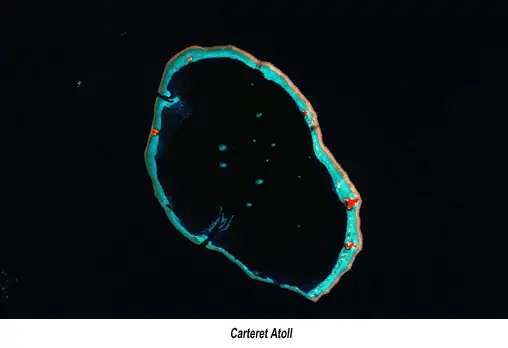
Yup, we're sinking. The day has finally come, and a critical landmark in the saga of global climate change is occurring as we speak—and hardly anyone has noticed. The Carteret Islanders of Papua New Guinea have become the world's first entire community to be displaced by climate change. They're the first official refugees of global warming - and they're packing up their lives to move out of the way of ever-rising waters that threaten to overtake their homes and crops. The island they call home will be completely underwater by 2015. The Ecologist:

The evacuation of the Carteret Islands have begun. This morning I stood on black volcanic sand, pressed up right against the jungle, and watched a small white boat powered by a single outboard engine run in against the shore. On board were five men from the Islands, the fathers of five families, who have come to finish building houses and gardens already begun in a cleared patch of jungle at Tinputz, on the east coast of Bougainville. When these homes are ready the five will return to the Carterets, to fetch their wives and children back. Life, they hope, will be better for them here. On the Carterets, king tides have washed away their crops and rising sea levels poisoned those that remain with salt. The people have been forced to move.

The men climbed silently from the boat and into the shallows. They splashed towards us, carrying almost nothing. From beside me, others who had come to meet them walked out quietly in welcome. The air was still, both sad and happy, which seemed to suit the moment. That single boat carrying these five men is the first wave in what is, as far as I can tell, the world’s first official evacuation of an entire people because of climate change. Some say they will be ready to bring their families here next month when the houses are completed. Others that it will be June, when the first crop of sweet potatoes will be ready to feed them.

It was a combination of a little planning and a lot of luck that allowed me to be among the very few to see this. I heard the evacuation was beginning only yesterday, a day after arriving in Buka. It has been on again and off again many times over the past year, but Papua New Guinea seems to like throwing surprises. Given the chance to be there when it finally began, I leapt and travelled to Tinputz this morning, first by boat across Buka passage, which separates the island on which I am staying from Bougainville, and then through the jungle in the back tray of a Toyota Hilux 4-wheel drive with a crowd of local people. Some were from the NGO the Carterets established to broker their own move. Others were from the Carterets themselves, who had travelled to Buka on trading boats and wanted to be at Tinputz to welcome their friends. There were also a Kiwi and an Aussie, Kim and Kirsten, who have spent months as volunteers working towards today. We arrived only minutes before the boat itself.

After the arrival, the men sat in the shade of two unfinished timber frame houses among the trees – the beginnings of the homes they are to complete. The women cooked; clams and corned beef sandwiches, greens, rice and cassava wrapped in palm leaves. After hours the two parties came together to eat, to pray and to formally welcome the newcomers to Tinputz. There were speeches in Tok Pisin, only a little of which I followed. The five fathers sat in a line and nodded their heads in silence.

On the ride home, hundreds of children streamed along the road, in bright white shirts above blood red skirts and trousers, proving completely false my first thought that the dense forest on either side must be uninhabited. The only bitter taste to today came also on this return journey, riding high on the tray of the Toyota. We hit and killed a pig and then a dog that scampered out into the jungle road; fortunately our driver had no licence plate, or the call for retribution would have been swift (this is a country that puts a pig on its 20 kina note). A full beer-bottle also came screaming at us from a passing truck, but shattered harmlessly on the road. Possibly it was aimed at me, the only white guy in sight. At least that is what the others with me in the Toyota thought. On the other hand, I saw a man carrying a stone-tipped spear along the road, which is also something you don’t see every day.

Wednesday, May 6, 2009

WP: Opinion - The Cost of Climate Inaction

By Kristen Sheeran and Mindy Lubber in the Washington Post:

Robert J. Samuelson's April 27 op-ed, "Selling the Green Economy," was way off the mark on the economics of tackling climate change. It was a call to bury our collective heads in the sand simply because the future involves uncertainty -- exactly the opposite of what we need to do.

Samuelson argued that the cost of moving to a clean-energy economy is higher than advocates expect and that transition can't happen nearly fast enough to meet the ambitious goals proposed in the climate and energy bill sponsored by Reps. Henry Waxman (D-Calif.) and Edward Markey (D-Mass.).

But this assumes that all costs involved in mitigating climate change -- and there will be costs -- represent new costs, without acknowledging the massive error in our market system that equates the price of carbon emissions to zero. This fundamental error skews everything that follows, because if emitting carbon costs nothing on a balance sheet, all steps to reduce pollution count as "new costs."

The real cost of carbon emissions is far from zero. Each new scientific report brings proof of a changing climate that promises to disrupt agricultural patterns, set off a scramble for dwindling resources, raise sea levels, propel population shifts and require massive emergency spending as we try to react to the growing crises. These are the costs of inaction.

A smart climate policy can create a mechanism to put the right price on carbon, and rapid economic change will follow that firm price signal, along with reduced climate risks. Our work with more than 100 economists nationwide and at RealClimateEconomics.org demonstrates the weight of economic analysis supporting this point.

The failure to put a real price on carbon emissions also undermines Samuelson's second point, that we cannot switch to clean energy technologies quickly. Many claim that these technologies will not work, at least in a cost-effective way, because we would already be using them if they did.

But we are not using them enough now because we have set the price of carbon pollution at zero and have devoted most of our financial incentives to fossil fuel production to gas up our vehicles, heat our homes and power our factories. Acknowledging the climate crisis and pricing its risks correctly, instead of passing them on to our children, would produce an amazingly quick shift to new technologies and behaviors. We change habits when it makes economic sense to do so. Price matters.

Ultimately, households and businesses care more about their total energy bill than costs per gallon or per kilowatt hour. Gas at $4 per gallon is cheaper in a car that gets 40 miles per gallon than $3-a-gallon gas in a clunker that gets 20 mpg. American entrepreneurial and research genius can move us to far greater energy efficiency quickly, using mostly existing technologies, when a carbon price rewards the effort.

The economic impacts on households, then, may not be as dramatic as some warn. We can mobilize the political will for clean technologies and emissions reduction when, as economic research demonstrates, there is a visible payoff in jobs and strides in international competitiveness from these technologies.

And none of this is in conflict with the business community. Quite the contrary. Consider Business for Innovative Climate and Energy Policy (BICEP), a coalition of nationally and globally known companies including Nike, Starbucks, Sun Microsystems, Timberland and Levi Strauss that the investor coalition Ceres coordinates. The heads of these companies believe that passing strong climate and energy legislation this year is in the interests of both the planet and their businesses.

Some BICEP businesses already see climate change affecting their supply chains, manufacturing and international markets. Those are costs. These companies see strong climate and energy policy as pro-business because increased energy efficiency saves them money and clear price signals on carbon help them plan competitive strategies on a more level playing field.

The cost of inaction is high and could be catastrophic. But, contrary to claims, the cost of switching to cleaner energy and dramatically lower emissions will spur competitive gains, cost far less and come much more quickly once we have set our goals, adjusted our incentives and corrected the market's false signals.

History shows that big changes often come in a rush, unforeseen by the critics of the day. We believe that honest accounting for the reality of climate change will bring a convergence of effort and interests, triggering change on a scale that will, once again, alter the course of history.

Kristen Sheeran is executive director of the Economics for Equity and the Environment Network, a nationwide group of economists focused on environmental policy. Mindy Lubber is president of Ceres, a national coalition of investors, environmentalists and public interest groups working with companies to address sustainability challenges.

Wednesday, April 15, 2009

NYtimes: Coral Fossils Suggest That Sea Level Can Rise Rapidly


Evidence from fossil coral reefs in Mexico underlines the potential for a sudden jump in sea levels because of global warming, scientists report in a new study. The study, published in the journal Nature, suggests that a sudden rise of 6.5 feet to 10 feet occurred within a span of 50 to 100 years about 121,000 years ago, at the end of the last warm interval between ice ages. “The potential for sustained rapid ice loss and catastrophic sea-level rise in the near future is confirmed by our discovery of sea-level instability” in that period, the authors write. Yet other experts on corals and climate are faulting the work, saying that big questions about coastal risks in a warming world remain unresolved. One of the most momentous and enduring questions related to human-caused global warming is how fast and far seas may rise. Studies of past climate shifts, particularly warm-ups at the ends of ice ages, show that fast-eroding ice sheets have sometimes raised sea levels worldwide in bursts of up to several yards in a century....

http://www.nytimes.com/2009/04/16/science/earth/16coral.html?partner=rss&emc=rss

EPA: U.S. greenhouse emissions rose 1.4 percent in 2007


U.S. greenhouse gas emissions rose 1.4 percent in 2007, compared to the previous year, the U.S. Environmental Protection Agency reported on Wednesday. The report also indicates that U.S. emissions of climate-warming gases such as carbon dioxide and methane rose 17.2 percent from 1990 to 2007. The increase in 2007 was mainly due to a rise in carbon dioxide emissions related to fuel and energy consumption, the environmental agency said in a statement.

Shit.

Monday, April 13, 2009

Kenna, Lupe Fiasco, & Justin Timberlak to Climb Mount Kilimanjaro For Charity


As seen on Okayplayer.com:

The list of crisis' that affect this world of ours is ever growing, but one major one that is often overlooked would be the water crisis. Many third world countries are being decimated due to lack of clean water, while the rest of the world looks on with blind eyes. Ethiopian born Singer Kenna has decided to do something about this. He has recruited Lupe Fiasco and Justin Timberlake to join him in climbing Mount Kilimanjaro (the highest peak in Africa) this fall, in a bid to raise money and awareness for the worldwide water crisis. Lupe says he plans on turning the climb into a friendly competition saying: "Part of the motivation is beating Kenna to the top. Sabotaging his tent, taking the lining out of his coat, lacing it with ants or something like that." Wow, who would have thought you can accomplish good deeds via publicity, and not just senseless rap beef. For further perspective on the water crisis check BBC. After the jump watch a fan made video for Mos Def's "New World Water" to hammer the point in further.


Here is a thought though...........while there, also address the fact that the iconic glacier on top of Kilimanjaro is shrinking. There is a present controversy over whether it is shrinking from lack of precipitation or global warming. I remember seeing it when I was a kid from Kenya and Tanzania. You might remember it from pictures or The Lion King.