Showing posts with label Environment. Show all posts

Friday, December 11, 2009

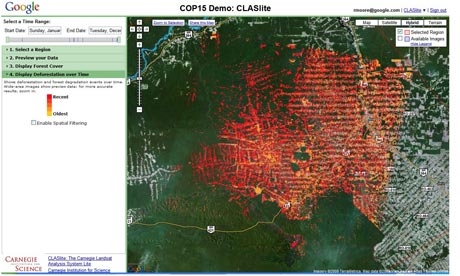
Google: Google unveils breakthrough technology to monitor deforestation


New REDD monitoring system out of Google.

Guardian:
Tracking the destruction of the world's forests is to become much easier for scientists and forest managers, thanks to a software tool unveiled by search-engine giant Google's philanthropic arm today.

The software, which uses Google's computing resources to extract scientific information from decades of satellite images of forests, was demonstrated at the UN climate conference in Copenhagen. "We hope this technology will help stop the destruction of the world's rapidly disappearing forests," said a statement on the Google.org blog.

"Emissions from tropical deforestation are comparable to the emissions of all of the EU, and are greater than those of all cars, trucks, planes, ships and trains worldwide. According to the Stern Review – the report prepared for the British government in 2006 on the economics of climate change by Lord Nicholas Stern – protecting the world's standing forests is a highly cost-effective way to cut carbon emissions and mitigate climate change."

The UN mechanism to reduce deforestation is called Reducing Emissions from Deforestation and Forest Degradation in Developing Countries (Redd), a system whereby richer countries would provide financial incentives to protect forests in poorer nations. For Redd to be successful, however, countries need ways to accurately monitor and report on the state of their forests.

In Google.org's prototype software, environmental authorities or NGOs interested in monitoring forests start with satellite images of their area and track how the size and shape of the tree cover has changed over time. The software can processes the images to extract useful scientific and tracking information about how much the forests have changed.

For the analysis, the Google.org team worked with Greg Asner of Carnegie Institution for Science and Carlos Souza of Imazon. Technology developed by Asner and Souza is used in Latin America to track changes in forest cover – but mainstream use of the models has been slow due to lack of access to high-quality satellite images and the computer power needed to carry out the analysis.

Google.org's solution is to enhance the Asner and Souza models using its own computing power. "What if we could gather together all of the earth's raw satellite imagery data – petabytes of historical, present and future data – and make it easily available on this platform? We decided to find out, by working with Greg and Carlos to re-implement their software online, on top of a prototype platform we've built that gives them easy access to terabytes of satellite imagery and thousands of computers in our data centres," it wrote.

Colby Loucks, deputy director of the conservation science program at WWF-US said: "A cost-effective and transparent approach for monitoring deforestation is needed to help pave the way for a global Redd program. If Google's system can be expanded to cover forests globally and access near real-time imagery, it can potentially be a powerful tool that helps tropical countries monitor forest loss."

Wednesday, December 2, 2009

Grist: Annie Leonard misses the mark in her new video, “The Story of Cap-and-Trade”

The Story of Cap & Trade from Story of Stuff Project on Vimeo.


I posted this video the other day about Cap and Trade, and said that it oversimplified the issues.

Here is a more complete explanation of what's wrong with this video from Grist:

The greenosphere is all abuzz about a new video from Annie Leonard, creator of semi-famous anti-consumerism video/book The Story of Stuff. It’s being billed as a definitive debunking of cap-and-trade, but it’s more like a perfect representation of all the confusion and misplaced focus that plagues the green left right now.

Now, I suppose I’m generally viewed among greens as a defender of cap-and-trade—or, in the less charitable version, a defender of the “party line,” a shill for the administration, a sell-out “insider,” whatever. A “pro” in the “pro vs. anti cap-and-trade” argument. But that’s not how I see it. It’s more that I think it’s the wrong argument. Activists like Leonard are just mis-identifying the barriers to effective climate action. I’ll have lots more to say on that subject soon, but for now, let’s focus on the video.

The Story of Cap & Trade

The video contains four basic arguments against cap-and-trade:

1. Allowance giveaways are bad. This is true. It would be better to auction 100% of the pollution allowances and use the revenue to invest in clean energy and protect consumers. The bill in Congress gives away too many allowances (Leonard elides the fact that the bulk of them are devoted to consumer protection, though it’s open to debate whether they’ll be used that way, and some Senators are pushing for more giveaways).

The most obvious solution to this is to give away fewer allowances. Yet Leonard and crew imply that allowance giveaways are inherent to cap-and-trade and the only solution is to ditch it. They imply that other “real” solutions would somehow be immune to polluters seeking loopholes and special favors, but never explain why.

The allowance giveaways in the climate bill reflect the power of the fossil fuel lobby. Switching policies would not diminish that power. Reduce that power and any climate policy gets better. The policy isn’t the problem; the power of the fossil fuel lobby is.

2. Offsets are bad. Leonard’s “argument” against offsets, if it can be called that, is fairly typical for this genre. She highlights a few ridiculous-sounding projects from the Clean Development Mechanism (CDM), implicitly conflates those projects and the CDM with offsets generally, and then concludes, based on the anecdotes, that offsets are bad and they make cap-and-trade toothless.

The reality is far more complex. The quality of offset projects varies widely, as do enforcement mechanisms. The bill in Congress actually contains some fairly stringent measures for policing offsets. Many people close to international policy negotiations believe that high-quality offsets are a vital measure enabling a stronger international treaty. (See Glenn Hurowitz.) Many think that emissions reductions will prove cheap enough that offsets won’t be extensively utilized in early years. Others think that moving emission reductions overseas short-sells the clean energy revolution needed here in the U.S.

These are complex topics, and they’re not well-served by the simplistic, hand-waving dismissal of offsets in Leonard’s video. Regardless, if you think offsets are a problem, the obvious solution is to reduce the number of offsets. But again, Leonard and crew pretend that offsets are inherent to cap-and-trade and the only solution is to ditch it. Again, they pretend that “real” solutions would be immune to similar loopholes and giveaways.

One more time, from the top: The number of offsets in the climate bill reflects the power of the fossil fuel lobby (and the common impression that reducing emissions will be costly). Switching policies would not diminish that power (or that impression). The policy isn’t the problem; the power of the fossil fuel lobby is.

3. Carbon markets are bad. I hesitate to call this an “argument” in the video, since it mainly consists of using the words “Enron,” “bubble,”“Wall Street,” and “scam” suggestively, without saying anything at all specific about why this commodity market—which would be one of any number of commodity markets, most of which work perfectly well, including the carbon market in Europe—would be uniquely evil. I’m with Kevin Drum: there’s no meat here. I’ve never seen anything to this argument but the kind of suggestive handwaving that’s in the video. I don’t know why the green left has decided that markets are bad, in and of themselves, but it seems both politically unwise and substantively thin.

It’s certainly true that certain financial instruments should be eliminated or regulated more heavily; this is true for financial markets in general. There’s some fairly strong language in the bill about regulating carbon markets; that language will likely be folded into the larger financial market reforms that the Senate will address soon. But no one, outside this narrow topic, is suggesting that markets should be abolished!

Remember, trading of allowances is the feature of cap-and-trade that makes it more flexible than a flat tax that applies to all entities equally. This was always the argument for C&T over a tax. Instead of rebutting that argument, Leonard et al. seem instead to have decided that “market Goldman Sachs derivatives bugga bugga!” suffices.

4. Cap-and-trade is a “distraction” from “real solutions.” Of all the arguments, this is, forgive my bluntness, the silliest. The idea is that cap-and-trade has (for reasons never explained) magically come to dominate the policy conversation and made people forget about other options. “Cap-and-trade makes citizens think everything will be OK if we just drive a little less, change our light bulbs, and let These Guys do the rest.” Whaaat? It does? Any empirical evidence for this? Polls? Surveys? Anything? Honestly, it’s a depressing hallmark of liberalism to view progress—or the impression of progress—as a deflating force. Over on the other side of the aisle, they’re constantly declaring victory. Why do we think they do that? Does it seem to be de-motivating the conservative base?

First of all, there are reasons cap-and-trade has garnered the most support, but C&T bashers are so busy attacking a caricature they can’t see them. Second of all, what is the sociopsychological theory here supposed to be? If we just stopped talking about cap-and-trade, everyone would wake, as though from mysterious trance, and start talking about “real” solutions? The only reason the world hasn’t come together around tough measures that would financially damage fossil fuel companies is that the world’s citizens are, like kittens, distracted by the shiny cap-and-trade bauble?

This is the worst feature of the C&T bashers (and carbon tax advocates): their utter political naivete and Romanticism. There’s no plausible story about power here, and no real effort to tell one. It’s just: “Once everyone hears our clever arguments, the world will unite around Real Solutions!” It’s irresponsible.

The video concludes by saying, “the next time somebody tells you cap-and-trade is the best we’re going to get, don’t believe them.” But why not? Literally nothing in the video even addresses that point! It’s a fundamentally political point that the video just wishes away. At this point the green left desperately needs less Mead and more Machiavelli. Unless greens get serious about identifying the loci of political and financial power, identifying ways to block or leverage that power, and building power of their own, they’re going to lose. Policy arguments are more-or-less orthogonal to that important undertaking, not a substitute for it.

———

There are also some straight-up errors in the video. Europe’s trading system is working, despite relentless hype to the contrary. Any program that caps and reduces CO2 would help those hurt by climate change, even if the money was distributed inequitably. The Clean Air Act does not enable EPA to “cap” carbon the same way cap-and-trade does, and would not serve as an equally effective substitute for a cap. Etc etc.

But my larger critique is that the video, and the bashing of cap-and-trade generally, just misses the point. I’ve got longer posts on this coming up, but here’s a capsule summary: it’s clear that politics as currently constituted, particularly in the U.S., will not tolerate a high price on carbon. So we’re going to end up with a fairly low price, hopefully with mechanisms to automatically raise it over time. A different carbon pricing mechanism won’t solve that problem.

The smart response would be to secure the low-and-rising carbon price and then start pushing other emission reduction policies, namely sector-specific regulations, industrial policies focused on capacity building, and large-scale investments in RD&D. If all the C&T bashers would turn their energy in that direction, we’d be having a much more productive conversation. Instead they’re echoing arguments from Exxon and Don Blankenship, vaguely hoping that if cap-and-trade is politically destroyed, a herd of ponies will thunder in to replace it. Once and for all: there are no ponies.

Monday, November 30, 2009

NYtimes: The Road to Copenhagen - Tree Harvester Offers to Save Indonesian Forest


Ok, so I admittedly have been slacking on posting updates from the whole "Road to Copenhagen" process but frankly there is just too much happening to really make sense of it and there are daily BREAKING NEWS that aren't that interesting, such as Obama setting emissions targets, the African delegation walking out of talks, the Chinese fucking around, etc.

Anyway, I'm gonna try to post more interesting snippets and MAJOR things happening in Copenhagen over the next few weeks. Hopefully we'll get a robust internationally binding treating, but it's a long shot. Till then, check out some of the international efforts to help mitigate climate change.

This article should highlight some of the difficulties of the climate negotiations, and accounting for what should be eligible and ineligible for carbon credits.

NYtimes:

TELUK MERANTI, Indonesia — From the air, the Kampar Peninsula in Indonesia stretches for mile after mile in dense scrub and trees. One of the world’s largest peat swamp forests, it is also one of its biggest vaults of carbon dioxide, a source of potentially lucrative currency as world governments struggle to hammer out a global climate treaty. The vault, though, is leaking.

Canals — used legally and illegally — extend from surrounding rivers nearly into the peninsula’s impenetrable core. By slowly draining and drying the peat land, they are releasing carbon dioxide, contributing to making Indonesia the world’s third biggest emitter of greenhouse gases, after China and the United States.

The leaks were evident to a family of fishermen from this village, just south of the peninsula, as they paddled up a creek in a dugout canoe.

“I can tell the peat land’s leaking because the water here is getting browner and more acidic,” said Amiruddin, 31, who like many Indonesians uses only one name, as his wife, Delima, 29, scooped up the creek’s coffee-colored water to drink.

Forests like the one on the Kampar Peninsula are at the center of a growing battle over the shape of a new climate treaty and efforts to curb the destruction and degradation of forests. Though countries are expected to reach only a broad agreement at next month’s summit meeting in Copenhagen, governments, scientists, businesses and environmentalists are already arguing over what kinds of forests should qualify as carbon reducers and what kinds of projects should be rewarded financially.

The arguments over the Kampar have become particularly heated, not just because of its ecological importance, but because, so far, the most detailed plan to stop the leaks from the peat land comes from an unlikely source: a giant paper and pulp company that, according to its critics, has been one of the driving forces of deforestation in Indonesia. The company, Asia Pacific Resources International Limited, or April, says it wants to create a ring of industrial tree plantations around the peninsula’s core to preserve it.

What is more, it hopes to receive carbon credits for doing so under a United Nations program to reward nations for conserving forests and reforesting degraded ones. The program, Reducing Emissions From Deforestation and Forest Degradation, or REDD, is expected to be part of a new climate treaty. Unlike the 1997 Kyoto Protocol, a new treaty is expected to tackle deforestation, which alone accounts for 20 percent of the world’s greenhouse gas emissions. Halting deforestation in tropical forest nations like Indonesia and Brazil, the world’s fourth biggest emitter, is considered crucial to reining in global warming.

Developing nations that preserve forests would be paid with carbon credits that they could sell to industrialized nations seeking to meet emissions reduction targets. Though the program’s specifics will probably take months or years to be worked out, more than a dozen projects of the United Nations program are already under way in Indonesia, backed by such diverse entities as conservation groups, the Australian government and Merrill Lynch, in addition to paper and pulp companies.

Environmental groups say the paper and pulp companies, after years of despoiling Indonesia, should not be rewarded under the program.

“They are the ones that did the damage,” said Michael Stuewe, an expert on Indonesia at the World Wildlife Fund. “Now they’re saying: ‘We were bad boys. Now we’re good. So give us the money.’ ”

The companies argue that the United Nations program could provide them with the financial incentives to preserve forests even as they expand their operations, a goal supported by the Indonesian government, which sees the paper and pulp industry as a mainstay of the country’s economic development.

“We could perhaps reduce the annual Indonesian emissions by 5 percent with this one project,” said Jouko Virta, April’s president of global fiber supply, referring to the company’s plan to ring the peninsula’s core. “It’s so significant. One project.”

Everyone agrees, at least, on the importance of saving the Kampar Peninsula, a nearly one-million-acre peat bog on the equator inhabited by Sumatran tigers, bears, monkeys, crocodiles and other wildlife.

Most of the peninsula remains free of humans, though small fishing camps can be found up its creeks. More significantly, illegal loggers can be seen operating in bases set up along some canals and creeks. And east of here, near a village called Pulau Muda, more than a dozen houses flank a long canal jutting into the peninsula, in what appears to be the biggest human settlement on the Kampar.

Made up of decomposed trees and plants, sometimes as deep as 50 feet, the waterlogged land stores billions of tons of carbon dioxide. But once drained or cleared, the peat land releases many times more carbon dioxide than the deforestation of rain forests. Most experts believe that, as with rain forests, the protection of peat swamp forests will be eligible for carbon credits under the United Nations program.

The Kampar Peninsula is one of the last tracts of green left in central Sumatra, where forests have been cleared to make way for palm oil plantations and industrial tree plantations, especially those belonging to April and its chief rival, Asia Pulp and Paper, both owned by Indonesian conglomerates. According to the World Wildlife Fund, here in Riau, the province where the two companies have their main mills and plantations, two-thirds of the area’s forests have disappeared in the past quarter century.

Illegal loggers have also clear-cut vast chunks of forest. Migrants often slash and burn land for farming, sometimes inside national parks; like people elsewhere in Indonesia, they are often encouraged by local governments seeking to populate areas for economic or political reasons, in defiance of officials from the understaffed Forestry Ministry.

April, which, with its partners, has government-issued concessions across a third of Kampar, says its ring of acacia plantations around the core will block off any such encroachment, though it says it needs to acquire more land to complete the circle. On plantations already in operation, the company uses a sophisticated network of canals and dams that minimizes leakage from the peat land, environmental groups acknowledge.

If April acquired control over the core, it could be paid for protecting it. The company says it believes that it can be, at the very least, rewarded for the ring, about half of which would be turned into acacia plantations and half left as natural forests or what it calls “conservation areas.”

“The carbon we are storing in the conservation areas could be financed through REDD,” Mr. Virta said in an interview at April’s 4,300-acre mill, about two hours west of here by car.

Agus Purnomo, who leads the government’s National Council on Climate Change, said it would take months or years of negotiations after next month’s climate conference to determine whether April’s ring would be entitled to carbon credits.

Much will depend on whether an agreement includes stipulations against the conversion of natural forests into industrial tree plantations. Indonesia, like other countries with paper and pulp industries, counts industrial tree plantations as forests.

Environmental groups caution against any project of the United Nations program involving the conversion of natural forests into industrial tree plantations. Bill Barclay, policy director at the Rainforest Action Network, said the priority in Indonesia should be to “halt further conversion of natural forests” and “further draining of peat lands.”

But that kind of argument finds little traction in a nation with an economy that is still developing.

Mr. Purnomo, of the country’s climate change council, said government officials were worried that Indonesia’s ranking as the world’s third biggest emitter of greenhouse gases would increase pressure to reduce emissions.

“Are we going to remain underdeveloped because of that?” he asked.

Since starting operations on a new concession near here in September, April has brought jobs to Teluk Meranti. As part of its community outreach, it has brought a new generator to increase the supply of electricity and construction material to renovate two mosques. Still, Teluk Meranti had yet to buy April’s vision of the future. Villagers remained overwhelmingly opposed to the company’s presence here, opponents and supporters of the company said.

“We don’t know what we’ll get,” said Firdaus, a 39-year-old man operating a makeshift convenience store. “What rights do we have?”

He was unaware of April’s ring project. But, yes, he had heard of the importance of peat from environmental groups. “We were told,” he said, “to protect the peat for the climate.”

Friday, October 2, 2009

Grist: ‘No compromise’ faction attacks climate bill


Grist:
Global warming activists endorsed by the preeminent climatologist James Hansen are working to defeat the climate and energy bill in Congress, and they’re using some provocative stunts to spread their message.

Briefly:

* Activists handed out fake $2 trillion bills at a rally for climate legislation in New York last week, criticizing the size of the global-warming emissions market they oppose. ($2 trillion is their estimate for the size of the emissions market they oppose.) The bills depict Al Gore holding a wrench and a compact-fluorescent light bulb and the words “Corporate Giveaways! Carbon Ponzi Schemes! FALSE SOLUTIONS!”
* Others hung a 14-foot banner of the same bill from the Manhattan headquarters of the Natural Resources Defense Council (NRDC).
* “Cap’n Trade,” an actor in a pirate costume, unfurled a similar banner at a presentation by Connie Hedegaard, chairperson of the Dec. 2009 UN Climate Summit and Denmark’s minister for climate and energy.
* Still others blocked a motorcade of UN delegates to drop a banner with the message “Cap + Trade is a Dead End.”

At least three groups worked together on last week’s events—Climate SOS, Rising Tide North America, and “Greenwash Guerrillas,” which pied Thomas Friedman last year. They all hold a “no compromise” philosophy on climate-change action, opposing carbon markets that allow polluters to buy and sell pollution credits and arguing that larger environmental groups such as NRDC have compromised too much in working with businesses and Democratic lawmakers.

“It’s an awkward position to be environmentalists working on climate change but opposing a climate bill,” said Climate SOS organizer Rachel Smolker, a Vermont ecologist and author. “Especially with a new administration that we want to support. But we felt we need to take a really strong position because this [bill] is so inadequate.”

The campaign is awkward for “establishment” green groups too. They’ve been preparing to battle fossil-fuel interests over the energy bill introduced in the Senate this week. Now they must figure out if and how to respond to this attack from the far left.

“It’s troubling,” said Daniel J. Weiss, director for climate strategy at the Center for American Progress, a center-left think tank with close ties to the Obama administration. “No one believes that the clean energy bill that will come out of Congress will address the threat of global warming in a single step. But we have to start.”

“The real enemies are Big Oil and Big Coal and the right wing attack machine,” he said. “For them to mock [Gore] in the way they did shows that they don’t understand you need to attack your enemies and not your allies.”

Hansen’s involvement is especially troublesome. The director of NASA’s Goddard Institute for Space Studies wasn’t involved in the New York stunts, but he endorsed Climate SOS’s recent tour against a climate bill. The $2 trillion bill includes his statement that a cap-and-trade program “would be worse for the environment than doing nothing.”

The opposition by Hansen and Climate SOS is unlikely to influence Washington policymakers, in Weiss’s opinion, but it’s got the potential to make everyday Americans think the situation is hopeless.

“If they hear from such a respected scientist as James Hansen that what Congress is doing won’t matter, then why would they bother to call their senators to say ‘Act on this’?” he said.

Aside from the stunts last week, other moves by the “no-compromise” camp are downright perplexing. Last week Greenwash Guerrillas launched a website in response to Cleanenergyworks.us, a three-month-old diverse coalition supporting a comprehensive energy bill. The similar-sounding Cleanenergyworks.biz was a replica of the real Clean Energy Works site, with two notable changes: The phone number and email address for spokesperson Josh Dorner had been changed. His name was left the same. The site changed to a more innocuous version over the weekend and is currently down.

Dorner had no interest in speaking about the site that took his name. “I don’t send too much of my day worrying about a website,” he said Thursday. “There are considerably more important tasks before us to get this bill across the Senate floor.”

NRDC spokesperson Michael Oko shared Dorner’s reluctance to give attention to the stunts. “There are a lot of different groups out there,” he said in regard to the banner hung at NRDC’s office. “Everybody has the right to express themselves.”

About the replica website Oko said, “Frankly, I was a little confused about what their intention was.”

Smolker of Climate SOS said the idea was “to provide a spoof, to reveal the emptiness of the claims Clean Energy Works provides. For them, it’s green jobs and clean energy and everything’s a smiley-face, you know? Our goal is to tell people to look deeper and take the smiley faces off.”

She said she contributed ideas for the mock site, but individuals from Greenwash Guerrillas, who did not want to be identified, created the idea.

The 51-year-old Smolker has seen firsthand how environmental groups can evolve, professionalize, and grow in wealth and influence. Her father was one of the founders of Environmental Defense Fund (EDF), another group targeted by Climate SOS last week. EDF met in her childhood home when it was still a “ragtag group,” as Climate SOS is now, she said. (Smolker, who works for Biofuel Watch, declined to give funding information for Climate SOS but said all members were volunteers.)

“We’ve played that compromise game for a long time,” she said. “There’s too much at stake right now.”
The old saw

The compromise question—whether to sacrifice what is ecologically necessary for what seems politically possible—has been around as long as the green movement itself. The naturalist-and-mystic John Muir and the politician-and-forester Gifford Pinchot clashed over the same tensions in the early 20th century.

As for Hansen’s “worse than nothing” remark, there has been plenty written about the failings of the House climate and energy bill—it gives away too much to dirty-energy backers, it even protects coal-plant pollution from further regulation. But there is historical precedent of legislation that is deeply flawed at first evolving into something effective and durable. The original Clean Air Act did not address the acid rain crisis, an omission not corrected until 1990. The original Social Security Act did not include domestic or agricultural workers, effectively excluding many Hispanic, black, and immigrant workers, as Democratic strategist Paul Begala notes.

“If that version of Social Security were introduced today, progressives like me would call it cramped, parsimonious, mean-spirited and even racist,” writes Begala. “Perhaps it was all those things. But it was also a start. And for 74 years we have built on that start.”

Most progressives, including many major green groups, would gladly embrace an imperfect climate bill as a start.

“Those who see the House clean energy bill as somehow tainted by deals, and therefore want a carbon tax, have to understand that no tax proposal would ever emerge from Congress as we know it without similar or worse deals being made,” said Weiss. “Unfortunately the moral high ground of ‘we must act for our children’ is necessary but not sufficient for our political process.”

Smolker said Climate SOS would continue on a different tack, insisting on an acceptable bill from the get-go. She expected the group would pause to take stock of the bill released in the Senate this week, then regroup.


Here’s Cap’n Trade delivering his message to Danish climate and energy minister Connie Hedegaard:

Economist: Last gasp for the forest

Economist:

A new climate treaty could provide a highly effective way to reduce carbon emissions by paying people to not cut down forests

IN THE south-eastern corner of the Brazilian state of Amazonas, in the municipality of Novo Aripuanã, there is thick forest cover—for now. But as new, paved highways are driven into the trees, illegal loggers inevitably follow. At the current rate of deforestation, around one-third of the forest in Amazonas will have been lost by 2050, releasing a colossal 3.5 billion tonnes of carbon dioxide into the atmosphere.
href="http://media.economist.com/images/20090926/3909ST1.jpg">

Novo Aripuanã is the site of a novel response to this threat: the Juma Sustainable Development Reserve, an area of 600,000 hectares (1.2m acres) bordered by two highways. This is a nature reserve with an unusual twist: local people will be paid to prevent the trees from being cut down. Each family in the area has been issued with a debit card. Regular inspections will ensure that the trees are still standing: as long as they are, families will have 50 reais ($28) a month credited to their accounts.

These funds come from the rich world, where governments and companies that cannot reduce their own emissions cheaply are prepared to pay others to reduce emissions on their behalf (as “carbon offsets”). Not cutting down trees in endangered areas prevents emissions that would otherwise have occurred, which gives untouched forest huge financial value—and provides people who live in the forest with an incentive to preserve it.
Still Pictures
Still Pictures


This idea is known as “avoided deforestation” or “reducing emissions from deforestation and degradation” (REDD). At the moment REDD is not so much a plan as a collection of proposals and some working schemes, like Juma. The fate of the forests in Brazil, Indonesia, the Philippines (pictured above) and elsewhere around the world could hang on the success of this approach. But there will need to be substantial international commitments to reduce global emissions to create demand for the carbon offsets that REDD schemes can provide. This means a lot hangs on a deal being struck in December in Copenhagen, where countries will meet to negotiate a new climate treaty.

Burning problems

Amid concern that progress towards a new treaty is slipping, Ban Ki-moon, the secretary-general of the United Nations, hosted a summit in New York this week to encourage nations to agree to carbon-reducing policies. REDD was high on the agenda, and governments and the private sector were urged to start investing in such schemes. There has also been talk of wrapping up carbon offsets into “forest bonds” to interest pension funds.

Preventing deforestation is potentially one of the simplest ways to reduce global emissions. At the moment, carbon emissions from deforestation account for some 18% of global greenhouse-gas emissions, more than all the world’s trains, cars, lorries, aeroplanes and ships combined. Reducing deforestation and land-degradation will be vital if temperature increases are to be kept to within safe levels (generally assumed to mean no more than about a 2°C increase). Some argue it would be a quicker and cheaper way of reducing emissions than many alternatives, such as weaning the world’s vehicle fleet off fossil fuels, forcing people to cut back on energy use or switching to low-carbon forms of power generation, such as wind farms and nuclear power. All those things will be necessary too, but they will take a long time, will require new technologies and cause controversies of their own.

Paying people to not chop down trees looks easy by comparison. It does not depend on any elaborate or costly new technology and is likely to be able to garner the required political support. Achim Steiner, the head of the UN’s environment programme, thinks avoided deforestation should be an easy thing to sell. As well as reducing carbon emissions, keeping forests standing also protects soil from erosion, improves the quality of water, helps regulate rainfall and ensures biodiversity. “How on earth can we not afford to make this work?” he asks.
Still Pictures
Still Pictures

Learning in the forest

But if it is to work, REDD must address the failings of the UN’s Clean Development Mechanism (CDM), which forms part of the Kyoto protocol, the 1997 treaty that aims to curb greenhouse gases. Since 2006, the CDM has allowed developing countries to sell carbon offsets, known as credits, for adopting green technology: switching an entire village to energy-saving light bulbs, for example, or planting lots of trees. The CDM has been criticised, however, for allowing countries to sell credits even for dubious things like building dams. There are also concerns about enforcement. And the Kyoto rules do not allow countries to sell offsets from avoided-deforestation schemes. Planting new trees qualified, but refraining from cutting down existing ones did not.

REDD raises further concerns of its own. One of the main criticisms of it is that some rich countries might, in effect, outsource the tricky business of reducing carbon emissions to the developing world, by buying carbon offsets and continuing with business as usual at home. Some also wonder if the promised amount of carbon reduction could be so large. Gilberto Câmara, head of Brazil’s National Institute for Space Research (which monitors deforestation from space), thinks that REDD’s capacity to deliver global emissions cuts is being oversold. Based on his analysis of Brazil, which accounts for 40% of the world’s deforestation, he says there is no way the world can cut 18% or so of emissions through avoided deforestation. This figure is based on outdated estimates of the rate of deforestation, which has fallen dramatically in Brazil in recent years, he says.

This highlights another problem with REDD: it is hard to say how much deforestation there would have been anyway. Benchmarking REDD schemes against existing data, which can be out of date with higher rates of attrition, would give an exaggerated impression of their effectiveness, overstating the volume of emissions that had been prevented and causing rich countries to pay too much.

Nicholas Stern, a British economist and author of a report for the British government which put avoided deforestation on the climate agenda in 2007, says the exact amount by which emissions can be reduced is not terribly important. “It actually doesn’t matter whether it is 15% or 20%—the point is that it is big,” he says. What if Dr Câmara is right and avoided deforestation can reduce emissions only by, say, 10%? “I suspect it is not that low, but 10% is still a big slice,” says Lord Stern. “The point is to get the mechanisms going and the funding at a serious level.”

A further difficulty is that countries that have already taken effective action to prevent deforestation, such as Costa Rica, will be unable to benefit from a REDD scheme; it would, paradoxically, end up rewarding the worst offenders, since they would have the greatest scope to mend their ways, and get paid to do so. Various proposals have been put forward to pay retrospective rewards to such well-behaved countries.

Provided these problems can be overcome, what would REDD cost? Again, hard and fast figures are difficult to come by. The cost of setting up and running REDD schemes is unclear, and successful efforts to reduce deforestation would probably drive up timber prices, which might then make it necessary to pay more to prevent deforestation. Estimates for the cost of halving the rate of deforestation (and therefore reducing global emissions by as much as 9%) range from $7 billion to $28 billion a year. These costs do not include the initial set-up process, during which appropriate enforcement mechanisms would need to be put in place in leafy-but-dodgy countries.

If avoided deforestation is to work on a global scale, it will need to involve Indonesia and Congo, countries where corruption and mass deforestation go hand in hand. So REDD projects will require reporting, auditing and monitoring mechanisms. The advent of low-cost satellite imagery will help, but all this will still be expensive.

Seeing the wood

Assuming world leaders cut emissions by 20-40% relative to 1990 levels, however, the scale of the investments required would be about right, according to the International Institute for Environment and Development. This British think-tank says the global carbon market will be worth $118 billion a year, so if 10% of the reduction in emissions was achieved by purchasing REDD offsets, forest-carbon credits will be worth $11.8 billion a year.

The world has rallied around the idea of REDD with remarkable speed. The UN, the World Bank and governments in several countries, including Australia, Britain and particularly Norway, have already stumped up around $800m over the past two years to get REDD projects going. Benoit Bosquet, head of the World Bank’s Forest Carbon Partnership Facility, says early funding is important to allow organisers to get started in anticipation of a new global climate agreement.

Even if the world fails to reach a deal in Copenhagen, REDD schemes like the one in Juma will not grind to a halt. Many countries, notably America, are expected to rely heavily on the purchase of forest-carbon credits as part of their efforts to reduce emissions.

One way to do this is for governments and companies in particular countries to fund REDD projects in other countries directly. The drawback of this approach is that instead of bringing into being a truly international market for carbon credits, it looks rather more like traditional bilateral aid. Such projects would also be vulnerable to political manipulation. For example, if America started bilaterally financing REDD projects it is easy to imagine that the State Department would insist on having a say over which countries should receive funds and which should not. The result could be a kind of arboreal Washington consensus, with an approved set of tree-related economic-policy prescriptions

Another disadvantage is that different schemes will end up being subject to different rules, regulations and standards, so it will be difficult to compare them. If private-sector investors are to provide capital for REDD schemes, they would much prefer an international trading scheme where credits are fungible across the entire market. Abyd Karmali, head of carbon emissions at Bank of America Merrill Lynch, says such a scheme would set a harmonised standard for forest-carbon credits and might include rules for profit-sharing with indigenous communities or local landowners, monitoring and verifying credits and protecting biodiversity. Without such standards, he says, the result could be “sustainability arbitrage”, where project developers and companies flock towards less sustainable schemes that offer cheaper credits.

There are also concerns about market-based schemes. Even though markets could provide much-needed finance for REDD schemes, many people are uncomfortable that they could also yield big profits for investors and landowners. In China, a market-based scheme to encourage companies to phase out a powerful greenhouse gas, HFC-23, produced such enormous windfall profits for some companies that the government felt it necessary to impose a 65% tax, with the proceeds invested in green development projects.

It seems likely, however, that REDD will start off as a series of funded projects, with a market in forest-carbon credits emerging in a few years’ time, depending on what happens at the Copenhagen meeting. Many people expect that ultimately both approaches will co-exist.

However they end up working, REDD schemes will still face the question of how to distribute the money they produce. Governments could launch national initiatives to prevent deforestation, selling credits and directing the proceeds to the activities it believes are effective. One advantage of this country-level approach is that any “leakage” of deforestation (where a forest protected in one area shifts deforestation to another) would be easier to control. But governments will need to distribute some of the money on the ground—especially if the locals feel they have every right to cut down their trees.

In Juma, in addition to the payments made directly to local people, proceeds from the scheme also support investment in schools, hospitals, transport, communications and helping people find new, sustainable sources of income. All of this makes REDD look very much like traditional development aid. But Mr Karmali says he would not want to get involved with any REDD project that did not involve local communities and environmental groups. “We can’t make the mistake of thinking we have all the answers,” he says.

Watching carefully

Preventing deforestation does not simply involve close monitoring of forests themselves. Mr Bosquet of the World Bank thinks the forces driving deforestation “are mostly outside the forest sector and are the big challenge for REDD.” Dr Câmara points out that in Brazil 90% of deforestation is illegal encroachment driven by the desire to make money from timber and agricultural products grown on cleared land, such as soyabeans. Rather than paying money to criminals, he says, international traders should refuse to buy timber, soyabeans and beef from deforested land. A number of schemes try to certify that products such as timber or palm oil have been produced without causing deforestation. But so far the results have been disappointing: European consumers are reluctant to pay premium prices for goods made from certified timber, for example.

Palm oil, much of which is produced on land that was once virgin rainforest in Indonesia, is a particular problem. According to a report by McKinsey, a consultancy, if the present rate of deforestation continues, Indonesia will lose 1.1m hectares of forest every year until 2030. A plan to certify palm oil seems unlikely to help. The idea that air travel has environmental consequences is now widely understood, but the environmental consequences of palm-oil-based toiletries are not. Even a big multinational such as Unilever says it can do little to insist that its suppliers do not use palm oil from deforested land, since the power in the market rests with the sellers.

Deforestation is an integrated and multidisciplinary problem, says Mr Bosquet. That means preventing it may involve adopting different strategies in different countries. In some parts of the world, such as Indonesia, this might mean launching efforts to increase agricultural productivity and the use of marginal land in order to reduce the pressure for forest conversion. In other parts of the world it might involve certification or helping people find alternative ways to earn a living.
AFP
AFP

Last one standing

Land tenure is another big flashpoint for REDD. There are fears that putting a value on forests will lead to land-grabs in areas where property rights are poorly defined and not well protected. In Africa, for example, governments claim ownership of 98% of the forest, but making REDD work will involve recognising the rights of those who live in the forest too. If that does not happen, there is every reason to fear large-scale corruption and human-rights abuses, because it will be far cheaper and quicker to clear people from the forests than to work out a sustainable way for them to stay.

Even though governments have yet to introduce legislation to govern the trade in forest-carbon credits, some private-sector investors have not been content to wait. This impatience brings risks. In Papua New Guinea, landowners have been hoodwinked into paying to get involved in non-existent deals that promised huge returns from “sky money”. The local World Wildlife Fund office has even been asked by landowners how the carbon from burning trees will be captured and transported to the capital. International negotiators decry the behaviour of “carbon cowboys”, but they have to recognise that private capital can move a lot faster than plodding national and international legislation.

Overshadowing all these discussions is the spectre of the CDM, which has been bedevilled by its lack of transparency and the difficulty of proving that its carbon offsets are genuine. REDD is a big idea that will work only if all these smaller problems are sorted out. It probably will help to prevent deforestation and to reduce carbon emissions, though perhaps by less than some people hope. But it has the potential to tackle such a big chunk of global emissions, and deliver so many other environmental benefits, that it is worth trying.

Making it work

There are risks for forest dwellers, who must rely on outsiders both to ensure that their rights are protected and to provide an alternative path for economic development. But although REDD poses risks, the alternative—in which deforestation continues as usual—presents even greater long-term environmental and economic dangers, because the world’s poor will bear the brunt of climate change.

Doing nothing, in short, would be more dangerous than giving REDD a try. Kevin Conrad, Papua New Guinea’s climate ambassador, says financial systems must begin to take account of environmental values “if our economies are to survive”. Given that the basic principle of REDD is to establish a financial link between those who will benefit from preserving forests and those who must ensure the forests’ survival, it is an economically sound idea. The question is whether the world has the determination to create a system that will work. Some, like the UN’s Mr Steiner, say that it isn’t rocket science. Others, though, wish it were that simple.


Friday, September 25, 2009

Paul Krugman: It’s Easy Being Green

NYtimes:
So, have you enjoyed the debate over health care reform? Have you been impressed by the civility of the discussion and the intellectual honesty of reform opponents?

If so, you’ll love the next big debate: the fight over climate change.

The House has already passed a fairly strong cap-and-trade climate bill, the Waxman-Markey act, which if it becomes law would eventually lead to sharp reductions in greenhouse gas emissions. But on climate change, as on health care, the sticking point will be the Senate. And the usual suspects are doing their best to prevent action.

Some of them still claim that there’s no such thing as global warming, or at least that the evidence isn’t yet conclusive. But that argument is wearing thin — as thin as the Arctic pack ice, which has now diminished to the point that shipping companies are opening up new routes through the formerly impassable seas north of Siberia.

Even corporations are losing patience with the deniers: earlier this week Pacific Gas and Electric canceled its membership in the U.S. Chamber of Commerce in protest over the chamber’s “disingenuous attempts to diminish or distort the reality” of climate change.

So the main argument against climate action probably won’t be the claim that global warming is a myth. It will, instead, be the argument that doing anything to limit global warming would destroy the economy. As the blog Climate Progress puts it, opponents of climate change legislation “keep raising their estimated cost of the clean energy and global warming pollution reduction programs like some out of control auctioneer.”

It’s important, then, to understand that claims of immense economic damage from climate legislation are as bogus, in their own way, as climate-change denial. Saving the planet won’t come free (although the early stages of conservation actually might). But it won’t cost all that much either.

How do we know this? First, the evidence suggests that we’re wasting a lot of energy right now. That is, we’re burning large amounts of coal, oil and gas in ways that don’t actually enhance our standard of living — a phenomenon known in the research literature as the “energy-efficiency gap.” The existence of this gap suggests that policies promoting energy conservation could, up to a point, actually make consumers richer.

Second, the best available economic analyses suggest that even deep cuts in greenhouse gas emissions would impose only modest costs on the average family. Earlier this month, the Congressional Budget Office released an analysis of the effects of Waxman-Markey, concluding that in 2020 the bill would cost the average family only $160 a year, or 0.2 percent of income. That’s roughly the cost of a postage stamp a day.

By 2050, when the emissions limit would be much tighter, the burden would rise to 1.2 percent of income. But the budget office also predicts that real G.D.P. will be about two-and-a-half times larger in 2050 than it is today, so that G.D.P. per person will rise by about 80 percent. The cost of climate protection would barely make a dent in that growth. And all of this, of course, ignores the benefits of limiting global warming.

So where do the apocalyptic warnings about the cost of climate-change policy come from?

Are the opponents of cap-and-trade relying on different studies that reach fundamentally different conclusions? No, not really. It’s true that last spring the Heritage Foundation put out a report claiming that Waxman-Markey would lead to huge job losses, but the study seems to have been so obviously absurd that I’ve hardly seen anyone cite it.

Instead, the campaign against saving the planet rests mainly on lies.

Thus, last week Glenn Beck — who seems to be challenging Rush Limbaugh for the role of de facto leader of the G.O.P. — informed his audience of a “buried” Obama administration study showing that Waxman-Markey would actually cost the average family $1,787 per year. Needless to say, no such study exists.

But we shouldn’t be too hard on Mr. Beck. Similar — and similarly false — claims about the cost of Waxman-Markey have been circulated by many supposed experts.

A year ago I would have been shocked by this behavior. But as we’ve already seen in the health care debate, the polarization of our political discourse has forced self-proclaimed “centrists” to choose sides — and many of them have apparently decided that partisan opposition to President Obama trumps any concerns about intellectual honesty.

So here’s the bottom line: The claim that climate legislation will kill the economy deserves the same disdain as the claim that global warming is a hoax. The truth about the economics of climate change is that it’s relatively easy being green.

Thursday, September 24, 2009

ClimateWire: A plan to save rainforests gains international momentum

I haven't reported much on the G20 and Obama's climate speech (mostly because there is nothing to report), but here is a pretty decent summary on the status of REDD (Reducing Emissions from Deforestation and Degradation) in the climate negotiations. A few of my EDF colleagues are quotes.

E&E News:

Jessica Leber, E&E reporter

The scene was one for the history books. Kevin Conrad, representing the small tropical nation of Papua New Guinea, stood up at the 2007 climate negotiations in Bali, Indonesia. He gave the United States two options: Either lead or "get out of the way." The dramatic moment broke a deadlock at the time.

Today, some analysts believe that a plan to save the world's rainforests, championed then by Conrad in Bali, could again carry the day -- this time at international climate talks in Copenhagen in December aimed at drafting a replacement to the Kyoto Protocol.

While the United States and China continue to hedge on their broader commitments to reduce greenhouse gas emissions, negotiators have made steady progress on the plan, known by its acronym REDD, which stands for Reducing Emissions from Deforestation and Forest Degradation.
Rainforest canopy
Before: Because of the lush Amazon rainforest's carbon dioxide-storing capability, preserving it is regarded as essential to reducing the threat of climate change.

The underlying concept seems simple at first glance. Industrialized countries pay to lock carbon into developing nations' forests. The money, if directed as intended, would provide a long-absent motive for local landowners and indigenous populations to abstain from clear-cutting their trees to create ranches, plantations and farms. Conservationists hope it will save the rainforests where decades of other efforts have fallen short.

"We have to value forests when they are alive and standing. Presently, we only value them when they're dead," Conrad told reporters yesterday. He spoke after a high-level meeting at the United Nations yesterday, attended by Secretary-General Ban Ki-moon and key world leaders.
A deal with appeal to rich and poor nations

Those who have watched REDD's development since it was first placed on the international agenda by Papua New Guinea in 2005, say that it may provide the best hope for a concrete deal that includes nations both rich and poor.

"I regard it as having the potential to be at center stage in Copenhagen as a mechanism for breaking logjam and enabling an overall agreement," said Annie Petsonk, international counsel for the Environmental Defense Fund. She said yesterday's meeting was encouraging because many prominent leaders attended and declared the importance of REDD in the broader framework.

REDD is powerful because it is one of the quickest and cheapest available options for slowing the trajectory of rising temperatures in the atmosphere. Deforestation causes nearly 20 percent of global greenhouse gas emissions, the equivalent of the world's entire transport sector. Indonesia and Brazil are, respectively, the world's third- and fourth-largest emitting nations. In Brazil, deforestation is responsible for 70 percent of emissions.

"Protecting tropical forests is one of the most affordable ways to reduce climate pollution," Glenn Hurowitz, Washington director of the nonprofit Avoided Deforestation Partners.

According to figures cited at the U.N. meeting, a ballpark of $22 billion to 36 billion dollars of global investment in REDD by 2015 -- a relatively small amount in the grand climate financing scheme -- could cut global deforestation rates by a quarter.

That low cost is a big carrot for the United States. At a bargain price of about $5 a ton, REDD credits could either slash expenses in meeting emissions targets or afford lawmakers the flexibility to propose more lofty aims. For example, the cost of the climate legislation passed by the House, sponsored by Reps. Henry Waxman (D-Calif.) and Edward Markey (D-Mass.), would rise by 89 percent without its international offset options, most of which would come from tropical forest projects, U.S. EPA estimated.
So far, the U.S. and other big emitters sit on their wallets

But at the United Nations yesterday, big emitters, including the United States, backed away from offering firm financing to fund REDD goals, echoing deadlocks seen elsewhere in the negotiations. "Developing nations are willing to lead, provided they work in partnership with developed nations and receive the required financial and technical support," said Secretary-General Ban.

Those very developing nations also lamented the lack of progress. "There isn't adequate financing currently on the table," said Guyanese President Bharrat Jagdeo. The president said that he and others were expending precious political capital championing a cause that could potentially slow their development, while Western nations refused to do the same.

And a focus on the potential pitfalls of REDD, rather than its benefits, means that it is not receiving the attention it needs to be included prominently in a Copenhagen agreement, he said.

But embedded in those pitfalls are other open questions that have yet to be resolved beyond the issue of cold, hard cash: namely, how and to whom that money will be delivered, who will claim credit and responsibility for the carbon output avoided, and how it all fits into a broader climate deal.

Brazil and the United States are the two countries with perhaps the most at stake in the answers. High-level leaders of the former were notably absent from yesterday's meeting and U.S. Secretary of State Hillary Rodham Clinton, on the program to attend, did not come due to a scheduling conflict.
Brazil has sovereignty worries

For years, Brazil's leaders, fearful of ceding sovereignty over its own lands, opposed any discussion of tropical deforestation in climate negotiations. But since 2003, the country has reversed that attitude and has also promised to slash its forestry emissions by an impressive 80 percent by 2020, with the help of a $1 billion investment from Norway.
Deforestation
After: "Slash and burn" farming techniques turn forests into ash and rubble for relatively short-term economic gains.

The Amazon nation, however, has big reservations about sharing the fruits of its efforts by offering credits on a market, which could ultimately give the United States a free pass to make fewer of its own sacrifices. Instead, it wants to receive most of its funds outright to meet its own goals, although even that stance is slipping as powerful state leaders push Brazil's leadership for access to open markets, said Hurowitz of Avoided Deforestation Partners.

Less powerful countries are also pushing back. The Coalition for Rainforest Nations, a bloc of 32 countries, including Indonesia and Guyana, wants developed nations to fund two successive REDD start-up phases. These would help individual countries build the capacity to create, measure and verify legitimate forest carbon projects, according to Federica Bietta, deputy director of the coalition, which Conrad heads.

Ultimately, the coalition envisions a third phase, one that is key to the United States: credits sold to the market to offset buyers' emissions. This market approach, the coalition believes, would make it harder for a few countries to monopolize the wealth.

And African nations in the Congo Basin, which have so far maintained more of their forests, don't want to be left out of the pool. That may eventually require a different payment plan to reward landowners despite their low historic deforestation rates. "The Copenhagen process must not leave precious forests like the Congo Basin unprotected just because it is not so-called 'high risk,'" wrote Denis Sassou Nguesso, president of the Republic of the Congo, in an op-ed in the Boston Globe this week.

Such insurance will also prevent loggers and ranchers from getting visas and moving to new nations where they can still slash and burn. This is a prospect several small island nations, slated to disappear off the map as sea level rises, fear the most.
A game changer for negotiations

In the end, the power of progress on REDD is also in how it could change the negotiating dynamic.

Depending on its structure, a forest payment plan could allow major emitters, such as Brazil, to adopt binding emissions targets financed in part by international funds. Smaller nations, such as Papua New Guinea and many African countries, meanwhile, could use the aid to prove they are contributing what they can to global goals.

And because U.S. businesses so desperately want the cost savings of offset credits, the scheme gives tropical nations leverage to push the United States to adopt more stringent emissions targets. Brazil, for example, has signaled that it plans to do exactly this, said Hurowitz. That dynamic tension could even nudge along a U.S. deal with China, said Environmental Defense Fund counsel Petsonk.

Despite all the talk, however, there have been few projects of substantial size that would now measure up to what everyone involved promises will be stringent integrity standards.

Although both the United Nations and the World Bank have raised millions of dollars to prepare nations to stem the tide of carbon leaving their forests, these funds have not yet been filled, and billions more will ultimately be needed, said the Coalition for Rainforest Nations' Bietta. Hurowitz said that some countries may be willing to commit to REDD funding before Copenhagen, while others -- like the United States -- will be loath to get ahead of domestic legislation.

The pending U.S. legislation does look promising. The Waxman-Markey bill would offer 5 percent of annual emissions revenues to fund extra emissions reductions through tropical forest projects, and would also permit up to 2 billion tons a year of offsets. And yesterday, dozens of prominent U.S. ecologists wrote to President Obama, urging him to definitively link tropical forest conservation with his global climate mission.

But as with the broader negotiations, progress is slow. "So far, it's all talk. There is no REDD," said the Environmental Defense Fund's tropical forest policy director, Steve Schwartzman. But he said efforts to change that over the next few months look promising. "You can really see some light at the end of the tunnel."

Tuesday, September 22, 2009

Obama’s address to the UN climate summit

UN Climate Change Summit, New York, NY

As Prepared for Delivery:

Good morning. I want to thank the Secretary-General for organizing this summit, and all the leaders who are participating. That so many of us are here today is a recognition that the threat from climate change is serious, it is urgent, and it is growing. Our generation¹s response to this challenge will be judged by history, for if we fail to meet it ­ boldly, swiftly, and together ­ we risk consigning future generations to an irreversible catastrophe.

No nation, however large or small, wealthy or poor, can escape the impact of climate change. Rising sea levels threaten every coastline. More powerful storms and floods threaten every continent. More frequent drought and crop failures breed hunger and conflict in places where hunger and conflict already thrive. On shrinking islands, families are already being forced to flee their homes as climate refugees. The security and stability of each nation and all peoples ­ our prosperity, our health, our safety ­ are in jeopardy. And the time we have to reverse this tide is running out.

And yet, we can reverse it. John F. Kennedy once observed that ³Our problems are man-made, therefore they may be solved by man.² It is true that for too many years, mankind has been slow to respond to or even recognize the magnitude of the climate threat. It is true of my own country as well. We recognize that. But this is a new day. It is a new era. And I am proud to say that the United States has done more to promote clean energy and reduce carbon pollution in the last eight months than at any other time in our history.

We're making our government's largest ever investment in renewable energy ­ an investment aimed at doubling the generating capacity from wind and other renewable resources in three years. Across America, entrepreneurs are constructing wind turbines and solar panels and batteries for hybrid cars with the help of loan guarantees and tax credits ­ projects that are creating new jobs and new industries. We¹re investing billions to cut energy waste in our homes, buildings, and appliances ­ helping American families save money on energy bills in the process. We¹ve proposed the very first national policy aimed at both increasing fuel economy and reducing greenhouse gas pollution for all new cars and trucks ­ a standard that will also save consumers money and our nation oil. We¹re moving forward with our nation¹s first offshore wind energy projects. We¹re investing billions to capture carbon pollution so that we can clean up our coal plants. Just this week, we announced that for the first time ever, we¹ll begin tracking how much greenhouse gas pollution is being emitted throughout the country. Later this week, I will work with my colleagues at the G20 to phase out fossil fuel subsidies so that we can better address our climate challenge. And already, we know that the recent drop in overall U.S. emissions is due in part to steps that promote greater efficiency and greater use of renewable energy.

Most importantly, the House of Representatives passed an energy and climate bill in June that would finally make clean energy the profitable kind of energy for American businesses and dramatically reduce greenhouse gas emissions. One committee has already acted on this bill in the Senate and I look forward to engaging with others as we move forward.

Because no one nation can meet this challenge alone, the United States has also engaged more allies and partners in finding a solution than ever before. In April, we convened the first of what have now been six meetings of the Major Economies Forum on Energy and Climate here in the United States. In Trinidad, I proposed an Energy and Climate Partnership for the Americas. We¹ve worked through the World Bank to promote renewable energy projects and technologies in the developing world. And we have put climate at the top of our diplomatic agenda when it comes to our relationships with countries from China to Brazil; India to Mexico; Africa to Europe.

Taken together, these steps represent an historic recognition on behalf of the American people and their government. We understand the gravity of the climate threat. We are determined to act. And we will meet our responsibility to future generations.

But though many of our nations have taken bold actions and share in this determination, we did not come here today to celebrate progress. We came because there is so much more progress to be made. We came because there is so much more work to be done.

It is work that will not be easy. As we head towards Copenhagen, there should be no illusions that the hardest part of our journey is in front of us. We seek sweeping but necessary change in the midst of a global recession, where every nation¹s most immediate priority is reviving their economy and putting their people back to work. And so all of us will face doubts and difficulties in our own capitals as we try to reach a lasting solution to the climate challenge.

But difficulty is no excuse for complacency. Unease is no excuse for inaction. And we must not allow the perfect to become the enemy of progress.

Each of us must do what we can when we can to grow our economies without endangering our planet ­ and we must all do it together. We must seize the opportunity to make Copenhagen a significant step forward in the global fight against climate change.

We also cannot allow the old divisions that have characterized the climate debate for so many years to block our progress. Yes, the developed nations that caused much of the damage to our climate over the last century still have a responsibility to lead. And we will continue to do so ­ by investing in renewable energy, promoting greater efficiency, and slashing our emissions to reach the targets we set for 2020 and our long-term goal for 2050.

But those rapidly-growing developing nations that will produce nearly all the growth in global carbon emissions in the decades ahead must do their part as well. Some of these nations have already made great strides with the development and deployment of clean energy. Still, they will need to commit to strong measures at home and agree to stand behind those commitments just as the developed nations must stand behind their own. We cannot meet this challenge unless all the largest emitters of greenhouse gas pollution act together. There is no other way.

We must also energize our efforts to put other developing nations ­ especially the poorest and most vulnerable ­ on a path to sustainable growth. These nations do not have the same resources to combat climate change as countries like the United States or China do, but they have the most immediate stake in a solution. For these are the nations that are already living with the unfolding effects of a warming planet ­ famine and drought; disappearing coastal villages and the conflict that arises from scarce resources. Their future is no longer a choice between a growing economy and a cleaner planet, because their survival depends on both. It will do little good to alleviate poverty if you can no longer harvest your crops or find drinkable water.

That is why we have a responsibility to provide the financial and technical assistance needed to help these nations adapt to the impacts of climate change and pursue low-carbon development.

What we are seeking, after all, is not simply an agreement to limit greenhouse gas emissions. We seek an agreement that will allow all nations to grow and raise living standards without endangering the planet. By developing and disseminating clean technology and sharing our know-how, we can help developing nations leap-frog dirty energy technologies and reduce dangerous emissions.

As we meet here today, the good news is that after too many years of inaction and denial, there is finally widespread recognition of the urgency of the challenge before us. We know what needs to be done. We know that our planet¹s future depends on a global commitment to permanently reduce greenhouse gas pollution. We know that if we put the right rules and incentives in place, we will unleash the creative power of our best scientists, engineers, and entrepreneurs to build a better world. And so many nations have already taken the first steps on the journey towards that goal.

But the journey is long. The journey is hard. And we don¹t have much time left to make it. It is a journey that will require each of us to persevere through setback, and fight for every inch of progress, even when it comes in fits and starts. So let us begin. For if we are flexible and pragmatic; if we can resolve to work tirelessly in common effort, then we will achieve our common purpose: a world that is safer, cleaner, and healthier than the one we found; and a future that is worthy of our children. Thank you.
Monday, September 7, 2009

NYtimes: White House Official Resigns After G.O.P. Criticism


NYtimes:
White House officials on Sunday tersely accepted the resignation of the administration’s special adviser for environmental jobs after a number of his past statements became fodder for conservative critics and Republican officials.

The adviser, Van Jones, a controversial and charismatic community organizer and “green jobs” advocate from the San Francisco Bay Area, signed a petition in 2004 questioning whether the Bush administration had allowed the terrorist attacks of September 2001 to provide a pretext for war in the Middle East.

He also used a vulgarity to refer to Republicans just before being appointed to his White House post early this year, and he has publicly supported Mumia Abu-Jamal, who is on death row for the murder of a Philadelphia police officer.

Mr. Jones was a relatively minor figure in the administration, in charge of a small White House program advocating for jobs in energy-efficient industries. But he threatened to become a significant distraction as President Obama is planning a prime-time address on health care to a joint session of Congress on Wednesday night in an effort to regain traction on the issue.

The timing and manner of Mr. Jones’s departure were unusual, coming in a pair of written statements just after midnight Saturday on a holiday weekend after the controversy over him, fueled on conservative talk radio and television, seemed to catch the Obama administration by surprise.

Mr. Obama’s plan to speak to public school students on Tuesday has also drawn the ire of conservatives, and critics of his health care proposals have vocally expressed their opposition throughout the summer.

Mr. Jones’s hiring and departure again raised questions about the quality of the White House personnel vetting process and the proliferation of so-called policy czars who are not subject to Senate confirmation or legislative oversight.

The Obama administration entered office promising the most thorough scrutiny ever of candidates for senior jobs, including an extensive questionnaire and time-consuming background checks that have left many senior posts vacant for months. But the process seems to have missed Mr. Jones’s most inflammatory comments and associations, as well as the tax problems that scuttled the nominations of former Senator Tom Daschle to two top health policy posts and Nancy Killefer as chief performance officer.

A White House official suggested that Mr. Jones’s post was not seen as senior enough to warrant the full vetting given other officials. The official spoke on condition of anonymity because the authorized White House account was delivered by administration officials in televised interviews on Sunday.

Robert Gibbs, the White House press secretary, said that Mr. Obama did not endorse Mr. Jones’s views and that he had quickly accepted Mr. Jones’s resignation so the controversy did not swamp the administration’s larger mission.

“Well, what Van Jones decided was that the agenda of this president was bigger than any one individual,” Mr. Gibbs said on “This Week with George Stephanopoulos” on ABC. “The president thanks Van Jones for his service in the first eight months, helping to coordinate renewable energy jobs and lay the foundation for our future economic growth.”

It was as cool a goodbye as is seen in Washington, intended to put an end to a week of intense criticism of Mr. Jones — who has been associated with a number of radical protest movements, including one rooted in Marxist theory — on television and radio talk shows and on the Internet.

Chief among those keeping the story alive was Glenn Beck, the conservative host of a Fox News Channel program. Mr. Beck began criticizing Mr. Jones in July, first in segments on his syndicated talk radio show and then, on July 23, on his Fox News program, said Christopher Balfe, the president of Mr. Beck’s production company.

Mr. Beck, who regularly draws almost three million viewers on Fox News, called Mr. Jones a “communist-anarchist radical.” A few days later, Mr. Beck called Mr. Obama a racist on a Fox News show, leading Color of Change, an activist group co-founded by Mr. Jones four years ago, to call on Mr. Beck’s advertisers to stop sponsoring his television program. Color of Change says Mr. Jones is no longer affiliated with the group.

Mr. Balfe emphasized that Mr. Beck had spoken about Mr. Jones’s background before Color of Change “began targeting Glenn.” In a statement Sunday, Mr. Beck said that Americans had demanded answers about Mr. Jones, but that “instead of providing them, the administration had Jones resign under cover of darkness.”

As the advertiser campaign heightened, Mr. Beck devoted more time to Mr. Jones’s past remarks. Dozens of advertisers issued statements to distance themselves from Mr. Beck’s show in the past month, but Fox said no revenue had been lost.

Though Mr. Jones, 40, had apologized twice during the week for earlier comments, he was combative in his resignation letter. “On the eve of historic fights for health care and clean energy, opponents of reform have mounted a vicious smear campaign against me,” Mr. Jones said. “They are using lies and distortions to distract and divide.”

He said he had received numerous calls and notes from supporters urging him to stay and fight. But, he said, “I cannot in good conscience ask my colleagues to expend precious time and energy defending or explaining my past. We need all hands on deck, fighting for our future.”

Mr. Jones could not be reached for further comment.

Mr. Jones’s boss, Nancy Sutley, chairwoman of the White House Council on Environmental Quality, unsentimentally accepted her aide’s departure. “Over the last six months, he has been a strong voice for creating 21st-century jobs that improve energy efficiency and utilize renewable resources,” Ms. Sutley said in a statement. “We appreciate his hard work and wish him the best moving forward.”

On Friday, Representative Mike Pence of Indiana, chairman of the House Republican conference, called on Mr. Jones to resign, and Senator Christopher S. Bond, Republican of Missouri, called for a hearing on Mr. Jones’s appointment. Mr. Obama has appointed more than two dozen special advisers, or “czars,” who are not subject to the confirmation process.

Before joining the Obama administration, Mr. Jones wrote a book on environmental issues called “The Green Collar Economy” and co-founded several nonprofit groups, including the Ella Baker Center for Human Rights, which promotes alternatives to violence and prisons, and Green for All, which works to bring energy-related jobs to inner cities.

Former Vice President Al Gore and Speaker Nancy Pelosi, among others, endorsed his environmental work, and he has been a sought-after motivational speaker.

Howard Dean, the former chairman of the Democratic National Committee, defended Mr. Jones on Sunday, saying he was being penalized for not realizing what the petition he signed in 2004 was.

“This guy’s a Yale-educated lawyer,” Mr. Dean said on “Fox News Sunday.” “He’s a best-selling author about his specialty. I think he was brought down, and I think it’s too bad. Washington’s a tough place that way, and I think it’s a loss for the country.”

Van Jones resignation


I need to get my thoughts together before I write a full post on the whole Van Jones situation, because frankly, I don't want my words and actions to be misconstrued against me like Mr. Jones' were.

Personally, as a black environmentalist, this is one of the most discouraging things I have seen in a while. I really looked up to this guy. I recommend that everyone read his book. I plan to write to Mr. Jones and offer my strong support.

WP:

The resignation of White House environmental adviser Van Jones has revealed a lapse in the administration's vetting procedures that, nearly eight months into his tenure, delivered President Obama with an unwelcome distraction as he begins an important week on behalf of his health-care reform initiative.

Jones's resignation late Saturday came as calls for his ouster increased from Republican leaders, who have been critical of past statements and associations that have also taken the White House by surprise. His departure as a top adviser to the White House Council on Environmental Quality leaves Obama's push to create "green" jobs, which he has called an essential element of the more stable economy he is trying to build, without a leader.

White House press secretary Robert Gibbs on Sunday explained the resignation on ABC's "This Week With George Stephanopoulos," saying Jones "decided that the agenda of this president was bigger than any one individual." Obama does not endorse Jones's past statements and actions, Gibbs said, "but he thanks him for his service."

Jones, a towering figure in the environmental movement, had issued two public apologies in recent days. One was for signing a petition in 2004 from the group 911Truth.org that questioned whether officials in President George W. Bush's administration "may indeed have deliberately allowed 9/11 to happen, perhaps as a pretext for war," and the other for using a crude term to describe Republicans in a speech he gave before joining the administration.

His involvement with the now-defunct Bay Area radical group Standing Together to Organize a Revolutionary Movement (STORM), which had Marxist roots, also emerged as an issue. And on Saturday, his advocacy on behalf of death-row inmate Mumia Abu-Jamal, who was convicted of fatally shooting a Philadelphia police officer in 1981, threatened to further deepen the controversy. A White House official, who spoke on the condition of anonymity to discuss a personnel matter, said Sunday that Jones's past was not studied as intensively as that of other advisers because of his relatively low rank.

While some conservatives tried to portray Jones as one of Obama's many issue czars, he was not. Nancy Sutley, head of the White House environmental council, hired him as her "special adviser for green jobs, enterprise and innovation" in mid-March, and he reported to her rather than to Obama. Because Jones's position did not require Senate confirmation, he avoided the kind of vetting that Cabinet officials were subjected to. "He was not as thoroughly vetted as other administration officials," the official said. "It's fair to say there were unknowns."

Those procedures were tightened during the transition after a history of unpaid taxes emerged during the confirmation hearings of two high-profile nominees -- Timothy F. Geithner and Thomas A. Daschle. Geithner was later confirmed as Treasury secretary, but Daschle withdrew from consideration as secretary of Health and Human Services.

Jones's skill in conveying how clean energy could provide economic opportunities for Americans across social strata earned him a prominent place in the green movement. In his six months at the CEQ, he delivered about two dozen speeches nationwide, as varied as an address in Indianapolis to trainees for a weatherization drive and a talk at a sustainability event in Philadelphia.

Kate Gordon, who serves as both a senior policy adviser for the Apollo Alliance and vice president of energy policy at the Center for American Progress, said Jones managed to make the idea of embarking on "a new industrial revolution . . . really compelling." He served as a senior fellow at the CAP, a liberal think tank, and as a board member of the Apollo Alliance, a clean energy coalition.

"He really transformed it from an idea to a movement," Gordon said. "He was very much in a spokesperson role. Van himself would say he's not a policy wonk."

Jones, who wrote the best-selling 2008 book "The Green Collar Economy" and graduated from Yale Law School, drew the attention of administration officials for his ability to forge alliances between people of color and a variety of groups such as labor unions to corporations.

"It didn't take work to find him," said Bracken Hendricks, a senior fellow at the CAP. "If you actually look at the substance of this [clean energy work], it's Chamber of Commerce stuff."

Jones informed Sutley on Saturday night that he was stepping down; the formal announcement came minutes after midnight Sunday morning. In a written statement, Jones said: "On the eve of historic fights for health care and clean energy, opponents of reform have mounted a vicious smear campaign against me. They are using lies and distortions to distract and divide." He continued: "I have been inundated with calls -- from across the political spectrum -- urging me to 'stay and fight.' But I came here to fight for others, not for myself. I cannot in good conscience ask my colleagues to expend precious time and energy defending or explaining my past. We need all hands on deck, fighting for the future."

Fox News Channel host Glenn Beck began the drive against Jones. Beck's campaign grew more vitriolic after a group Jones founded in 2005, ColorofChange.org, led an advertising boycott against his show to protest Beck's assertion that Obama is a racist. Republican calls for Jones to step down grew over the weekend. Rep. Mike Pence (R-Ind.) called on Jones to resign Friday, saying in a statement, "His extremist views and coarse rhetoric have no place in this administration or the public debate."

Environmentalists said they hope Obama will press for the clean energy priorities Jones championed.

David Axelrod, an Obama senior adviser, suggested on NBC's "Meet the Press" that the president would continue to do so. "The political environment is rough, and so these things get magnified," he said. "But the bottom line is that he showed his commitment to the cause of creating green jobs in this country by removing himself as an issue, and I think that took a great deal of commitment on his part."

The Words Behind the Controversy

Monday, September 7, 2009

THE STATEMENT: Van Jones was listed as a signatory on a petition released by 911Truth.org on Oct. 26, 2004. It called "for immediate public attention to unanswered questions that suggest that people within the current administration may indeed have deliberately allowed 9/11 to happen, perhaps as a pretext for war," an investigation by then-New York Attorney General Eliot Spitzer and congressional hearings into failings prior to the attacks.

THE WALK-BACK: "In recent days some in the news media have reported on past statements I made before I joined the administration -- some of which were made years ago. If I have offended anyone with statements I made in the past, I apologize. As for the petition that was circulated today, I do not agree with this statement and it certainly does not reflect my views now or ever," Jones said in a Sept. 3 statement issued by the White House Council on Environmental Quality after the petition was unearthed by blogger Jim Hoft of Gateway Pundit.

STATEMENT: After a Feb. 11, 2009, a speech in Berkeley, Calif., Jones was asked by an audience member how Republicans were able to achieve greater legislative success with a smaller congressional majority than Democrats now have.

"The answer to that is: They're a--holes," Jones said to laughter in remarks posted on YouTube on Sept. 1 by supporters of Glenn Beck. "That's a technical political science term. And Barack Obama's not an a--hole. So, now, I will say this, I can be an a--hole. And some of us who are not Barack Hussein Obama are gonna have to start getting a little bit uppity."

THE WALK-BACK: The comments were "clearly inappropriate," Jones said in a statement. "I apologize for the offensive words I chose to use during that speech. They do not reflect the views of this administration, which has made every effort to work in a bipartisan fashion, and they do not reflect the experience I have had since I joined the administration."

Thursday, September 3, 2009

Surface Area Required to Power the Whole World With Solar and Wind Power


The picture above has been making the rounds of the internet lately, done by the Land Art Generator Initiative. All the assumptions used to create the solar power pic above (you can click on it to see a bigger version) can be found here, but here are the main ones:

According to the US Department of Energy (Energy Information Administration), the world consumption of energy in all of its forms (barrels of petroleum, cubic meters of natural gas, watts of hydro power, etc.) is projected to reach 678 quadrillion Btu (or 7.15 exajoules) by 2030 - a 44% increase over 2008 levels (levels for 1980 were 283 quadrillion Btu and we stand at around 500 quadrillion Btu today). [...]

Dividing the global yearly demand by 400 kW•h per square meter (198,721,800,000,000 / 400) and we arrive at 496,804,500,000 square meters or 496,805 square kilometers (191,817 square miles) as the area required to power the world with solar panels. [...]

If divided into 5,000 super-site installations around the world (average of 25 per country), it would measure less than 10km a side for each. The UAE has plans to construct 1,500MW of capacity by 2020 which will require a space of 3 km per side. If the UAE constructed the other 7 km per side of that area, it would be able to power itself as a nation completely with solar energy. The USA would require a much larger area and approximately 1,000 of these super-sites.

According to the United Nations 170,000 square kilometers of forest is destroyed each year. If we constructed solar farms at the same rate, we would be finished in 3 years.


They did the same thing with wind power (again, you can click on the pic above to see a bigger version):

A 5 MW turbine can be expected to produce 17 GWh per year (they are 40% effective from their peak rated capacity - 5 MW x 365 x 24 = 43.8 GWh). Therefore, it would require 11,748,294 of the 5 MW capacity turbines to create the same yearly output. There are 500 million cars in the world so it's not like that's an unattainable goal from a manufacturing standpoint. And each 5 MW turbine is a 30 year lifespan money making machine for whoever buys it. The same can not be said for my car. But if we can build 90,000 Cape Wind size installations, we would be there on wind alone. Based on that installation, each turbine requires 1/2 square mile of area for offshore sites. This would require 5.85 million square kilometers for 2030 world energy needs.

Monday, August 24, 2009

Africa wants $67 billion a year to fight climate change


Reuters:
DDIS ABABA (Reuters) - African leaders will ask rich nations for $67 billion per year to mitigate the impact of global warming on the world's poorest continent, according to a draft resolution seen by Reuters on Monday.

Ten leaders are holding talks at African Union (AU) headquarters in the Ethiopian capital to try to agree a common stance ahead of a U.N. summit on climate change in Copenhagen in December.

Experts say Africa contributes little to the pollution blamed for warming, but is likely to be hit hardest by the droughts, floods, heatwaves and rising sea levels forecast if climate change is not checked.

The draft resolution, which must still be approved by the 10 leaders, called for rich countries to pay $67 billion annually to counter the impact of global warming in Africa.

It said there had been serious limitations on Africa's ability to negotiate in the past because of a lack of a coherent stance on global warming by African governments.

"The negotiating team need to be backed with the political weight at the highest level in the continent to ensure that the African voice on climate change negotiations is taken with the seriousness it deserves," the document said.

CALLS FOR COMPENSATION

Earlier this year, Ethiopian Prime Minister Meles Zenawi called on rich countries to compensate Africa for warming, arguing that pollution in the northern hemisphere may have caused his country's ruinous famines in the 1980s.

A study commissioned by the Geneva-based Global Humanitarian Forum that was released in May said poor nations bear more than nine-tenths of the human and economic burden of climate change.

The 50 poorest countries, however, contribute less than 1 percent of the carbon dioxide emissions that scientists say are threatening the planet, the report said.

Africa is the region most at risk from warming and is home to 15 of the 20 most vulnerable countries, it said. Other areas also facing the highest level of threat include South Asia and small island developing states.

Developing nations accuse the rich of failing to take the lead in setting deep cuts in greenhouse gas emissions, and say they are trying to get the poor to shoulder more of the burden of emission curbs without providing aid and technology.

A new climate treaty is due to be agreed in Copenhagen in December. But a senior U.N. official has warned the discussions risk failure if they are accelerated.

Yvo de Boer, head of the U.N. Climate Change Secretariat, said only "selective progress" had been made toward trimming a 200-page draft treaty text in Bonn earlier this month, one of a series of talks meant to end with a U.N. deal in Denmark.