Showing posts with label International Development. Show all posts

Tuesday, December 8, 2009

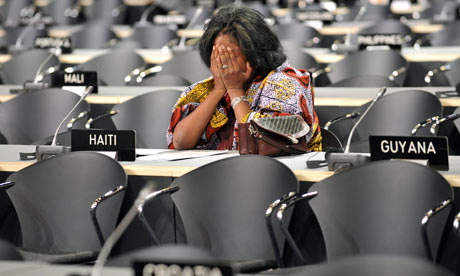
The Guardian: Copenhagen climate summit in disarray after 'Danish text' leak


Other than the news that global warming is actually happening (who knew?) this is the biggest news out of Copenhagen so far. It's not good. Seriously, this is fucked up.

Guardian:

The UN Copenhagen climate talks are in disarray today after developing countries reacted furiously to leaked documents that show world leaders will next week be asked to sign an agreement that hands more power to rich countries and sidelines the UN's role in all future climate change negotiations.

The document is also being interpreted by developing countries as setting unequal limits on per capita carbon emissions for developed and developing countries in 2050; meaning that people in rich countries would be permitted to emit nearly twice as much under the proposals.

The so-called Danish text, a secret draft agreement worked on by a group of individuals known as "the circle of commitment" – but understood to include the UK, US and Denmark – has only been shown to a handful of countries since it was finalised this week.

The agreement, leaked to the Guardian, is a departure from the Kyoto protocol's principle that rich nations, which have emitted the bulk of the CO2, should take on firm and binding commitments to reduce greenhouse gases, while poorer nations were not compelled to act. The draft hands effective control of climate change finance to the World Bank; would abandon the Kyoto protocol – the only legally binding treaty that the world has on emissions reductions; and would make any money to help poor countries adapt to climate change dependent on them taking a range of actions.

The document was described last night by one senior diplomat as "a very dangerous document for developing countries. It is a fundamental reworking of the UN balance of obligations. It is to be superimposed without discussion on the talks".

A confidential analysis of the text by developing countries also seen by the Guardian shows deep unease over details of the text. In particular, it is understood to:

• Force developing countries to agree to specific emission cuts and measures that were not part of the original UN agreement;

• Divide poor countries further by creating a new category of developing countries called "the most vulnerable";

• Weaken the UN's role in handling climate finance;

• Not allow poor countries to emit more than 1.44 tonnes of carbon per person by 2050, while allowing rich countries to emit 2.67 tonnes.

Developing countries that have seen the text are understood to be furious that it is being promoted by rich countries without their knowledge and without discussion in the negotiations.

"It is being done in secret. Clearly the intention is to get [Barack] Obama and the leaders of other rich countries to muscle it through when they arrive next week. It effectively is the end of the UN process," said one diplomat, who asked to remain nameless.

Antonio Hill, climate policy adviser for Oxfam International, said: "This is only a draft but it highlights the risk that when the big countries come together, the small ones get hurting. On every count the emission cuts need to be scaled up. It allows too many loopholes and does not suggest anything like the 40% cuts that science is saying is needed."

Hill continued: "It proposes a green fund to be run by a board but the big risk is that it will run by the World Bank and the Global Environment Facility [a partnership of 10 agencies including the World Bank and the UN Environment Programme] and not the UN. That would be a step backwards, and it tries to put constraints in developing countries when none were negotiated in earlier UN climate talks."

The text was intended by Denmark and rich countries to be a working framework, which would be adapted by countries over the next week. It is particularly inflammatory because it sidelines the UN negotiating process and suggests that rich countries are desperate for world leaders to have a text to work from when they arrive next week.

Few numbers or figures are included in the text because these would be filled in later by world leaders. However, it seeks to hold temperature rises to 2C and mentions the sum of $10bn a year to help poor countries adapt to climate change from 2012-15.

• For news and analysis of the UN climate talks in Copenhagen sign up for the Guardian's environment email newsletter Green light


VIEW THE LEAKED TEXT HERE

Friday, May 15, 2009

Commission on Climate Change and Development: Closing the Gap - Disaster Risk Reduction and Adaptation to Climate Change in Developing Countries


Just got out of a panel discussion with the leadership of the Commission on Climate Change and Development about their recent report entitled "Closing the Gap" about adaptation in the developing world. The panel was hosted at the BEAUTIFUL House of Sweden on the Georgetown waterfront which also houses the Swedish embassy. It was there because the Swedish Environmental Minister was part of the commission, and Sweden will hold the presidency of the EU for the next 6 months, during which the Copenhagen negotiations will happen. The head of WRI was also there, bunch of UN people, World Bank, etc.

I've just gotten through the executive summary, but it's a damn good summary of the changes and necessary steps for tackling climate adaptation and sustainable development. The seem to understand the inseparable goals of development and climate adaptation, and the necessary steps to amp up regular ODA. The give a comprehensive set of recommendations for every level of governance from the local and community level to the international multilateral.

More after I get through it.

Thursday, April 16, 2009

Economist: Rainfall and GDP - How rainfall can affect economic growth


DEVELOPING countries are more at risk from climate change because of their dependence on agriculture, especially the subsistence sort with poor irrigation. Climate variability has a more severe impact on the economies in which agriculture is a large share of GDP. In Ethiopia, around 75% of the population are dependent on farming, which is almost entirely small-scale and rain-fed. A further 10% earn their living from livestock. During the famine of the 1980s, rainfall was well below average and growth plunged. Whether rainfall is an accurate indicator of GDP growth is another matter, however. This chart from the United Nations appears to show changes in GDP growth preceding similar changes in rainfall in certain years.

Monday, April 13, 2009

WP: Kill the Pirates


Washington Post: With the rescue of American Richard Phillips from the hands of pirates yesterday, there was a blip of good news from the Indian Ocean, but it remains a scandal that Somali pirates continue to routinely defeat the world's naval powers. And worse than this ongoing demonstration of cowardice is the financing of terrorists that results from the huge ransom payments these pirates are allowed to collect. It is naive to assume that the millions paid annually in ransom to pirates merely enables them to purchase villas and fancy automobiles. Somalia is a country without government, where anarchy is being exploited by terrorist organizations. Although the threat that pirates pose to commercial ships is increasingly known, little is being done to combat it. And we must consider the bigger picture: Terrorists are far more brutal than pirates and can easily force pirates -- petty thieves in comparison -- to share their ransom money.....http://www.washingtonpost.com/wp-dyn/content/article/2009/04/12/AR2009041202262.html

The bigger question should be how to stop the root cause of the poverty and lawlessness from which this piracy is born. Could it be a failed state that and neglected people that have been living in wild west conditions since the 90s? Untold numbers of innocent people live in poverty in Somalia with no hope of raising themselves out of their situation within their own borders. Foreign aid missions cannot function there without a functioning government, and the most lucrative source of income is piracy. I'd be willing to be that the top echelon of Somalian intellects work in piracy, simply because it is the most entrepreneurial business around. Do I have a solution? No. But I don't think simply patrolling the coast will solve all the problems. That is like sending more cops into a riot, instead of asking why the people are angry.

Friday, April 10, 2009

Economist: The Maldives Goes Carbin-Neutral


ON MARCH 15th the president of the Maldives, Mohamed Nasheed, announced that his country would try to stop using fossil fuels—and thus eliminate most of its greenhouse-gas emissions—by 2020. The Maldives is not wealthy but it leads richer nations in tackling climate change.........

http://www.economist.com/research/articlesBySubject/displaystory.cfm?subjectid=7933604&story_id=13354355

Thursday, April 9, 2009

Center for Global Development: Desert Power: The Economics of Solar Thermal Electricity for Europe, North Africa, and the Middle East - Working Paper


Really good paper by CGDev:

A climate crisis is inevitable unless developing countries limit carbon emissions from the power sector in the near future. This will happen only if the costs of low-carbon power production become competitive with fossil fuel power.

In this CGD working paper, Kevin Ummel and senior fellow David Wheeler focus on a leading candidate for investment: solar thermal or concentrating solar power (CSP), a commercially available technology that uses direct sunlight and mirrors to boil water and drive conventional steam turbines. Solar thermal power production in North Africa and the Middle East could provide enough power to Europe to meet the needs of 35 million people by 2020.

Ummel and Wheeler compute the subsidies needed to bring CSP to financial parity with fossil-fuel alternatives. They conclude that large-scale deployment of CSP is attainable with subsidy levels that are modest, given the planetary stakes. By the end of the program, unsubsidized CSP projects are likely to be competitive with coal- and gas-based power production in Europe.

The question is not whether CSP is feasible but whether programs using CSP technology will be operational in time to prevent catastrophic climate change. For such programs to spur the clean energy revolution, efforts to arrange financing should begin right away, with site acquisition and construction to follow within a year.