Showing posts with label Climate Change. Show all posts

Monday, December 14, 2009

FAIL: the Copenhagen Conference's Carbon Footprint

Tallying Copenhagen’s Carbon Footprint

The food court at the conference center in Copenhagen.
Johan Spanner for The New York Times
The food court at the Bella Center in Copenhagen.

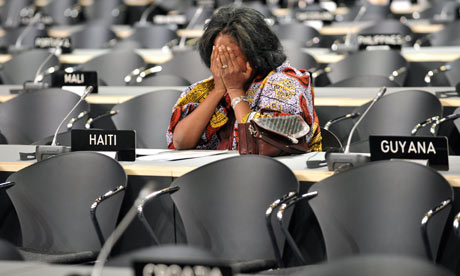
As the world focuses on the effects of climate change in Copenhagen, some observers are focusing on the impacts of the conference itself.

Despite efforts by organizers to green the conference – by using limos fueled by plant waste, serving organic food and tap water (instead of bottled), and offering the free use of 200 bicycles – the United Nations Framework Convention on Climate Change estimates that the conference will generate about 40,500 metric tons of carbon dioxide equivalent. (By way of comparison, Denmark, the conference host, emitted 72 million metric tons of carbon dioxide equivalent in 2006.)

Most of this is the result of travel to and from Copenhagen by the 15,000 or so participants (not including thousands of journalists), but it also includes emissions that result from energy use at the Bella Center (which has nearly 80,000 square meters of conference space and enough telecommunications infrastructure to handle 80,000 simultaneous phone calls), hotel stays and local transportation.

Martin Nesirky, a spokesman for the U.N. secretary general, said in a news briefing on Tuesday that action is be taken to ensure pollution generated by the conference is canceled out – via an emissions-reduction project in Bangladesh.

“The Danish government says it is offsetting the emissions through a project in Bangladesh that reduces emissions in a brick manufacturing plant,” Mr. Nesirky said. “And the offset more than covers all the travel and emissions related to the conference.”

According to the Danish Ministry of Climate and Energy, the million-dollar project, made possible through an agreement between Denmark, the World Bank and Bangladesh, will involve replacing heavily polluting brick kilns with 20 new energy efficient ones. The kiln swap, the ministry notes, will cut more than 100,000 tonnes of CO2 emissions each year and “improve air quality in one of the world’s most polluted cities.”

Still, groups like Greenpeace say organizers didn’t go far enough in addressing the event’s carbon footprint. Tarjei Haaland, a climate and energy campaigner for Greenpeace, told the Copenhagen post that claims of being “carbon neutral” were effectively meaningless.

Tuesday, December 8, 2009

The Guardian: Copenhagen climate summit in disarray after 'Danish text' leak


Other than the news that global warming is actually happening (who knew?) this is the biggest news out of Copenhagen so far. It's not good. Seriously, this is fucked up.

Guardian:

The UN Copenhagen climate talks are in disarray today after developing countries reacted furiously to leaked documents that show world leaders will next week be asked to sign an agreement that hands more power to rich countries and sidelines the UN's role in all future climate change negotiations.

The document is also being interpreted by developing countries as setting unequal limits on per capita carbon emissions for developed and developing countries in 2050; meaning that people in rich countries would be permitted to emit nearly twice as much under the proposals.

The so-called Danish text, a secret draft agreement worked on by a group of individuals known as "the circle of commitment" – but understood to include the UK, US and Denmark – has only been shown to a handful of countries since it was finalised this week.

The agreement, leaked to the Guardian, is a departure from the Kyoto protocol's principle that rich nations, which have emitted the bulk of the CO2, should take on firm and binding commitments to reduce greenhouse gases, while poorer nations were not compelled to act. The draft hands effective control of climate change finance to the World Bank; would abandon the Kyoto protocol – the only legally binding treaty that the world has on emissions reductions; and would make any money to help poor countries adapt to climate change dependent on them taking a range of actions.

The document was described last night by one senior diplomat as "a very dangerous document for developing countries. It is a fundamental reworking of the UN balance of obligations. It is to be superimposed without discussion on the talks".

A confidential analysis of the text by developing countries also seen by the Guardian shows deep unease over details of the text. In particular, it is understood to:

• Force developing countries to agree to specific emission cuts and measures that were not part of the original UN agreement;

• Divide poor countries further by creating a new category of developing countries called "the most vulnerable";

• Weaken the UN's role in handling climate finance;

• Not allow poor countries to emit more than 1.44 tonnes of carbon per person by 2050, while allowing rich countries to emit 2.67 tonnes.

Developing countries that have seen the text are understood to be furious that it is being promoted by rich countries without their knowledge and without discussion in the negotiations.

"It is being done in secret. Clearly the intention is to get [Barack] Obama and the leaders of other rich countries to muscle it through when they arrive next week. It effectively is the end of the UN process," said one diplomat, who asked to remain nameless.

Antonio Hill, climate policy adviser for Oxfam International, said: "This is only a draft but it highlights the risk that when the big countries come together, the small ones get hurting. On every count the emission cuts need to be scaled up. It allows too many loopholes and does not suggest anything like the 40% cuts that science is saying is needed."

Hill continued: "It proposes a green fund to be run by a board but the big risk is that it will run by the World Bank and the Global Environment Facility [a partnership of 10 agencies including the World Bank and the UN Environment Programme] and not the UN. That would be a step backwards, and it tries to put constraints in developing countries when none were negotiated in earlier UN climate talks."

The text was intended by Denmark and rich countries to be a working framework, which would be adapted by countries over the next week. It is particularly inflammatory because it sidelines the UN negotiating process and suggests that rich countries are desperate for world leaders to have a text to work from when they arrive next week.

Few numbers or figures are included in the text because these would be filled in later by world leaders. However, it seeks to hold temperature rises to 2C and mentions the sum of $10bn a year to help poor countries adapt to climate change from 2012-15.

• For news and analysis of the UN climate talks in Copenhagen sign up for the Guardian's environment email newsletter Green light


VIEW THE LEAKED TEXT HERE

Monday, November 30, 2009

NYtimes: The Road to Copenhagen - Tree Harvester Offers to Save Indonesian Forest


Ok, so I admittedly have been slacking on posting updates from the whole "Road to Copenhagen" process but frankly there is just too much happening to really make sense of it and there are daily BREAKING NEWS that aren't that interesting, such as Obama setting emissions targets, the African delegation walking out of talks, the Chinese fucking around, etc.

Anyway, I'm gonna try to post more interesting snippets and MAJOR things happening in Copenhagen over the next few weeks. Hopefully we'll get a robust internationally binding treating, but it's a long shot. Till then, check out some of the international efforts to help mitigate climate change.

This article should highlight some of the difficulties of the climate negotiations, and accounting for what should be eligible and ineligible for carbon credits.

NYtimes:

TELUK MERANTI, Indonesia — From the air, the Kampar Peninsula in Indonesia stretches for mile after mile in dense scrub and trees. One of the world’s largest peat swamp forests, it is also one of its biggest vaults of carbon dioxide, a source of potentially lucrative currency as world governments struggle to hammer out a global climate treaty. The vault, though, is leaking.

Canals — used legally and illegally — extend from surrounding rivers nearly into the peninsula’s impenetrable core. By slowly draining and drying the peat land, they are releasing carbon dioxide, contributing to making Indonesia the world’s third biggest emitter of greenhouse gases, after China and the United States.

The leaks were evident to a family of fishermen from this village, just south of the peninsula, as they paddled up a creek in a dugout canoe.

“I can tell the peat land’s leaking because the water here is getting browner and more acidic,” said Amiruddin, 31, who like many Indonesians uses only one name, as his wife, Delima, 29, scooped up the creek’s coffee-colored water to drink.

Forests like the one on the Kampar Peninsula are at the center of a growing battle over the shape of a new climate treaty and efforts to curb the destruction and degradation of forests. Though countries are expected to reach only a broad agreement at next month’s summit meeting in Copenhagen, governments, scientists, businesses and environmentalists are already arguing over what kinds of forests should qualify as carbon reducers and what kinds of projects should be rewarded financially.

The arguments over the Kampar have become particularly heated, not just because of its ecological importance, but because, so far, the most detailed plan to stop the leaks from the peat land comes from an unlikely source: a giant paper and pulp company that, according to its critics, has been one of the driving forces of deforestation in Indonesia. The company, Asia Pacific Resources International Limited, or April, says it wants to create a ring of industrial tree plantations around the peninsula’s core to preserve it.

What is more, it hopes to receive carbon credits for doing so under a United Nations program to reward nations for conserving forests and reforesting degraded ones. The program, Reducing Emissions From Deforestation and Forest Degradation, or REDD, is expected to be part of a new climate treaty. Unlike the 1997 Kyoto Protocol, a new treaty is expected to tackle deforestation, which alone accounts for 20 percent of the world’s greenhouse gas emissions. Halting deforestation in tropical forest nations like Indonesia and Brazil, the world’s fourth biggest emitter, is considered crucial to reining in global warming.

Developing nations that preserve forests would be paid with carbon credits that they could sell to industrialized nations seeking to meet emissions reduction targets. Though the program’s specifics will probably take months or years to be worked out, more than a dozen projects of the United Nations program are already under way in Indonesia, backed by such diverse entities as conservation groups, the Australian government and Merrill Lynch, in addition to paper and pulp companies.

Environmental groups say the paper and pulp companies, after years of despoiling Indonesia, should not be rewarded under the program.

“They are the ones that did the damage,” said Michael Stuewe, an expert on Indonesia at the World Wildlife Fund. “Now they’re saying: ‘We were bad boys. Now we’re good. So give us the money.’ ”

The companies argue that the United Nations program could provide them with the financial incentives to preserve forests even as they expand their operations, a goal supported by the Indonesian government, which sees the paper and pulp industry as a mainstay of the country’s economic development.

“We could perhaps reduce the annual Indonesian emissions by 5 percent with this one project,” said Jouko Virta, April’s president of global fiber supply, referring to the company’s plan to ring the peninsula’s core. “It’s so significant. One project.”

Everyone agrees, at least, on the importance of saving the Kampar Peninsula, a nearly one-million-acre peat bog on the equator inhabited by Sumatran tigers, bears, monkeys, crocodiles and other wildlife.

Most of the peninsula remains free of humans, though small fishing camps can be found up its creeks. More significantly, illegal loggers can be seen operating in bases set up along some canals and creeks. And east of here, near a village called Pulau Muda, more than a dozen houses flank a long canal jutting into the peninsula, in what appears to be the biggest human settlement on the Kampar.

Made up of decomposed trees and plants, sometimes as deep as 50 feet, the waterlogged land stores billions of tons of carbon dioxide. But once drained or cleared, the peat land releases many times more carbon dioxide than the deforestation of rain forests. Most experts believe that, as with rain forests, the protection of peat swamp forests will be eligible for carbon credits under the United Nations program.

The Kampar Peninsula is one of the last tracts of green left in central Sumatra, where forests have been cleared to make way for palm oil plantations and industrial tree plantations, especially those belonging to April and its chief rival, Asia Pulp and Paper, both owned by Indonesian conglomerates. According to the World Wildlife Fund, here in Riau, the province where the two companies have their main mills and plantations, two-thirds of the area’s forests have disappeared in the past quarter century.

Illegal loggers have also clear-cut vast chunks of forest. Migrants often slash and burn land for farming, sometimes inside national parks; like people elsewhere in Indonesia, they are often encouraged by local governments seeking to populate areas for economic or political reasons, in defiance of officials from the understaffed Forestry Ministry.

April, which, with its partners, has government-issued concessions across a third of Kampar, says its ring of acacia plantations around the core will block off any such encroachment, though it says it needs to acquire more land to complete the circle. On plantations already in operation, the company uses a sophisticated network of canals and dams that minimizes leakage from the peat land, environmental groups acknowledge.

If April acquired control over the core, it could be paid for protecting it. The company says it believes that it can be, at the very least, rewarded for the ring, about half of which would be turned into acacia plantations and half left as natural forests or what it calls “conservation areas.”

“The carbon we are storing in the conservation areas could be financed through REDD,” Mr. Virta said in an interview at April’s 4,300-acre mill, about two hours west of here by car.

Agus Purnomo, who leads the government’s National Council on Climate Change, said it would take months or years of negotiations after next month’s climate conference to determine whether April’s ring would be entitled to carbon credits.

Much will depend on whether an agreement includes stipulations against the conversion of natural forests into industrial tree plantations. Indonesia, like other countries with paper and pulp industries, counts industrial tree plantations as forests.

Environmental groups caution against any project of the United Nations program involving the conversion of natural forests into industrial tree plantations. Bill Barclay, policy director at the Rainforest Action Network, said the priority in Indonesia should be to “halt further conversion of natural forests” and “further draining of peat lands.”

But that kind of argument finds little traction in a nation with an economy that is still developing.

Mr. Purnomo, of the country’s climate change council, said government officials were worried that Indonesia’s ranking as the world’s third biggest emitter of greenhouse gases would increase pressure to reduce emissions.

“Are we going to remain underdeveloped because of that?” he asked.

Since starting operations on a new concession near here in September, April has brought jobs to Teluk Meranti. As part of its community outreach, it has brought a new generator to increase the supply of electricity and construction material to renovate two mosques. Still, Teluk Meranti had yet to buy April’s vision of the future. Villagers remained overwhelmingly opposed to the company’s presence here, opponents and supporters of the company said.

“We don’t know what we’ll get,” said Firdaus, a 39-year-old man operating a makeshift convenience store. “What rights do we have?”

He was unaware of April’s ring project. But, yes, he had heard of the importance of peat from environmental groups. “We were told,” he said, “to protect the peat for the climate.”

Tuesday, November 3, 2009

Financial Times: Heating Up


FT:
Analysis from one of my colleagues:

Yesterday and today, the FT published a comprehensive analysis, "Heating Up," and two lengthy editorials on the science and politics of climate change -- all told, 3500 words.

The lengthy call to "Follow the science on climate change" is nothing new, except for an explicit swipe at geo-engineering and a shout-out to Marty Weitzman and the importance of fat tails.

The second editorial, on "The deal we need from Copenhagen," is slightly naïve on the politics. But it does make three points very much in line with our thinking:

(1) the editorial explicitly calls cap-and-trade the best solution, "in the actual world". That's a major editorial shift for the FT.
(2) it makes the explicit CLEAR argument for us: a lesser obligation by developing countries "is a case for more generous quotas, not an excuse from signing up to a global emissions target" -- i.e. absolute caps for everyone, some more generous than others.
(3) it emphasizes carbon markets as the major way to generate international finance

Heating up

By Fiona Harvey

Published: November 3 2009 02:00 | Last updated: November 3 2009 02:00

Fresh off flights to Barcelona from their various capitals, a group of weary public servants yesterday lugged their bulging briefcases into yet another air-conditioned conference centre for one more round of negotiations on climate change. They know each other well, having met every few months since December 2007. Their mission: to draft a pact that would forge a new global framework to tackle global warming, intended to be agreed at a Copenhagen summit next month.

Campaigners are badging the talks as the last 45 days in which to save the world. But the urgent tenor belies the numbing reality of combing through a draft text nearly 200 pages long and bristling with more than 1,000 square brackets denoting clauses and sub-clauses that must be accepted or expunged after hours of argument, sometimes over matters as trivial as the placing of a comma.

If the talks fail, the world will have no plan for cutting greenhouse gas emissions, a state of affairs that leading scientists warn would lead to a disastrous future of storms, floods, droughts and heatwaves - wild weather that could trigger mass migrations and conflict. If a deal is struck, it will require the transformation of nearly all sectors of the global economy and will determine the world's response to the threat of climate change for decades to come.

"We have to get a political agreement," says Yvo de Boer, the United Nations' top official on climate change and the man charged with bringing the talks to a successful conclusion - and a deal appears tantalisingly close.

In any long-running talks, however - and these have been running in various forms for two decades - there are dozens of ups and downs before an accord is reached, as the negotiators know all too well. Indeed, the Dutchman's own demeanour is usually a good indicator of where the climate talks are on the rollercoaster. At a low point at the Bali conference of two years ago, when the US under George W. Bush was refusing to compromise until finally shamed into it by boos from developing countries, he appeared to weep on the platform.

But ahead of Barcelona - the last formal session ahead of the gathering in the Danish capital - Mr de Boer looks chipper, though cautious. "It can be done," he says, though warning: "It's important not to overreach at Copenhagen - to try to get more than is politically achievable, and end up with nothing."

Progress on some issues has been followed by setbacks on others, while arguments that looked to have been put to rest have been resurrected by governments at the 11th hour. "The result is hanging in the balance," admits Ed Miliband, the UK's usually jaunty energy secretary, in a sombre moment. "We are not there yet."

Exasperation in recent months has centred on the US, where the congressional fate of healthcare legislation left little room for progress on the climate. As the administration of President Barack Obama has had no time to seal a so-called cap-and-trade bill on carbon, the US has been left without clear domestic commitments on its emissions targets, or on the money it will offer to poor countries to help them combat climate change.

The point of the talks is to ensure that global temperatures rise by no more than 2°C compared with preindustrial levels. Scientists brought together by the Intergovernmental Panel on Climate Change, a United Nations offshoot, say this is the limit of safety, beyond which climate change is likely to become catastrophic and irreversible.

To stay within that limit, according to Mr de Boer, governments must agree on four main areas. First, developed countries need to take on emission-cutting targets for the medium term, generally defined as 2020. Second, emerging economies must commit to certain actions to limit the growth of their emissions. Third, a financial infrastructure has to be put in place that ensures a flow of funds from rich to poor nations, to help the latter curb emissions and adapt to the effects of warming. Fourth, institutions should be set up to oversee the governance of these commitments.

On all of these, progress has been made. Nearly all developed countries have set out targets to slash their emissions by 2020 - they fall short of what developing countries are demanding but could be acceptable.

The second requirement is even closer to resolution, though on the surface it may not appear so. Jairam Ramesh, India's environment minister, has vociferously opposed taking on targets to cut emissions, accusing the west of trying to halt development, and Beijing has frequently echoed him. But this belies a more doveish reality. No developing nations have been asked to take on absolute reductions - instead, they should agree to curb their future emissions growth. While protesting against cuts, in reality China, India and several other rapidly emerging economies have committed themselves to do so, through actions including investments in renewable energy and efficiency. That will almost certainly be enough to satisfy the rich world, if the countries make these legally binding.

That leaves two pressing problems, and both pivot around the US. Mr Obama was hailed last year as the man to save the world at Copenhagen, a stark contrast with his predecessor, who blocked all agreement on climate change. Indeed, some suspect his Nobel peace prize - to be awarded in Oslo while the Copenhagen talks go on - is intended as an inducement to hop across the Skagerrak strait to chivvy the talks along.

The US political system has now become the clearest obstacle to a deal. A cap-and-trade bill, with a target for emissions cuts and provisions allowing US companies to offset their own emissions by investments in poorer countries, has passed the House of Representatives and a slightly different one is in committee in the Senate. But there is almost certainly too little time left to clear the remaining legislative hurdles before Copenhagen. For its part, the Obama administration is unlikely to push too hard for victory, as a defeat would be disastrous for its stance at the summit.

W ithout a bill, the US could still in theory sign up to targets on emissions and funding at Copenhagen. "Not a single country that signed the Kyoto protocol had in place a legislative package to meet its commitments," Mr de Boer recalls.

But American negotiators are acutely aware of the pitfalls of making commitments on the international stage that are still in doubt at home. Todd Stern, US special envoy for climate change, is a veteran of the Clinton administration, which signed up to Kyoto in 1997 only to be rebuffed by Congress. The US never ratified the protocol, sealing its failure. On taking office, Mr Stern vowed he would sign no deal that would be "dead on arrival" in Congress. Nor will other countries repeat the mistakes of 12 years ago - they are determined that a deal cannot exclude the US.

On financing, the European Union has come up with a proposal that rich countries should commit €22bn ($33bn, £20bn) to €50bn a year to the poor world by 2020, of which the EU's share at the top end of that range would be about €15bn. But other countries have yet to come up with sums, giving rise to a war of words between the US and Europe.

Mr Stern brushes aside the contention that Washington is holding up the talks. He says the US has made clear the possible range of targets it will accept, at 14-20 per cent below 2005 levels, adding: "There is no huge mystery about what our number will be." He also points to estimates for financial flows contained in the bills.

Other countries, though, want the US to confirm its emissions and finance commitments before they will be drawn into a deal. "Sometimes the greatest deliberative body in the world [the Senate] acts as though it is the only deliberative body in the world," John Bruton, EU ambassador, railed recently. "The world cannot wait on the Senate's timetable." An exasperated Mr Stern snapped back: "It may be that some people on the other side of the pond don't understand the system that well, but that's the way our system works, and we're pushing ahead."

If the US cannot agree firm targets at Copenhagen or find a way to finesse the negotiations, the talks could go into next year. For some, that would be preferable to a poor deal. Sir David King, the UK's former chief scientific adviser, says: "If it does not look like we can get the strong deal that we need, there should be a moratorium on the talks for 12 months and then we come back."

But as the negotiators battle through their forest of brackets, the prospect of carrying on for another year looks distinctly unappealing. A spectre haunts these talks: that of the Doha round of trade negotiations, which have run on for eight years with little prospect of a breakthrough. "The world doesn't want Copenhagen to come to mean another Doha," says Kim Carstensen of WWF, the green campaigning group.

That is why both the UN and the Danish hosts are adamant Copenhagen is a real deadline. "There is no plan B," insists Connie Hedegaard, the Danish climate minister. "Deadlines concentrate minds. We have to agree at Copenhagen." As Mr de Boer remarks, carrying on beyond December would not improve the prospects: "I don't think it's going to get any easier if we go into next year. I can only see it getting more difficult."

The Obama effect

Will Barack Obama, US president, go to Copenhagen? Will it make any difference? The White House is tight-lipped on travel plans. Although the timing of a possible trip to Oslo to collect the Nobel peace prize seems auspicious - bang in the middle of the summit - it falls before ministers have arrived. What leaders tell their negotiators is more important than their mere presence, says Connie Hedegaard, who as Danish environment minister will host the talks. "Only leaders can give their negotiating teams new instructions."

Coal and voter wariness capture senators' attention

For US senators such as Ben Nelson, climate change is not simply a matter of party politics. It strikes at the core of his heartland state of Nebraska. "[We rely] heavily on coal-fired electricity generation so we would be disproportionately hit by the trade part of this," says the Democrat, referring to the cap-and-trade proposal before the Senate that would make large polluters buy permits to emit greenhouse gases. "We don't have to destroy the economy to save the environment."

Winning over Democrats from farming and coal states like Mr Nelson, Blanche Lincoln of Arkansas, Mary Landrieu of Louisiana and Evan Bayh of Indiana will be crucial if the Senate is to pass a climate change bill.

The upper chamber is still at the beginning of the legislative process. Its energy committee passed a bill in the summer and the influential environment and public works committee last week began discussing a proposal that aims to cut US emissions by 20 per cent by 2020. Analysts say it would take a miracle for the Senate to pass a bill - let alone reconcile it with the version already passed by the House of Representatives - in time for the Copenhagen summit next month.

The White House and the Democratic leadership, already facing an uphill battle over President Barack Obama's domestic priority - healthcare - have little political capital to spend on pushing through a climate change deal.

"There are so many Democrats from energy-producing states who are just not going to vote for it," says Patrick Michaels of the Cato Institute, a free-market think-tank. "What legislator wouldn't like to wash their hands of this, given the negative reaction of their communities to cap and trade?"

Still, Barbara Boxer of California and John Kerry of Massachusetts pressed ahead last week with their bill for a cap-and-trade system. While broadly similar to the bill already passed by the House, they are more ambitious on emissions reductions targets, aiming for a 20 per cent cut by 2020 compared with 17 per cent in the House version.

Initially, companies would receive billions of dollars of free permits. But the bill would require most of the money be returned to consumers and would entitle coal-fired plants that capture and store carbon emissions to bonus credits. It would also encourage investment in green technologies and nuclear power.

Still, it poses a challenge for many senators on the committee. "When I hear concerns about jobs and higher costs for consumers, I'm very much concerned," says Arlen Specter, a moderate Democrat facing a tough re-election in the coal and steel state of Pennsylvania next year. Most Democrats from coal states want a reduction of only 14 per cent to give industry time to adapt.

The overarching concern among resistant Democrats is the cost. "I don't see the logic of spending money to get a permit to emit. They should be spending money on R&D, not on permits," says Mr Nelson.

Others such as Ms Lincoln, who was recently elected chairwoman of the agriculture committee, argue that existing "tremendously good, bipartisan" legislation that promotes renewables, conservation and energy efficiency already offers the tools to curb emissions.

Monday, November 2, 2009

WP: Climate bill faces hurdles in Senate

Senate needs to take some action.

Washington Post:

The climate-change bill that has been moving slowly through the Senate will face a stark political reality when it emerges for committee debate on Tuesday: With Democrats deeply divided on the issue, unless some Republican lawmakers risk the backlash for signing on to the legislation, there is almost no hope for passage.

Like the measure adopted by the House, the legislation favors a cap-and-trade system that would issue permits for greenhouse gas emissions, gradually lower the amount of emissions allowed, and let companies buy and sell permits to meet their needs -- all without adding to the federal deficit, according to projections. But key Republicans are making their opposition clear, even as Sen. John F. Kerry (D-Mass.) has enlisted Sen. Lindsey O. Graham (S.C.) as his most visible GOP ally in gathering support for the bill.

Sen. George V. Voinovich (Ohio), a member of the Environment and Public Works Committee who was initially seen as one of the few Republicans who might consider backing the majority, is helping lead the opposition.

"Why are we trying to jam down this legislation now?" he asked during a hearing last week. "Wouldn't it be smarter to take our time and do it right?"

He wrote Environmental Protection Agency Administrator Lisa P. Jackson twice this summer to ask for a more detailed economic analysis of the House-passed climate legislation, and he has joined the other six Republicans on the committee in boycotting the climate bill's markup, scheduled for Tuesday.

The measure has deeply divided Democrats. With states in the Midwest, South and Rocky Mountain West dependent on fossil fuels for energy, many senators are worried about the legislation's impact on industry and consumers.

"I think at the end of the day, the people who turn the switch on at home will be disadvantaged," Sen. Ben Nelson (D-Neb.) told CNBC on Friday, explaining why he did not think the bill Kerry had sponsored along with Environment and Public Works Chairman Barbara Boxer (D-Calif.) could pass.

So Democratic leaders, with the support of the Obama administration, are trying to sway at least half a dozen Republicans by offering amendments to speed along their top priority: building nuclear power plants.

Graham has suggested provisions on nuclear power and offshore oil drilling that could win his support for a cap-and-trade climate bill. Sen. Joseph I. Lieberman (I-Conn.) has established a bipartisan working group of 17 Senate offices that is close to producing a detailed amendment aimed at hurrying the construction of U.S. nuclear reactors.

But it remains unclear whether that approach will hold currency in the current era of political polarization. One of the top Republicans whom Democrats hope to recruit in this effort -- Sen. Lisa Murkowski (Alaska), whom Graham and Kerry recently buttonholed on the Senate floor -- has voiced skepticism about the legislation.

"A tepid nuclear title isn't enough to get her to support a bad climate bill," said Robert Dillon, a spokesman for Murkowski.

Graham and Kerry are set to meet Wednesday with Energy Secretary Steven Chu, as well as with Obama's top climate adviser, Carol M. Browner, and Interior Secretary Ken Salazar to discuss a possible compromise. They are also setting up meetings with colleagues on the issue.

"There is nowhere near 60 votes for a nuclear power bill on its own. There's not 60 votes for a cap-and-trade bill as it's currently constructed," Graham said in an interview. He said combining the two measures is "the only way you'll get to 60 votes."

It is what Sierra Club Executive Director Carl Pope calls "the old formula for bipartisanship."

"They would agree on a goal, they would not agree exactly on the means to a goal, and they'd come up with a legislative solution that takes elements from both sides," he said.

And Graham, for his part, has become a lightning rod for controversy back home. On Oct. 22, the American Energy Alliance, an advocacy group funded in part by energy companies, launched a radio, TV and online advertising campaign in South Carolina that has cost "close to $300,000" so far, according to the group's spokesman, Patrick Creighton.

Featuring a Halloween theme, the TV commercial warns of "some scary stories coming out of Washington" and says, "The latest is Senator Lindsey Graham's support for a national energy tax called cap-and-trade."

Creighton said the group questions why Graham says a deal will help offshore drilling, which Congress has already allowed.

Groups backing the climate bill came to Graham's defense last week. They aired radio and television ads that featured state Sen. John Courson, a conservative Republican who became concerned about global warming after witnessing the decline of polar bears in Churchill, Manitoba.

"Out-of-state interests are attacking our Senator Lindsey Graham," Courson says in an ad underwritten by Republicans for Environmental Protection, "because he's backing an energy plan that produces more power in America."

Sen. Tom Udall (D-N.M.), a member of the Environment and Public Works Committee, said he is optimistic that the parties can reach an accord because Americans are not divided along party lines on global warming. "Is there bipartisanship in the country? I think clearly there is," he said.

State lawmakers who came to advise the White House last week on climate saw a different picture. "We looked for any Republican, in any state legislature in the country, who supported a bill," recalled Minnesota state Rep. Jeremy Kalin. "We found not a one."

Tuesday, October 13, 2009

Economist: Cool heads or heated conflicts?


Economist:

A lesson from history on how to prevent climate-induced wars

THE starkest views of climate change paint war as a looming threat. The idea that violence will erupt as drought and rising sea levels displace people from their homes is, in part, why the Nobel prize for peace was awarded in 2007 to the Intergovernmental Panel on Climate Change and Al Gore. Yet a newly published study analysing the historical connection between war and climate throws into question the assumption that rising temperatures and violence go hand in hand.

Aware that evidence for the link was lacking, Richard Tol of the Economic and Social Research Institute in Dublin, Ireland, and Sebastian Wagner of GKSS, a research institute near Hamburg, Germany, set out to collect data on climate and conflict in Europe over the past thousand years. Their results have just been published in Climatic Change.

The information they worked with came from a variety of sources. Thermometers and rain gauges have been used in Europe since 1500, and many of the records are now easily available on the internet. For earlier years, the two researchers relied on indirect data such as ice cores, tree rings and the growth patterns of corals that they culled from other people’s papers.

Measuring fighting proved more challenging, since the definition of “conflict” varies throughout history. Dr Tol and Dr Wagner decided to confine their efforts to those events which lasted for a year or more. They used www.warscholar.com to count the number of such contretemps that had been taking place during each year from 1000 to 2000.

The chart shows the correlation between the number of conflicts and the average temperature during most of the second half of the millennium, the period for which the data are best. Until the mid-18th century, this correlation is continuously and significantly negative (the line remains close to the 95% confidence level, suggesting there is only one chance in 20 that it is an accidental, random effect). In other words, lower temperatures mean more wars. Then, suddenly, the negative correlation vanishes. The line goes into positive territory, but not enough to be statistically meaningful. The inverted correlation between temperature and conflict has therefore disappeared.

Dr Tol and Dr Wagner suggest that in the more remote past the effects of cold weather on harvests led to supply shortages, and that these increased the likelihood of people fighting over food and the land needed to produce it. They argue that the reason the relationship between warfare and cold vanishes in the mid-18th century is that this is the moment when the industrial revolution began. Both agriculture and transport improved rapidly at this time. Systematic plant breeding, the introduction of new crops and new forms of crop rotation, and better irrigation increased the food supply. Improvements in roads and the large-scale construction of canals allowed food to be transported from areas of plenty to areas of scarcity.

These developments meant farmers could often produce reasonable yields during colder weather—and even when they could not, long-distance trade provided a buffer against crop failure. Meanwhile, the growth of cities and non-agricultural occupations meant there was money to buy such traded crops.

Just because cold, rather than heat, caused problems in Europe during the millennium that Dr Tol and Dr Wagner examined does not mean rising temperatures pose no threat. The lesson, rather, is that the way to minimise the likelihood of climate-induced conflict in the future is to continue the process of crop improvement (for example, by taking advantage of the potential of genetic engineering) so that heat- and drought-tolerant varieties are available; to make farmers aware of these new crops and encourage their use; and to promote free trade and non-agricultural economic development. That way people will have no cause to fight, and tyrants no excuse to stir them up.

Tuesday, October 6, 2009

Economist: Seasonally adjusted - Farmland and Climate Change


Economist:
Global warming will make it harder to feed the world in 2050

SINCE time immemorial, farmers have planted their crops according to the seasons. “That is what my forefathers have been doing,” says Mohammad Ilisasuddin in Shibganj, in northern Bangladesh, but now “the weather does not seem right for what we have done traditionally.” Seasonal planting is “useless”, agrees Florence Madamu, a smallholder in Bulirehe, in western Uganda. “The sun is prolonged until the end of September and whenever it rains, it rains so heavily it destroys all our crops.” Oxfam, a British charity, has compiled a litany of laments by poor farmers. John Magrath, a researcher, says they all say similar things: “moderate, temperate seasons are shrinking…rainy seasons are shorter and more violent…making it more difficult to grow crops [and] difficult for them to know when best to plant.”

As the earth warms up, many have feared that farmers will pay a high price. But working out who will pay, how, and where is tricky. Higher temperatures might turn arid shrub lands into deserts while improving the growing season in colder steppes. Global warming could produce more evaporation from plants, and more rain, which would benefit some places, while hurting others. In theory extra carbon dioxide in the atmosphere should help plants grow faster, though whether this actually happens may also depend on the amount of nitrogen in the soil.

In the most comprehensive effort* so far to think these questions through, the International Food Policy Research Institute, a think-tank in Washington, DC, has reached some sobering conclusions. In parts of the developing world some crop yields in 2050 could be only half of their 2000 levels. Irrigation may not help: climate change will hit irrigated systems harder than rain-fed ones. And the hope that gainers from climate change will outweigh losers looks vain: the damage from higher temperatures and erratic rainfall will be too big.

In its forecast IFPRI started with the “A2 scenario” of the Intergovernmental Panel on Climate Change. This is the second-gloomiest of six IPCC scenarios (it assumes the world will be releasing roughly twice as much CO2 in 2050 as it does now) and says the oceans’ surface temperature will rise by around 1.6°C by 2050.

However, this says nothing about the temperature and rainfall patterns that would result on farmland. To forecast those, IFPRI fed the IPCC assumptions into two climate-change models, one run by America’s National Centre for Atmospheric Research (NCAR), the other by Australia’s Commonwealth Scientific and Industrial Research Organisation (CSIRO).

These gave different descriptions of the world in 2050. NCAR thinks the climate would be hotter and wetter, with rainfall about 10% heavier than now. The CSIRO forecasts that there would be 2% more rain. There were big regional disparities, too: CSIRO forecast the sharpest increases in temperature in southern Africa; NCAR sees Russia and Canada heating up more. To take account of the differences IFPRI fed both forecasts into its own computer, which describes how every agricultural region and, in some places, practically every farm, responds to changes in temperature and rainfall.

The results varied less than the assumptions. In developing countries, IFPRI found, irrigated wheat in 2050 would yield 34% less than in 2000, using NCAR data; and 28% less going by CSIRO figures. For irrigated rice, the declines would be 19% and 14% (see chart). These falls are large but not unlikely: scientists in South Africa recently said the region could see a 50% fall in cereals productivity by 2080.

Bad though they are, the average declines hide even more disturbing variations. Latin America comes out of the exercise relatively well: the yields of its main crops are expected to fall by only a few percent. China’s farming may also be more resilient than it sometimes appears. But South Asia, the world’s most heavily populated region, looks vulnerable: IFPRI forecasts a possible 50% fall in its wheat yield in 2050 (one-sixth of all the world’s wheat grows on the north Indian plain). In the Middle East the institute predicts yield declines of 47% for maize and 30% for rice.

As patterns of production shift, argues Jerry Nelson, the report’s lead author, it becomes all the more important to liberalise farm trade, so that farming keeps pace with changing comparative advantage. But overall, he argues, the yield declines are so great that only another round of technological change—a new Green Revolution—would be enough to offset them. In principle, such a thing looks possible: the technology to double or triple many crop yields exists in laboratories. The problem is to get it into the fields. To that end, last week’s G20 meeting in Pittsburgh promised to put more taxpayer money into farm research and other help for agriculture.

The ups and downs of diplomacy used to be compared to the cycle of the seasons. But as poor smallholders are finding out, the seasons are not what they were.

Sunday, September 27, 2009

WP: Climate-Change Study Cites Role of Ancient Farming

WP:

Has climate change been around as long as the pyramids?

It is an odd-sounding idea, because the problem is usually assumed to be a modern one, the product of a world created by the Industrial Revolution and powered by high-polluting fossil fuels.

But a professor emeritus at the University of Virginia has suggested that people began altering the climate thousands of years ago, as primitive farmers burned forests and built methane-bubbling rice paddies. The practices produced enough greenhouse gases, he says, to warm the world by a degree or more.

Other scientists, however, have said the idea is deeply flawed and might be used to dampen modern alarms over climate change.

Understanding the debate requires a tour through polar ice sheets, the inner workings of the carbon molecule, the farming habits of 5,000-year-old Europeans and trapped air bubbles more ancient than Rome.

"The greenhouse gases went up, and they should have gone down" many thousands of years ago, said U-Va.'s William Ruddiman. "Why did that happen?"

His answer is based on circumstantial evidence. Ruddiman said two events in world history -- an apparent shift in the composition of the atmosphere and the first explosion of human agriculture -- took place at nearly the same time.

"Greenhouse gases do something they never did before," Ruddiman said. "And humans do something the Earth [had] never seen before."

Ruddiman first presented his idea of ancient climate change in 2003. But he returned to the subject last month, in a paper intended to rebut one major criticism -- that there were not enough people on the planet thousands of years ago for their emissions to make a difference.

Ruddiman's response: yes, there were. And in those days, one farmer was as destructive as multiple farmers are today.

He and Erle Ellis, a professor at the University of Maryland Baltimore County, wrote in the journal Quaternary Science Reviews that early farmers did not have modern fertilizer or factory-made tools, but they did have a lot of land. They would clear an area by cutting or burning it, farm the ground until it was nearly barren and move on.

"Those tens of millions [of people] had the impact of hundreds of millions, because per person, they had 10 times the impact," Ruddiman said. "And that's enough to start the curve turning around."

The assertion is the heart of Ruddiman's arguments -- and his critics' complaints. Where he sees human impact on the curving plot of global temperatures, they see a misunderstanding of what nature was doing at the time.

"I think it's a bunch of bosh," said Wallace Broecker, a professor at Columbia University. Broecker said he worried that the idea of pre-modern people as carbon emitters would turn into an argument that the modern world need not worry so much about its own pollution. "I get really upset with him, because people who oppose global warming [legislation] can use this as some dodge."

The science of the debate begins with the idea that Earth has natural freeze-and-thaw cycles, driven heavily by changes in its orbit. The planet is in a warm "interglacial" period, which began 10,000 years ago with the end of the last Ice Age.

Beginning more than 8,000 years ago, Ruddiman said, things should have started slowly cooling off again.

But for some reason, he said, the cooling was less than expected.

Ruddiman thinks the explanation is revealed in long "cores" taken from polar ice, in which tiny bubbles of air have been trapped for thousands of years. He has examined the bubbles and found that about 5,000 years ago, they began showing unexpected increases in carbon dioxide and methane.

His theory is that the gases were pollutants, produced by civilizations on several continents that were picking up the settled life of farmers.

The carbon dioxide, Ruddiman said, could have come from smoke, from forests burned to create farmland on several continents. It could have seeped out of felled trees as they rotted. The methane, a byproduct of decay in swampy water, could have come from areas of Asia newly flooded to grow rice. It also might have been expelled by livestock.

In the atmosphere, Ruddiman says, the gases trap solar heat that might otherwise have bounced back out to space. They were greenhouse gases, the same as now.

His theory is that the trapped heat, amplified by natural feedback cycles, may have kept Earth's temperature steady, when it otherwise might have slipped back toward an ice age. That effect lasted until modern times, he said: temperatures might be more than one degree Fahrenheit higher than they would have been.

The early farmers "did not . . . change the actual climate," said Ellis, Ruddiman's collaborator on the recent paper. "They kept the climate from changing."

But Ruddiman's critics say he is wrong to see human impact here: nature was in control all along.

"I think it's more or less a hypothesis without any evidence to support [it]," said Ken Caldeira, a researcher at the Carnegie Institution for Science in California.

In fact, critics of Ruddiman say, there is strong scientific evidence to prove him wrong. They say that recent studies of very deep ice samples show that ice ages did not always come and go on the same schedule. That could throw off Ruddiman's calculations for when the next round of cooling was supposed to start.

And there is evidence, they say, inside the carbon atoms themselves. Carbon atoms that come from plants can be tracked, by looking at the number of neutrons in their nucleus. If Ruddiman was right, and ancient farmers burned enough plants to change the climate, then the amount of carbon from plants in those bubbles would rise significantly.

But, they say, it did not.

"The general feeling [about Ruddiman's theories] in the community is 'Interesting -- but probably not,' " said Gavin Schmidt, a climate researcher at NASA's Goddard Institute for Space Studies in New York.

Ruddiman, though, says he has science-based counterarguments on both points.

One thing all sides agree on: the suggestion that early farmers were causing climate change is not a sign that the modern world can stop worrying about it.

Ruddiman said there is still a need to cap and reduce greenhouse gases, since modern smokestacks and tailpipes are pumping them out at a level that dwarfs anything from earlier eras.

Tuesday, September 22, 2009

Obama’s address to the UN climate summit

UN Climate Change Summit, New York, NY

As Prepared for Delivery:

Good morning. I want to thank the Secretary-General for organizing this summit, and all the leaders who are participating. That so many of us are here today is a recognition that the threat from climate change is serious, it is urgent, and it is growing. Our generation¹s response to this challenge will be judged by history, for if we fail to meet it ­ boldly, swiftly, and together ­ we risk consigning future generations to an irreversible catastrophe.

No nation, however large or small, wealthy or poor, can escape the impact of climate change. Rising sea levels threaten every coastline. More powerful storms and floods threaten every continent. More frequent drought and crop failures breed hunger and conflict in places where hunger and conflict already thrive. On shrinking islands, families are already being forced to flee their homes as climate refugees. The security and stability of each nation and all peoples ­ our prosperity, our health, our safety ­ are in jeopardy. And the time we have to reverse this tide is running out.

And yet, we can reverse it. John F. Kennedy once observed that ³Our problems are man-made, therefore they may be solved by man.² It is true that for too many years, mankind has been slow to respond to or even recognize the magnitude of the climate threat. It is true of my own country as well. We recognize that. But this is a new day. It is a new era. And I am proud to say that the United States has done more to promote clean energy and reduce carbon pollution in the last eight months than at any other time in our history.

We're making our government's largest ever investment in renewable energy ­ an investment aimed at doubling the generating capacity from wind and other renewable resources in three years. Across America, entrepreneurs are constructing wind turbines and solar panels and batteries for hybrid cars with the help of loan guarantees and tax credits ­ projects that are creating new jobs and new industries. We¹re investing billions to cut energy waste in our homes, buildings, and appliances ­ helping American families save money on energy bills in the process. We¹ve proposed the very first national policy aimed at both increasing fuel economy and reducing greenhouse gas pollution for all new cars and trucks ­ a standard that will also save consumers money and our nation oil. We¹re moving forward with our nation¹s first offshore wind energy projects. We¹re investing billions to capture carbon pollution so that we can clean up our coal plants. Just this week, we announced that for the first time ever, we¹ll begin tracking how much greenhouse gas pollution is being emitted throughout the country. Later this week, I will work with my colleagues at the G20 to phase out fossil fuel subsidies so that we can better address our climate challenge. And already, we know that the recent drop in overall U.S. emissions is due in part to steps that promote greater efficiency and greater use of renewable energy.

Most importantly, the House of Representatives passed an energy and climate bill in June that would finally make clean energy the profitable kind of energy for American businesses and dramatically reduce greenhouse gas emissions. One committee has already acted on this bill in the Senate and I look forward to engaging with others as we move forward.

Because no one nation can meet this challenge alone, the United States has also engaged more allies and partners in finding a solution than ever before. In April, we convened the first of what have now been six meetings of the Major Economies Forum on Energy and Climate here in the United States. In Trinidad, I proposed an Energy and Climate Partnership for the Americas. We¹ve worked through the World Bank to promote renewable energy projects and technologies in the developing world. And we have put climate at the top of our diplomatic agenda when it comes to our relationships with countries from China to Brazil; India to Mexico; Africa to Europe.

Taken together, these steps represent an historic recognition on behalf of the American people and their government. We understand the gravity of the climate threat. We are determined to act. And we will meet our responsibility to future generations.

But though many of our nations have taken bold actions and share in this determination, we did not come here today to celebrate progress. We came because there is so much more progress to be made. We came because there is so much more work to be done.

It is work that will not be easy. As we head towards Copenhagen, there should be no illusions that the hardest part of our journey is in front of us. We seek sweeping but necessary change in the midst of a global recession, where every nation¹s most immediate priority is reviving their economy and putting their people back to work. And so all of us will face doubts and difficulties in our own capitals as we try to reach a lasting solution to the climate challenge.

But difficulty is no excuse for complacency. Unease is no excuse for inaction. And we must not allow the perfect to become the enemy of progress.

Each of us must do what we can when we can to grow our economies without endangering our planet ­ and we must all do it together. We must seize the opportunity to make Copenhagen a significant step forward in the global fight against climate change.

We also cannot allow the old divisions that have characterized the climate debate for so many years to block our progress. Yes, the developed nations that caused much of the damage to our climate over the last century still have a responsibility to lead. And we will continue to do so ­ by investing in renewable energy, promoting greater efficiency, and slashing our emissions to reach the targets we set for 2020 and our long-term goal for 2050.

But those rapidly-growing developing nations that will produce nearly all the growth in global carbon emissions in the decades ahead must do their part as well. Some of these nations have already made great strides with the development and deployment of clean energy. Still, they will need to commit to strong measures at home and agree to stand behind those commitments just as the developed nations must stand behind their own. We cannot meet this challenge unless all the largest emitters of greenhouse gas pollution act together. There is no other way.

We must also energize our efforts to put other developing nations ­ especially the poorest and most vulnerable ­ on a path to sustainable growth. These nations do not have the same resources to combat climate change as countries like the United States or China do, but they have the most immediate stake in a solution. For these are the nations that are already living with the unfolding effects of a warming planet ­ famine and drought; disappearing coastal villages and the conflict that arises from scarce resources. Their future is no longer a choice between a growing economy and a cleaner planet, because their survival depends on both. It will do little good to alleviate poverty if you can no longer harvest your crops or find drinkable water.

That is why we have a responsibility to provide the financial and technical assistance needed to help these nations adapt to the impacts of climate change and pursue low-carbon development.

What we are seeking, after all, is not simply an agreement to limit greenhouse gas emissions. We seek an agreement that will allow all nations to grow and raise living standards without endangering the planet. By developing and disseminating clean technology and sharing our know-how, we can help developing nations leap-frog dirty energy technologies and reduce dangerous emissions.

As we meet here today, the good news is that after too many years of inaction and denial, there is finally widespread recognition of the urgency of the challenge before us. We know what needs to be done. We know that our planet¹s future depends on a global commitment to permanently reduce greenhouse gas pollution. We know that if we put the right rules and incentives in place, we will unleash the creative power of our best scientists, engineers, and entrepreneurs to build a better world. And so many nations have already taken the first steps on the journey towards that goal.

But the journey is long. The journey is hard. And we don¹t have much time left to make it. It is a journey that will require each of us to persevere through setback, and fight for every inch of progress, even when it comes in fits and starts. So let us begin. For if we are flexible and pragmatic; if we can resolve to work tirelessly in common effort, then we will achieve our common purpose: a world that is safer, cleaner, and healthier than the one we found; and a future that is worthy of our children. Thank you.

Monday, August 24, 2009

Africa wants $67 billion a year to fight climate change


Reuters:
DDIS ABABA (Reuters) - African leaders will ask rich nations for $67 billion per year to mitigate the impact of global warming on the world's poorest continent, according to a draft resolution seen by Reuters on Monday.

Ten leaders are holding talks at African Union (AU) headquarters in the Ethiopian capital to try to agree a common stance ahead of a U.N. summit on climate change in Copenhagen in December.

Experts say Africa contributes little to the pollution blamed for warming, but is likely to be hit hardest by the droughts, floods, heatwaves and rising sea levels forecast if climate change is not checked.

The draft resolution, which must still be approved by the 10 leaders, called for rich countries to pay $67 billion annually to counter the impact of global warming in Africa.

It said there had been serious limitations on Africa's ability to negotiate in the past because of a lack of a coherent stance on global warming by African governments.

"The negotiating team need to be backed with the political weight at the highest level in the continent to ensure that the African voice on climate change negotiations is taken with the seriousness it deserves," the document said.

CALLS FOR COMPENSATION

Earlier this year, Ethiopian Prime Minister Meles Zenawi called on rich countries to compensate Africa for warming, arguing that pollution in the northern hemisphere may have caused his country's ruinous famines in the 1980s.

A study commissioned by the Geneva-based Global Humanitarian Forum that was released in May said poor nations bear more than nine-tenths of the human and economic burden of climate change.

The 50 poorest countries, however, contribute less than 1 percent of the carbon dioxide emissions that scientists say are threatening the planet, the report said.

Africa is the region most at risk from warming and is home to 15 of the 20 most vulnerable countries, it said. Other areas also facing the highest level of threat include South Asia and small island developing states.

Developing nations accuse the rich of failing to take the lead in setting deep cuts in greenhouse gas emissions, and say they are trying to get the poor to shoulder more of the burden of emission curbs without providing aid and technology.

A new climate treaty is due to be agreed in Copenhagen in December. But a senior U.N. official has warned the discussions risk failure if they are accelerated.

Yvo de Boer, head of the U.N. Climate Change Secretariat, said only "selective progress" had been made toward trimming a 200-page draft treaty text in Bonn earlier this month, one of a series of talks meant to end with a U.N. deal in Denmark.

Wednesday, August 19, 2009

ClimateWire: How the World Bank Let 'Deal Making' Torch the Rainforests

Been working on this stuff for the past few weeks.

NYtimes:

The World Bank ignored its own environmental and social protection standards when it approved nearly $200 million in loan guarantees for palm oil production in Indonesia, a stinging internal audit has found.

The report, detailing five years of funding from the International Finance Corp. (IFC), the private-sector arm of the World Bank, lambastes the agency for allowing commercial pressures to influence four separate loans aimed at developing the industry.

"The IFC was aware for more than 20 years that there were significant environmental and social issues and risks inherent in the oil palm sector in Indonesia," auditors wrote. "Despite awareness of the significant issues facing it, IFC did not develop a strategy for engaging in the oil palm sector. In the absence of a tailored strategy, deal making prevailed."

The report(pdf) from the office of the Compliance Advisor Ombudsman comes as Indonesia prepares to enter the carbon markets by protecting its tropical forests. Working in partnership with Australia, the Indonesian government currently is working to design a national carbon accounting system. Australia is building a satellite to monitor deforestation in the Southeast Asian country, according to new U.N. submissions.

Indonesia is home to the world's second-largest reserves of natural forests and peat swamps, which naturally trap carbon dioxide -- the main greenhouse gas that causes climate change. But rampant destruction of the forests to make way for palm oil plantations has caused giant releases of CO2 into the atmosphere, making Indonesia the third-largest emitter of greenhouse gases on the planet.

The audit does not address climate change or how lending for palm oil -- an ingredient in foods and a biofuel added to diesel for cars -- fits into the World Bank's new "strategic framework" for development and climate change. It also does not examine any of the specific charges or environmental accusations lodged against the firm to which the World Bank loaned money.

Rather, the report confines itself to whether the IFC abided by its own standards. On that front, the multilateral bank came up short.

IFC saw burning the trees as having 'no impact'

Specifically, auditors said, when loaning to Wilmar International Ltd. and other firms between 2003 and 2008, the IFC did not check out concerns about the companies' supply chain plantations. The Forest Peoples Programme, a U.K.-based nonprofit group that originally brought the complaint, charged that the companies illegally used fire to clear forestland, cleared primary forests, and seized lands belonging to indigenous people without due process.

The IFC, auditors noted, labeled the initial loan as a "category C" -- a listing signifying that a project has little or no adverse environmental or social impacts, and which is typically given to financial intermediaries. But by failing to examine the subsidiaries that source the raw materials, IFC ignored issues like the absence of publicly available environmental impact assessments for the subsidiary companies.

"For each investment, commercial pressures were allowed to prevail," auditors wrote. "Commercial pressures dominated."

In a written response to auditors, the IFC acknowledged shortcomings in the review process. But the lender also defended investment in palm oil production as a way to alleviate poverty in Indonesia.

"IFC believes that production of palm oil, when carried out in an environmentally and socially sustainable fashion, can provide core support for a strong rural economy, providing employment and improved quality of life for millions of the rural poor in tropical areas," it said.

Hunting for a 'sustainable' strategy

The agency vowed to develop a new strategy to guide its future palm oil investments, to be completed in about three months, and to put "renewed emphasis" on assessing a company's supply chain before lending.

Marcus Colchester, director of the Forest Peoples Programme, called that response "inadequate."

In a letter to World Bank President Robert Zoellick and the board, Colchester and leaders of other nonprofit groups called on the World Bank to freeze palm oil lending, charging that IFC suffers a "systemic problem whereby the pressure to lend and to support business interests overcomes prudence, due diligence and concern for social and environmental outcomes."

They noted that the management response included no actions to address the problem of climate change being exacerbated by planting on peatlands and burning forests, and advised no discipline for staff that failed to comply with standards.

Barbara Bramble, a senior program adviser for international affairs at the National Wildlife Federation, said she believes the World Bank should help the Indonesian government at all levels change incentives for palm oil planting and refuse to invest in any company whose primary plantation is primary rainforest.

She, Colchester and even IMF officials widely agreed that there is in Indonesia an abundant amount of already degraded land that could be used for palm oil productuon. The challenge, Bramble said, is shifting national and local laws to encourage more sustainable production.

Meanwhile, the IFC indicated in a statement to E&E that the agency does not plan to give up palm oil investment anytime soon.

"IFC is aware of the environmental and social concerns associated with the palm oil sector in Indonesia. We also believe that the sector has considerable potential for job creation and economic growth," agency officials wrote. "We believe it is imperative to promote sustainable practices in the sector that will benefit the poor and preserve biodiversity."

Monday, July 13, 2009

Economist: Lines in the sand


Economist:

Climate change could ignite wars in volatile regions
THE Matterhorn, an iconic emblem of the Alps, has two peaks: one on its Swiss side and one on its Italian side. Between them, the boundary separating the two countries traces the mountain ridge until it reaches the glacier at its base. According to a convention agreed long ago between Switzerland and Italy, the ridge of the glacier marks the border between the two countries. But the glacier is now receding, so a draft agreement has been proposed to create a new border that coincides with the ridge of the underlying rock.

The proposed change to this particular international border is unlikely to result in war. As the world warms up, however, more and more countries will need to renegotiate their boundaries. Your correspondent is concerned that a peaceful outcome is by no means assured.

Indeed, two recent reports from the Centre for Naval Analysis, an American military-research institute, suggest that border-related conflicts are a growing threat. In its report on “National Security and the Threat of Climate Change”, published in 2007, it warns that “Climate change can act as a threat multiplier for instability in some of the most volatile regions of the world.”

Nowhere is this truer than along the disputed sections of India’s border with Pakistan and China. India and Pakistan have been locked in occasionally violent competition for control of Kashmir since their bloody partition in 1947. James Lee of the American University in Washington, DC, reckons “it is a very good bet that the Kashmir glaciers will get caught up in the India/Pakistan dispute.”

India’s border with China is also unresolved. The two countries fought a brief war over it in 1962. In early June, India signalled that it would boost its military presence close to the border. China responded on June 9th, when the Chinese Global Times published an editorial entitled “India’s Unwise Military Moves” denouncing India’s troop deployment.

At the same time, the melting of sea ice around the north pole is causing old rivalries to heat up over conflicting claims to what could be valuable stretches of seabed that are becoming accessible as a result. The same report from the Centre for Naval Analysis warns that “an Arctic with less sea ice could bring more competition for resources, as well as more commercial and military activity.” And at the other end of the world Chile and Argentina, which last had an armed standoff in 1978, have yet to agree formally on a borderline through the southern Patagonian ice fields, which will affect their overlapping seabed claims.

Rising sea levels will also eat away at all coastal communities, especially large, densely populated portions of many South and South-East Asian countries as well as tiny island nations in the South Pacific. In Bangladesh, where about 10% of the country is less than a metre above sea level, tens of millions could be displaced by global warming. India has already constructed a 4,100 kilometre (2,560 mile) fence along the border in an attempt to curb illegal immigration.

As the Centre for Naval Analysis states in its most recent report, “Powering America’s Defence”, which was published in May, “climate change could increasingly drive military missions in this century.” Many of these missions could involve environmental refugees fleeing marginal cropland, the productivity of which is likely to be reduced by global warming. It is worth noting that the report also found the American border to be at risk.

NYTimes: Disillusioned Environmentalists Turn on Obama as Compromiser


I hate to say it but..................

NYtimes:
For environmental activists like Jessica Miller, 31, the passage of a major climate bill by the House last month should have been cause for euphoria. Instead she felt cheated.

Ms. Miller, an activist with Greenpeace, had worked hard on her own time to elect Barack Obama because he directly and urgently addressed the issue nearest her heart: climate change.

But over the last few months, as the ambitious climate legislation was watered down in the House without criticism from the president, Ms. Miller became disillusioned. She worried that the bill had been rendered meaningless — or had even undermined some goals Greenpeace had fought for. And she felt that the man she had thought of as her champion seemed oddly prone to compromise.

“I voted for the president, I canvassed for him, but we just haven’t seen leadership from him,” said Ms. Miller, who rappelled down Mount Rushmore on Wednesday with colleagues to unfurl a banner protesting what they called President Obama’s acquiescence to the compromises. (They were arrested and charged with trespassing.)

While most environmental groups formally supported the House bill, the road to passage proved unsettling for the movement. Friends of the Earth, Greenpeace and Public Citizen opposed the bill; members of some other groups privately berated their leaders for going along with it. And some, like Ms. Miller, have shifted to open protest.

Few politicians make the transition from campaign trail to White House without sacrificing a few starry-eyed supporters along the way, of course.

And Mr. Obama’s early record on environmental issues suggests that he is more aggressive than any of his predecessors in supporting causes like combating global warming and shifting to renewable energy sources.

In an interview last month, Mr. Obama defended the House bill as “a good start.”

Referring to European leaders and others who said the bill was not strong enough, Mr. Obama said, “We don’t want to make the best the enemy of the good.”

He went on: “By putting a framework in place that is realistic, that is commonsensical, that protects consumers from huge spikes in electricity costs while setting real, meaningful targets — what we are doing is changing the political conversation and the incentive structures for businesses in this country.”

Still, the compromises that were made to win House approval by a 219-to-212 vote have left the president’s “green” base in some disarray.

For some environmental groups and individuals, the bill’s perceived shortcomings — like generous pollution allowances to coal utilities and the usurping of the federal Environmental Protection Agency’s regulatory authority over carbon emissions — were more than mere setbacks.

“This bill was worse than what we were expecting, even knowing we wouldn’t get the best bill,” said Nick Berning, a spokesman for the group Friends of the Earth.

The overriding of the E.P.A.’s regulatory authority over carbon emissions was particularly startling, Mr. Berning said.

The president clearly shares the blame, he said, adding, “He is not engaged enough.”

On the campaign trail, Mr. Obama used forceful and direct language on climate change, calling carbon emissions from human activity an “immediate threat” to the climate. His environmental critics say they miss that urgent tone.

“He was far too quiet during the House debate,” said Jessy Tolkan, the executive director of the Energy Action Coalition, a youth group in Washington that campaigns for clean energy. “He needs to live up to the promises he made to us when we poured our heart and soul into electing him.”

Ms. Tolkan said that her organization was hoping to take that point home to the Democratic Party before the midterm elections. “Those who played a leadership role in weakening this bill will feel the wrath of youth political power across the country,” she said. “2010 is not that far away.”

Democratic lawmakers have also drawn fire. Jill Stein, co-founder of the Massachusetts Coalition for Healthy Communities, which usually lobbies on local environmental issues, said she felt “betrayed” by the Democratic-controlled House. “If this is a political reality, we have to change our political leaders,” Ms. Stein said.

In a statement, Representative Henry A. Waxman, Democrat of California and an architect of the bill, defended the legislation. “We worked hard to craft legislation that would achieve our environmental goals while addressing the regional concerns of members of Congress,” he said. Politicians are not the only targets of dejected environmentalists.

The Clean, a collaborative grass-roots groups that encourages the use of renewable fuels, posted a critique of the climate bill on its Web site that asked at one point: “Why has this energy legislation become so bad?”

It blames “corporate polluters” for spending tens of millions of dollars on lobbying, but environmental groups, too.

“Several of the national ‘green’ groups decided to cooperate with industry and members of Congress in getting a bill through,” the Web site reads. “N.R.D.C., the Environmental Defense Fund and Pew all sat at the table and, whether or not it was their intent to do so, provided ‘cover’ for these bad policies.”

Daniel A. Lashof, director of the climate center for the Natural Resources Defense Council, an advocacy group in Washington, said that if his group had not come to the table, there might not have been any climate-change legislation at all. And he pointed out that Congressional support for environmental action was at a record high.

“We are not saying this is perfect,” Mr. Lashof said, “but we cannot hope for stronger environmental champions in Congress. If not now, when?”

Friday, July 10, 2009

Economist: Climate change talks - Wanted: fresh air


Economist:
WHEN argument fails, try metaphor. Shyam Saran, who heads India’s international negotiating team on climate change, says that greenhouse gases are taking up “carbon space” in the atmosphere. Past emissions of carbon dioxide and other gases from rich countries have taken up much of that space. Now the poor countries are standing up for their right to a little bit of that space too.

Put in those terms, it seems a matter of plain justice. Mr Saran is merely defending India’s right to industrialise. But as a negotiating position, it is one of the reasons why the talks on climate change at the G8 meeting in Italy this week have proved so fractious. Mr Saran says that the only limit India will accept on greenhouse-gas emissions is the same per-person amount enjoyed by citizens of developed countries. From the planet’s point of view that would mean a huge, and possibly catastrophic, increase in overall emissions.

India’s tough approach is supported by other developing countries. China, now the world’s biggest greenhouse-gas emitter, is particularly annoyed about a provision in America’s new cap-and-trade legislation on carbon emissions that would let America impose tariffs on goods from countries that do nothing to control emissions. The bill’s drafters reckon that China and similarly energy-thirsty countries are in effect subsidising their exports by allowing their firms to dodge costly environmental standards. But the Chinese say the measure could lead to a trade war.

Brazil takes a similar position. The cutting down of trees in the Amazon alone releases 700m tonnes of carbon dioxide into the air annually, fully half of the country’s total emissions. Brazil says it wants to curb deforestation, but it is reluctant to let outsiders’ rules tie its hands on the management of its sovereign territory.

The rich countries think they have already done a lot to meet the poor world halfway. At the G8 meeting in L’Aquila they proposed a “vision” in which the industrialised countries would by mid-century cut their emissions by 80% (against which base year is unclear), as part of a global effort to reduce emissions by half. The developing countries could burn more carbon as they got richer, but far less than the rich countries did in the 20th century. If the sums are correct, this would cap the rise in average global temperatures at 2°C (though that may still cause a lot of harm). If the poor countries do nothing, the rich countries argue, their own expensive efforts will be in vain. But with no interim targets, by mid-week the “vision” was fading from the draft deal at the summit.

This failure threatens to unravel a flimsy diplomatic consensus that dates back to the 1997 Kyoto protocol. Signed by most rich countries, this spoke of “common but differentiated” responsibilities for cutting emissions. This was diplomatic language that required nothing binding of developing countries and was the main reason why America never signed up for Kyoto. Barack Obama’s green-minded administration has changed that. So the spotlight is now on the poor countries. Their past position, of denouncing the previous American administration for inaction and hypocrisy, was enjoyable while it lasted but looks flimsy now. Instead they are being pressed to explain what if anything they are willing to do to save the planet.

The rich-world coalition is getting rickety too. America’s new seriousness turns unwelcome attention on countries such as Canada, Japan and Australia. They are seen as having fallen behind by the Europeans, the leaders (relatively speaking) in clean green growth

A dose of Mr Obama’s eloquence may bring a breakthrough by the end of the week. But the departure of the Chinese leader, Hu Jintao, to deal with unrest at home, seemed set to jinx the meeting’s chances. If the L’Aquila summit fails, the deadlock will threaten the climate summit to be held in Copenhagen in December. Governments’ efforts to deal with what many voters see as the world’s biggest problem will look pretty feeble.

Fresh thinking, instead of stale arguments, has rarely been so badly needed. A new paper published in the Proceedings of the National Academy of Sciences this week offered a contribution, based on the idea that it is rich people, rather than rich countries, who need to change the most. The authors suggest setting a cap on total emissions, and then converting that cap into a global per-person limit. This would be low enough that if everyone stuck to it, the worldwide target would be met.

Each country would then have the task of reducing its national consumption according to its number of “high emitters”—people with an extravagant output of carbon. Such individuals are scarce in India, more common in China, and common in America. If the goal were to cap emissions at 30 billion tonnes in 2030, say, that would mean squeezing the behaviour of some 1.1 billion “high emitters” worldwide. So the high-living, carbon-guzzling rich minority in India and China would not be able to hide behind their poor and carbon-thrifty compatriots.

The paper suggests that the personal emissions target would be set at around 10.8 tonnes of CO2 per year. China would have 300m emitters over this level by 2030, meaning that the country’s 4 billion tonnes of carbon emissions in 2003 should rise to no more than 8.5 billion in 2030, as opposed to a predicted 11.4 billion if China does nothing. The cuts required in Brazil and India would be far smaller, as they have fewer rich people. America’s cuts would have to be greater than those in the administration’s cap-and-trade bill.

It sounds a rather elegant idea—if implausibly complex to carry out. But as a thought experiment, it shows how even Mr Saran’s definition of “fair” falls short of the mark.

Thursday, July 9, 2009

Dr. James Hansen: G-8 Failure Reflects U.S. Failure on Climate Change


Dr. James Hansen, Director of the NASA Goddard Institute for Space Studies, wrote this editorial in the Huffington Post:

It didn't take long for the counterfeit climate bill known as Waxman-Markey to push back against President Obama's agenda. As the president was arriving in Italy for his first Group of Eight summit, the New York Times was reporting that efforts to close ranks on global warming between the G-8 and the emerging economies had already tanked:

The world's major industrial nations and emerging powers failed to agree Wednesday on significant cuts in heat-trapping gases by 2050, unraveling an effort to build a global consensus to fight climate change, according to people following the talks.
Of course, emission targets in 2050 have limited practical meaning -- present leaders will be dead or doddering by then -- so these differences may be patched up. The important point is that other nations are unlikely to make real concessions on emissions if the United States is not addressing the climate matter seriously.

With a workable climate bill in his pocket, President Obama might have been able to begin building that global consensus in Italy. Instead, it looks as if the delegates from other nations may have done what 219 U.S. House members who voted up Waxman-Markey last month did not: critically read the 1,400-page American Clean Energy and Security Act of 2009 and deduce that it's no more fit to rescue our climate than a V-2 rocket was to land a man on the moon.

I share that conclusion, and have explained why to members of Congress before and will again at a Capitol Hill briefing on July 13. Science has exposed the climate threat and revealed this inconvenient truth: If we burn even half of Earth's remaining fossil fuels we will destroy the planet as humanity knows it. The added emissions of heat-trapping carbon dioxide will set our Earth irreversibly onto a course toward an ice-free state, a course that will initiate a chain reaction of irreversible and catastrophic climate changes.

The concentration of CO2 in our atmosphere now stands at 387 parts per million, the highest level in 600,000 years and more than 100 ppm higher than the amount at the dawn of the Industrial Revolution. Burning just the oil and gas sitting in known fields will drive atmospheric CO2 well over 400 ppm and ignite a devil's cauldron of melted icecaps, bubbling permafrost, and combustible forests from which there will be no turning back. But if we cut off the largest source of carbon dioxide, coal, we have a chance to bring CO2 back to 350 ppm and still lower through agricultural and forestry practices that increase carbon storage in trees and soil.

The essential step, then, is to phase out coal emissions over the next two decades. And to declare off limits artificial high-carbon fuels such as tar sands and shale while moving to phase out dependence on conventional petroleum as well.

This requires nothing less than an energy revolution based on efficiency and carbon-free energy sources. Alas, we won't get there with the Waxman-Markey bill, a monstrous absurdity hatched in Washington after energetic insemination by special interests.

For all its "green" aura, Waxman-Markey locks in fossil fuel business-as-usual and garlands it with a Ponzi-like "cap-and-trade" scheme. Here are a few of the bill's egregious flaws:

It guts the Clean Air Act, removing EPA's ability to regulate CO2 emissions from power plants.
-It sets meager targets -- 2020 emissions are to be a paltry 13% less than this year's level -- and sabotages even these by permitting fictitious "offsets," by which other nations are paid to preserve forests - while logging and food production will simply move elsewhere to meet market demand.
-Its cap-and-trade system, reports former U.S. Undersecretary of Commerce for Economic Affairs Robert Shapiro, "has no provisions to prevent insider trading by utilities and energy companies or a financial meltdown from speculators trading frantically in the permits and their derivatives."
-It fails to set predictable prices for carbon, without which, Shapiro notes, "businesses and households won't be able to calculate whether developing and using less carbon-intensive energy and technologies makes economic sense," thus ensuring that millions of carbon-critical decisions fall short.
-There is an alternative, of course, and that is a carbon fee, applied at the source (mine or port of entry) that rises continually. I prefer the "fee-and-dividend" version of this approach in which all revenues are returned to the public on an equal, per capita basis, so those with below-average carbon footprints come out ahead.

A carbon fee-and-dividend would be an economic stimulus and boon for the public. By the time the fee reached the equivalent of $1/gallon of gasoline ($115/ton of CO2) the rebate in the United States would be $2000-3000 per adult or $6000-9000 for a family with two children.

Fee-and-dividend would work hand-in-glove with new building, appliance, and vehicle efficiency standards. A rising carbon fee is the best enforcement mechanism for building standards, and it provides an incentive to move to ever higher energy efficiencies and carbon-free energy sources. As engineering and cultural tipping points are reached, the phase-over to post-fossil energy sources will accelerate. Tar sands and shale would be dead and there would be no need to drill Earth's pristine extremes for the last drops of oil.

Some leaders of big environmental organizations have said I'm naïve to posit an alternative to cap-and-trade, and have suggested I stick to climate modeling. Let's pass a bill, any bill, now and improve it later, they say. The real naïveté is their belief that they, and not the fossil-fuel interests, are driving the legislative process.

The fact is that the climate course set by Waxman-Markey is a disaster course. Their bill is an astoundingly inefficient way to get a tiny reduction of emissions. It's less than worthless, because it will delay by at least a decade starting on a path that is fundamentally sound from the standpoints of both economics and climate preservation.

Former Defense Secretary Robert McNamara, who died this week, suffered for 40 years -- as did our country -- from his failure to turn back from a failed policy. As grave as the blunders of the Vietnam War were, the consequences of a failed climate policy will be more severe by orders of magnitude.

With the Senate debate over climate now beginning, there is still time to turn back from cap-and-trade and toward fee-and-dividend. We need to start now. Without political leadership creating a truly viable policy like a carbon fee, not only won't we get meaningful climate legislation through the Senate, we won't be able to create the concerted approach we need globally to prevent catastrophic climate change.