Was looking to see if I posted this John Forte song, which I evidently haven't. This was his first track he put out after getting out of prison (pardoned by Bush).
Wednesday, July 8, 2009


Tuesday, July 7, 2009
"Battle of Seattle" / "The Day of Infamy"
So I spent an hour today in class arguing against nearly everyone about how globalization actually is bad. While I understand that it has beneficial factors, those could have been achieved through controlled, non-exploitive means.
Whole thing made me think of the Battle in Seattle. Check out the movie.
Check out this movie while you're at it:
Whole thing made me think of the Battle in Seattle. Check out the movie.
Check out this movie while you're at it:
John Forte "Play My Cards For Me" and new EP

John Forte, fellow alumni of Phillips Exeter, continues to be active and productive since his release from prison this past December. Taking full advantage of his freedom, Forte has been teaching at the City College of New York, recording with Talib Kweli, working on his memoirs, as well as working with Harlem-based initiative "In Arms Reach," which works with at-risk youth who have incarcerated parents. Next Tuesday, John will be releasing an EP entitled, StyleFREE. The seven songs on the EP were written during the seven and a half years he was incarcerated. Here is one song off of the project, "Play My Cards For Me." Of the song, John says: "['Play My Cards For Me'] is about the journey of a man (in this case me), and the willingness to relinquish control to his (my) loved one in the event of his (my) demise." Look for a full length album, Water, Light, Sound, to drop in 2010. StyleFREE will be available for purchase next Tuesday from John's site.

Here is his song "Style Free":
Style Free from John Forte on Vimeo.
Chali 2na "Lock Shit Down" Ft Talib Kweli
Here is former J5 member, Chali 2na is stepping out and releasing his solo album, Fish Outta Water, via Decon. The LP is in stores today and features the likes of Talib Kweli, Anthony Hamilton, Beenie Man, Damian & Stephen Marley, and more. To give y'all a sample, here is the video for his lead single "Lock Shit Down" featuring Talib Kweli. The dope visuals you're watching were brought to you by Decon's Yoram Benz and Jason Goldwatch.
Daily Throwback: The Cool Kids "Black Mags"
Yeah, I hear ya, this actually isn't that old. I think this came out in 2006? But........IRRELEVANT! This is a hot track that SOUNDS is a throwback in style.
Call it a new classic.
ClimateWire: Rethinking 'fairness' in the climate debate
Here is further analysis of todays PNAS study for climate equity. I'm about halfway through it, trying to compare it to other emissions frameworks. So far I've heart the commentary that it would be difficult if not impossible to negotiate something based on “universal formula” among all nations. It could be more practical if modified for G-20 or OECD+BRIC.
ClimateWire:
ClimateWire:
As nations duke it out over whether and how much to reduce emissions, a group of researchers is looking at climate change responsibility in a whole new light.
In a study published today in the journal Proceedings of the National Academy of Sciences, researchers argue that wealthy, greenhouse gas-spewing individuals from America to Angola are responsible for abating climate change.
By tracking emissions from individuals in all countries rather than nations as a whole, the report has the potential to move the international global warming debate beyond entrenched skirmishes between developed and developing nations over the burden of slashing greenhouse gas output.
"This approach gives responsibilities to different countries based on the number of high emitters," said Shoibal Chakravarty, lead author of the study and part of the Carbon Mitigation Initiative at Princeton University.
Chakravarty noted that emerging countries like China and India, in particular, still have millions of people living in poverty. At the same time, he said, a sizable portion are wealthy and are driving up those countries' emissions levels.
"Even if the average emissions are still low, a large enough population would be contributing to global warming," he said. "They should be doing something about it, as well."
The idea of holding high emitters responsible for their CO2 output, no matter from where they hail, is a fairly new one. It essentially calls for a new way of looking at the concept of "common but differentiated responsibilities."
That fairness principle has been chiseled into international climate deals and has guided discussions among countries over climate actions. It also is at the core of the current Kyoto Protocol obligations, which require nothing of fast-growing developing countries like China and India.
The PNAS study loosely builds on the idea of "greenhouse development rights" outlined by nonprofit groups that creates a system in which payments for emissions reductions are based on a country's level of responsibility for emissions and its capacity to pay for them. The Heinrich Böll Foundation also produced a report last year laying out how the wealthiest and biggest emitters -- whether in the United States or Bangladesh -- can contribute to a goal of keeping warming below a 2 degrees Celsius rise in global temperatures.
'No one gets a pass'
The newest research uses individual emissions rather than income to reward improvements in national carbon intensity.
Assuming a global fossil fuel target of 30 billion tons of CO2 for 2030, the researchers estimated that the individual emissions cap would be 10.8 tons of CO2. That would leave about 1.13 billion people above the cap. If a country develops faster and has a rising number of high emitters, it would then have to do more.
"In our interpretation of fairness, individuals who emit similar amounts of CO2, regardless of where they live, are expected to contribute to fossil-fuel CO2 emission reductions in similar ways," the authors wrote.
"In principle, no country gets a pass, because even in the poorest countries some individuals have CO2 emissions above the universal emission cap."
The scheme does not specify how any nation would meet its responsibilities. But it shows that the United States and middle-income countries defined as part of the Organisation for Economic Co-operation and Development (OECD) -- both with high numbers of individual emitters above the threshold -- must address rising emissions immediately. China, by contrast, doesn't currently have as many people spewing greenhouse gases over that threshold, and responsibility for climate action under this scenario wouldn't start until about 2020.
Chakravarty said he and other scientists discussed the research at a March U.N. climate conference in Bonn, Germany, and currently are holding several briefings as negotiators work to hammer out an international treaty. Arne Jungjohann, who directs the Heinrich Böll Foundation's Environment and Global Dialogue Program, said he believes the notion of holding individuals responsible for high emissions is gaining traction.
The Mexican government, which has been at the forefront of helping rich and poor nations bridge the gap on climate change responsibilities, is working to integrate the concept into its negotiating position, he said.

TreeHugger: 13 Hot Eco-Cars that Go Zoom
It appears that Mark as raised a challenge. I will response with some more environmentally friendly dream cars.
 The Aero EV has a twin motor AESP producing a jaw-dropping 1,000 hp, 60 mph in 2.5 seconds, and its top speed is 208 mph. It can be charged and ready to go in 10 minutes on a standard 110 outlet has a range of 200 miles.
 The GreenGT is hoping to kick butt at the 2011 Le Mans. It gets 400 hp and has a top speed of 171 mph. It has 1,475 lb-ft of torque up to 100 mph, where it then eases to 590 lb-ft for high-speed traction. And if that doesn't make you drool, its powered by lithium-ion batteries charged by flexcell photovoltaic solar panels.
 Supercar maker Gumpert brought a moded version of their Apollo racer to the 24 Hours Nürburgring (inspired by the famous 24 Hours of Le Mans) this past May. The racecar has a 630 hp twin-turbo 3.3-liter V8 paired with a 134 hp electric motor that can recharge by regenerative braking.
 Ronn Motor Company's Scorpion is as controversial as it is hot. According to the manufacturer, their hydrogen injection powertrain (H2GO) which injects small amounts of hydrogen--generated on board--into the fuel line improves mileage by 30-percent. This process also reduces CO2 output.
 The RORMaxx Formula AE is a wind-assisted supercar concept designed by two high school students. With a 200 kW electric motor and lithium ion batteries, the RORMaxx gets a 50% boost in efficiency from its wind recovery system. It has a top speed of 155 mph and is covered flexible photovoltaic panels.
 Peugeot's RC HYmotion4 is business in front and all party in the back. It has a 1.6L gas engine in the back driving the rear wheels with 218 hp and 206 lb-ft of torque, where a 70 kW electric motor provides up to another 132 lb-ft for the front wheels. The car can operate in either internal combustion, electric only or blended modes. All this, and a miles per gallon of 52.3.
 Rinspeed's iChange is a one-seat sports car that can transform to a three-seat coupe thanks to a pop-up rear end. It's fully-electric drivetrain is also powered by solar panels on the roof, which also assist with the interior's climate. The iChange has a top speed of 137 mph and reaches 62 mph in just over 4 seconds.
 The 2025 Sunbeam Tiger LSR Tribute, designed by British student Ryan Skelley, honors the 1925 Sunbeam Tiger land speed record car. The original Tiger used a V12 engine to hit a record 145 miles-per-hour where this concept would reach 160 mph. The concept uses lithium titanate batteries and reaches 60 mph in just 2.3 seconds.
 Frazer-Nash collaborated with Italdesign Giugiaro to create this hybrid concept. Called the Namir, the supercar gets 362 hp from a pair of electric motors at each axle. It has a top speed of 187 mph, goes 0-62 in 3.5 seconds, and gets 91.7 mpg.
 Honda's FC Sport is a three-seat sports car that use a V-Flow fuel cell stack and an electric drivetrain from the FCX Clarity.

The Climax is more than just a name that will make 14-yr-old boys giggle. The Speed Racer-esque British concept that is powered by a flex-fuel capable four cylinder engine tuned to run on ethanol. It gets up to 60 mph in less than 4 seconds and has a top speed of 170 mph. All that while maintaining a combined fuel economy of 27.4 mpg.

The Dodge Circuit EV uses a 200 kW (268 hp) electric motor and has 480 lb-ft of torque. Along with reaching 60 mph in under 5 seconds, the lithium-ion batteries provide enough juice for a 200 mile range and can be charged in four hours via a 220 V outlet.
 Ruf--a Porsche high performance tuning specialist--built this prototype electric sports car based on the 911. Coined as the eRuf Greenster, the battery-powered 911 has a 270 kW Siemens electric motor with 695 lb-ft of torque. Along with regenerative braking, the car can be charged in an hour from a 400 V outlet.
I personally would go with the Tesla Roadster:

The Tesla Roadster is also all-electric. Compared to the TZero above, you could say that it is the new generation of electric cars. More refined and higher-technology. Using a lithium-ion battery pack and a 248 hp (185 kW) electric motor designed to spin at 14,000 RPM, the Tesla Roadster can accelerate from 0 to 60 mph in 3.9 seconds. Unfortunately, the credit crunch is affecting Tesla Motors and it has delayed its next model of electric car.
The Aero EV has a twin motor AESP producing a jaw-dropping 1,000 hp, 60 mph in 2.5 seconds, and its top speed is 208 mph. It can be charged and ready to go in 10 minutes on a standard 110 outlet has a range of 200 miles.The GreenGT is hoping to kick butt at the 2011 Le Mans. It gets 400 hp and has a top speed of 171 mph. It has 1,475 lb-ft of torque up to 100 mph, where it then eases to 590 lb-ft for high-speed traction. And if that doesn't make you drool, its powered by lithium-ion batteries charged by flexcell photovoltaic solar panels.Supercar maker Gumpert brought a moded version of their Apollo racer to the 24 Hours Nürburgring (inspired by the famous 24 Hours of Le Mans) this past May. The racecar has a 630 hp twin-turbo 3.3-liter V8 paired with a 134 hp electric motor that can recharge by regenerative braking.Ronn Motor Company's Scorpion is as controversial as it is hot. According to the manufacturer, their hydrogen injection powertrain (H2GO) which injects small amounts of hydrogen--generated on board--into the fuel line improves mileage by 30-percent. This process also reduces CO2 output.The RORMaxx Formula AE is a wind-assisted supercar concept designed by two high school students. With a 200 kW electric motor and lithium ion batteries, the RORMaxx gets a 50% boost in efficiency from its wind recovery system. It has a top speed of 155 mph and is covered flexible photovoltaic panels.Peugeot's RC HYmotion4 is business in front and all party in the back. It has a 1.6L gas engine in the back driving the rear wheels with 218 hp and 206 lb-ft of torque, where a 70 kW electric motor provides up to another 132 lb-ft for the front wheels. The car can operate in either internal combustion, electric only or blended modes. All this, and a miles per gallon of 52.3.Rinspeed's iChange is a one-seat sports car that can transform to a three-seat coupe thanks to a pop-up rear end. It's fully-electric drivetrain is also powered by solar panels on the roof, which also assist with the interior's climate. The iChange has a top speed of 137 mph and reaches 62 mph in just over 4 seconds.The 2025 Sunbeam Tiger LSR Tribute, designed by British student Ryan Skelley, honors the 1925 Sunbeam Tiger land speed record car. The original Tiger used a V12 engine to hit a record 145 miles-per-hour where this concept would reach 160 mph. The concept uses lithium titanate batteries and reaches 60 mph in just 2.3 seconds.Frazer-Nash collaborated with Italdesign Giugiaro to create this hybrid concept. Called the Namir, the supercar gets 362 hp from a pair of electric motors at each axle. It has a top speed of 187 mph, goes 0-62 in 3.5 seconds, and gets 91.7 mpg.Honda's FC Sport is a three-seat sports car that use a V-Flow fuel cell stack and an electric drivetrain from the FCX Clarity.The Climax is more than just a name that will make 14-yr-old boys giggle. The Speed Racer-esque British concept that is powered by a flex-fuel capable four cylinder engine tuned to run on ethanol. It gets up to 60 mph in less than 4 seconds and has a top speed of 170 mph. All that while maintaining a combined fuel economy of 27.4 mpg.
The Dodge Circuit EV uses a 200 kW (268 hp) electric motor and has 480 lb-ft of torque. Along with reaching 60 mph in under 5 seconds, the lithium-ion batteries provide enough juice for a 200 mile range and can be charged in four hours via a 220 V outlet.
Ruf--a Porsche high performance tuning specialist--built this prototype electric sports car based on the 911. Coined as the eRuf Greenster, the battery-powered 911 has a 270 kW Siemens electric motor with 695 lb-ft of torque. Along with regenerative braking, the car can be charged in an hour from a 400 V outlet.I personally would go with the Tesla Roadster:
The Tesla Roadster is also all-electric. Compared to the TZero above, you could say that it is the new generation of electric cars. More refined and higher-technology. Using a lithium-ion battery pack and a 248 hp (185 kW) electric motor designed to spin at 14,000 RPM, the Tesla Roadster can accelerate from 0 to 60 mph in 3.9 seconds. Unfortunately, the credit crunch is affecting Tesla Motors and it has delayed its next model of electric car.
Joell Ortiz - How To Change (feat. The Kickdrums)
Here is Joel Ortiz's video for "How To Change" featuring The Kickdrums off of the upcoming Inside A Change mixtape. The premise of the video, directed by my man Rik Cordero, is as follows: "a full band playing in the courtyard of Brooklyn’s Cooper Houses. Like I said before, the hood needs more horn sections."
New climate strategy: track the world's wealthiest
I'm writing a paper on this kind of stuff right now.
Reuters:
To fairly divide the climate change fight between rich and poor, a new study suggests basing targets for emission cuts on the number of wealthy people, who are also the biggest greenhouse gas emitters, in a country.
Since about half the planet's climate-warming emissions come from less than a billion of its people, it makes sense to follow these rich folks when setting national targets to cut carbon dioxide emissions, the authors wrote on Monday in Proceedings of the National Academy of Sciences.
As it stands now, under the carbon-capping Kyoto Protocol, rich countries shoulder most of the burden for cutting the emissions that spur global warming, while developing countries -- including fast-growing economies China and India -- are not required to curb greenhouse pollution.
Rich countries, notably the United States, have said this gives developing countries an unfair economic advantage; China, India and other developing countries argue that developed countries have historically spewed more climate-warming gases, and developing countries need time to catch up.
The study suggests setting a uniform international cap on how much carbon dioxide each person could emit in order to limit global emissions; since rich people emit more, they are the ones likely to reach or exceed this cap, whether they live in a rich country or a poor one.
For example, if world leaders agree to keep carbon emissions in 2030 at the same level they are now, no one person's emissions could exceed 11 tons of carbon each year. That means there would be about a billion "high emitters" in 2030 out of a projected world population of 8.1 billion.
EACH PERSON'S EMISSIONS
By counting the emissions of all the individuals likely to exceed this level, world leaders could provide target emissions cuts for each country. Currently, the world average for individual annual carbon emissions is about 5 tons; each European produces 10 tons and each American produces 20 tons.
With international climate talks set to start this week in Italy among the countries that pollute the most, the authors hope policymakers will look at the strong link between how rich people are and how much carbon dioxide they emit.
"You're distributing the task of doing something about emissions reduction based on the proportion of the population in the country that's actually doing the most damage," said Shoibal Chakravarty of the Princeton Environment Institute, one of the study's authors.
Rich people's lives tend to give off more greenhouse gases because they drive more fossil-fueled vehicles, travel frequently by air and live in big houses that take more fuel to heat and cool.
By focusing on rich people everywhere, rather than rich countries and poor ones, the system of setting carbon-cutting targets based on the number of wealthy individuals in various countries would ease developing countries into any new climate change framework, Chakravarty said by telephone.
"As countries develop -- India, China, Brazil and others -- over time, they'll have more and more of these (wealthy) individuals and they'll have a higher share of carbon reductions to do in the future," he said.
These obligations, based on the increasing number of rich people in various countries, would kick in as each developing country hit a certain overall level of carbon emissions. This level would be set fairly high, so that economic development would not be hampered in the poorest countries, no matter how many rich people live there.
Is this a limousine-and-yacht tax on the rich? Not necessarily, Chakravarty said, but he did not rule it out: "We are not by any means proposing that. If some country finds a way of doing that, it's great."
This week's climate talks in Italy are a prelude to an international forum in December in Copenhagen aimed at crafting an agreement to follow the Kyoto Protocol, which expires in 2012. At the same time, the U.S. Congress is working on legislation to curb U.S. carbon emissions.
Monday, July 6, 2009
Drake "Best I Ever Had"
Drake "Best I Ever Had" from kwest on Vimeo.
Gotta apologize for the lack of new posts. Couldnt get into blogger.com for some reason. Back up now.
Here is a new Drake joint, directed by Kanye.
I'm aware of the objectification of women in the video, so don't start. I honestly think that it is over the top for a reason. Anyway, it's a damn good song.
Monday, June 29, 2009
Economist: Migration and climate change - A new (under) class of travellers

Economist:
THE airstrip at Lokichoggio, in the scorched wastes of north Kenya, was once ground zero for food aid. During Sudan’s civil war, flights from here kept millions of people alive. The warehouses are quieter now, but NGOs keep a toehold, in case war restarts—and to deal with what pundits call the “permanent emergency” of “environmentally induced” migration.
Take the local Turkana people. Their numbers have surged in recent decades, and will double again before 2040. But as the area gets hotter and drier, it has less water, grazing and firewood. The drought cycle in northern Kenya has gone from once every eight years to every three years and may contract further. That means no recovery time for the Turkana and their livestock; the result is an increasingly frantic drift from one dry place to another.
A local crisis with local causes? Only partly. Scientists think it is part of a global phenomenon: people across the world on the move as a result of environmental degradation. Just how many are moving, or about to move, is maddeningly unclear.
The International Organisation for Migration thinks there will be 200m climate-change migrants by 2050, when the world’s population is set to peak at 9 billion. Others put the total at 700m.
These startling numbers may conjure up a picture of huge, desperate masses, trekking long distances and if necessary overrunning border defences because their homelands have dried up or been submerged. But at least initially, the situation in Kenya and other parts of east Africa is likely to be more typical: an already poor population whose perpetual search for adequate pasture and shelter grows harder and harder. In such conditions, local disputes—even relatively petty ones between clans and extended families—can easily worsen, and become embroiled in broader religious or political fights. And that in turn makes it harder for everybody in the area to survive, and more desperate to find new places to live, even if they are not far away.
A new report—“In Search of Shelter”—by the United Nations University, the charity CARE and Columbia University in New York lists the eco-migration “hot spots”: dry bits of Africa; river systems in Asia; the interior and coast of Mexico and the Caribbean; and low islands in the Indian and Pacific Oceans.
A one-metre rise in sea levels could displace 24m people along the Ganges, Brahmaputra, Irrawaddy, Salween, Mekong, Yangtze and Yellow rivers—which together support a quarter of humanity. A two-metre rise could uproot 14m people on the Mekong alone and swamp much of its farmland. Meanwhile, the melting of the Himalayan glacier will cause floods and erosion upstream, boosting the price of rice and other staples. And many regional conflicts could be exacerbated.
The scale of the likely population shift raises big questions. Will climate-change migrants be recognised? The classic definition of refugees—tossed between states by war or tyranny—is outdated. Eco-migrants will be paperless paupers, whose multiple woes are hard to disentangle.
Poverty campaigners want a revised legal regime to protect the new migrants. However, this looks tricky. America resists calling them “environmental refugees”: the word “refugee” implies guarantees that cannot realistically be given to the coming torrent of migrants. As American diplomats quietly admit, their rich country is still reeling from Hurricane Katrina in 2005, which killed 1,800 people and displaced hundreds of thousands.
Can the United Nations High Commissioner for Refugees (UNHCR) expand to cope with eco-migrants? It has already struggled to widen its remit to include the internally displaced (26m at the end of 2008) as well as strictly-defined refugees (10m, excluding the Palestinians who come under another agency). A tenfold surge in the numbers within its orbit would push the agency out of control, says James Milner, a professor at Ottawa’s Carleton University. Meanwhile some aid workers see signs of a competition between institutions to take ownership of the eco-migration issue, perhaps by oversimplifying it.
Charles Ehrhart of CARE thinks UNHCR will remain central, but wonders how it or anybody can now distinguish between “forced” and “voluntary” migration. He says climate change may cut agricultural output by half in lowland Africa by 2020. “In such a context, does migration constitute a choice or a necessity?”
Migrants’ rights may be easy to assert for islanders whose homes are drowned—but hard in the case of big, messy movements across Africa and Asia. Most of the displaced will drift to the next-most-liveable place, as the poor do anyway.
“Many states are already overwhelmed by internally displaced populations,” says Mr Ehrhart. “Will they be able to support even more people on the move? If not, whose duty is it to make up the difference?”. At the least, the gap between carbon usage and climate change’s effects portends angry North-South rows.
Meles Zenawi, who as Ethiopia’s prime minister will speak for Africa at several global gatherings this year, predicts that some parts of the continent will become uninhabitable and “those who did the damage will have to pay.” At the December summit on climate change in Copenhagen, he hopes that Africa will “aggressively” demand compensation for environmental damage as well as help with migrants and the mitigation of climate change: in his view a demand of $40 billion would be reasonable.
Many agree that more research is needed to pinpoint the reasons why migrants pick up sticks. People concur that climate change fuels conflict in Darfur, but nobody knows how big a factor it is. Drought helped jihadist fighters seize bits of south Somalia, but was it the main reason?
Gloom abounds. James Lovelock, an environmental guru, posits a collapse in human population, in part related to migration, with a few “lifeboat” regions surviving. Then there is the pace of social change. The number of “megacities”—with populations in the tens of millions—may grow to several hundred by the middle of the 21st century. Most are poorly planned.
Would a migrant from a collapsed city receive aid? “We’ve not experienced anything of this kind, where whole regions, whole countries, may well become unviable,” says Jeffrey Sachs, head of Columbia University’s Earth Institute.
No wonder strategists see vast new security risks, and a big expansion in the world’s “ungoverned spaces”. But much can be done before the exodus turns biblical. In West Africa subsistence farming is badly irrigated. Improve that, throw in some seeds and fertiliser, scrap tariffs, build warehouses and roads, and the region may beat the worst of climate change.
Geographers at UN Habitat, a city-planning agency, say conurbations must adapt to the needs of climate-change migrants. “You can’t just stockpile people,” says Alex de Sherbinin of Columbia University. The pressure is tangible in Addis Ababa, which already has teeming slums. The price of teff, a staple, has surged after a famine that is still pushing people to the city. Mr Meles is not alone in his wrath.
Lupe Fiasco x Kid Cudi Album Trailers
This past weekend two trailers for two highly anticipated albums hit the net. Above, watch Lupe Fiasco's trailer for his 3rd LP, Lasers. The promo vid is entitled, "The L.A.S.E.R.S. Manifesto." Look for Lasers to come out in December. Here is also the trailer for Kid Cudi's upcoming album, Man on the Moon: The End of Day (8/09).
Kid Cudi: Man on the Moon: the END of DAY from kwest on Vimeo.
Kanye West "Street Lights"
Kanye West - Street Lights [OFFICIAL VIDEO] from Burnocchio Story. on Vimeo.
I've posted an unofficial version of this video, which I think I'm a bigger fan of. The cartoons just seem like they are half-assed.
Friday, June 26, 2009
Method Man & Redman - Mrs. International f. Erick Sermon
the official video for Red&Meth’s Mrs. International. Off that Blackout2
Coast 2 Coast 85 Mixtape (Hosted by Lupe Fiasco)

Tracklist:
Lupe Fiasco - Shining Down f. Mathew Santos
Nas - Film (prod. by C-Sick)
Nipsey Hu$$le - My Language (rmx) f. Lloyd Banks / Cory Gunz / June Summers
B.o.B (Bobby Ray) - Mr. Bobby
Jamie Foxx - Digital Girl (rmx) f. Drake / Kanye West / The-Dream
Lupe Fiasco - Fire
Slaughterhouse - Woodstock f. M.O.P.
Tone Trump - Dirty South Freestyle
Sic Osyrus - Monsta f. Emilio Rojas / Nico the Beast / Push! Montana
The-Dream - Get Like me
Sha Stimuli - Follow the Leader
Rain - Fire Burn
Raekwon - Beauty f. Joell Ortiz & N.O.R.E.
Wildstyle - Poppin Off f. Lupe Fiasco
Kinfolk Thugs - Le's Go Get Dis Money f. 8Ball & MJG
C-Luk - Clap Your Hands
Bori Puro - It's About Time f. SJ
Supreme the Eloheem - 3 Kingz f. Tampaa & Shabaam Sahdeeq
La Femme Nikita - Flossin f. Joonya
Fatty Soprano
Jae-O - Ain't Like Me
Mr. Redd - Money Right
Flyboy & Tempa - Obsession
Lupe Fiasco - Outro
DOWNLOAD
Climate Bill Vote is Today: Everything You Need to Know

The Democrat's climate bill is heading for a vote in the House of Representatives today. A lot has been staked on its passage: Obama's political capital. Pelosi's prestige, and, oh yeah, the future security of the world's climate. There are plenty of representatives who are undecided on how they'll vote, and the chances of the bill passing are still uncertain even in the 11th hour. Here's a quick rundown of where the bill stands now, and what you need to know in order to join the rest of us green wonks in biting our nails whilst perched on the edge of our seats . . .
Quick Climate Bill Overview
The bill is massive--currently 1,200 pages--but here are the key components of the American Clean Energy and Security Act (according to the official Budget Summary):
1. A National Renewable Energy Standard
The bill would implement a renewable energy standard for the US that would "require electric utilities to meet 20% of their electricity demand through renewable energy sources and energy efficiency by 2020." Which is a solid, if mild target.
2. Reduce Greenhouse Gas Emissions
The bill will "reduce carbon emissions from major U.S. sources by 17% by 2020 and over 80% by 2050 compared to 2005 levels." It will do so by implementing a cap and trade system that sets a 'cap' on the amount of greenhouse gas emissions a company can emit, and forcing polluting companies to have permits for each ton of pollution they create. Most of the permits will initially be given away for free, but by 2015, a permit for each ton of pollution will be $13, and by 2030, they'll cost $26 per ton.
Where the Climate Revenue WIll Go:
Money generated from the cap and trade will go to the following:
55% of the allowances will be used to protect consumers from energy price increases; 19% will be used to assist trade-vulnerable and other industries make the transition to a clean energy economy; 13% will be used to support investments in clean energy and energy efficiency; and 10% will be used for domestic adaptation, worker assistance and training, prevention of deforestation, and international adaptation. The remainder (3% of allowances) will be used to help ensure that ACES is budget neutral.
3. Clean Energy Investments
The bill will direct a lot of funding to renewable energy, and unfortunately, clean coal technology. It will
Invest in new clean energy technologies and energy efficiency, including energy efficiency and renewable energy ($90 billion in new investments by 2025), carbon capture and sequestration ($60 billion), electric and other advanced technology vehicles ($20 billion), and basic scientific research and development ($20 billion).
4. Bring on the Energy Efficiency
Through a slew of measures, the bill will "Mandate new energy-saving standards for buildings and appliances, and promote energy efficiency in industry."
Where the Climate Bill Stands Today
In short: on the fence. Though Pelosi seems confident the bill will pass, many have their doubts. Barack Obama, who's been criticized by environmentalists and some Democrats for not advocating the bill vocally enough, has come through with some so-called 11th hour support. He's been calling skeptical Democrats and urging them to vote yes, but some fear it's too little too late. But why are Democrats skeptical in the first place?
Mostly because those Democrats who represent rural areas or coal or oil heavy regions fear the repercussions of voting for the bill now, and seeing it fail in the Senate. If that happens, their political opponents would ostensibly be able to capitolize on the Dems trying to pass "what amounts to a massive tax" (that's the Republican attack line) when they come up for reelection next term.
Republicans, none of which are expected to vote in favor of the climate bill, have been stressing this idea, and it's surely wracked the nerves of some moderate Dems. But with the once-opposed Agriculture Chairman Collin Peterson now on board, it may be more attractive for the more doubtful members of the party.
What Will Happen?
Well, we won't be able to say for a few hours more. But hopefully it passes--though some environmentalists are critical of the bill's watered down measures, I personally think it absolutely needs to pass. It's beyond a matter of is-it-good-enough (which it may not be), but simply passing it with the provisions it currently offers is much-needed progress. We can't sit idly by while companies continue to amp up their emissions. We need to support the clean energy economy as it finds its legs. As the most powerful nation on Earth, we can't allow climate change to progress unchecked. We need to pass this bill--it's an ethical necessity.
Head over to the Committe of Energy and Commerce website to read the full summary (or the whole thing, if you've got a spare week or five) of the climate bill.
WAXMAN-MARKEY VOTE TODAY
C-SPAN offers gavel to gavel coverage of the U.S. House of Representatives. C-SPAN also offers a variety of public affairs programming including congressional hearings, press briefings from the White House, State Department and Pentagon, campaign and election coverage, and international programming:
http://www.c-span.org/Watch/C-SPAN_wm.aspx
http://www.c-span.org/Watch/C-SPAN_wm.aspx
Thursday, June 25, 2009
B.o.B vs. Bobby Ray Album Release Party
KidduNot.com [B.o.B vs. Bobby Ray Listening Party] Atlanta from KidduNot.com on Vimeo.
Check out a live rendition of “Mr. Bobby” under the cut.
New Roots!
Here is a preview of what's to come on The Roots' new album, How I Got Over. On Late Night With Jimmy Fallon, The Roots performed the title track/lead single off of the album, "How I Got Over."
Nas & Damian "Jr Gong" Marley "Distant Relatives" Preview
Am I a little excited for this album? You could say that. Joint album by Nas and Jr. Gong? I need some new shorts.
Seeing them at Rock the Bells July 12.
Wednesday, June 24, 2009
U.S. resists EU climate target for G8 summit
Unbelievable. Need to get citizenship with an EU nation.
Reuters:
Reuters:
The United States has been resisting European calls for industrialized nations to target an upper limit for global warming of 2 degrees Celsius (3.6 Fahrenheit), according to a draft summit text.
Two degrees is seen by the European Union and many developing countries as the threshold beyond which climate change will reach danger levels, with rising seas and more heatwaves, floods and droughts.
The Italian draft for a Group of Eight summit in Italy next month, dated May 11 and obtained by Reuters, reaffirms a goal of agreeing a U.N. climate pact in December and says a "substantial share" of stimulus packages should go to a greener economy.
But it shows disagreement over targets in a section that would widen to the G8 a European Union target of limiting "the average increase in temperature to 2 Celsius (3.6 Fahrenheit) above pre-industrial levels."
The disputed section says: "We reiterate the goal of achieving at least a 50 percent reduction of global emissions by 2050, recognizing that this implies that global emissions need to peak by 2020." The 2020 peak would also be new for the G8.
The U.S. delegation wrote in a comment on the section that "any negotiation of numbers or figures should be undertaken in the context of the (U.N.) negotiations" on a new climate treaty.
U.N. talks in Bonn from June 1-12 failed to make progress on such goals. The U.S. comments also said the section should be reviewed after a meeting of major economies including China and India, taking place in Mexico on June 22-23.
"The major emerging economies will play a significant role in reaching any global goal and should, at a minimum, be included in such a discussion," the U.S. notes said. Developing countries have resisted setting a peak year for their emissions.
It was unclear if the G8 draft had changed since May 11.
U.S. President Barack Obama has promised to take far tougher action to slow global warming than his predecessor George W. Bush, aiming to cut U.S. emissions back to 1990 levels by 2020 and by 80 percent below 1990 levels by 2050.
DANGEROUS
Obama has not embraced the 2 Celsius goal. Temperatures have already risen about 0.7 Celsius since the start of the Industrial Revolution. Washington says deep cuts in emissions are its main yardstick for success. The U.S.-edited draft dropped a reference to "dangerous" change.
"It is extremely worrying that President Obama's officials appear to be weakening the G8's climate conclusions," said Damon Moglen, head of the U.S. climate campaign for environmental group Greenpeace.
"This is a long way from his pledge that the U.S. is ready to lead in the global effort to tackle climate change," he said.
Japan, Russia and Canada have also opposed a 2 Celsius goal, favored by European G8 nations Germany, Britain, France and Italy. At a 2008 summit in Japan, the G8 agreed a "vision" of a global halving of greenhouse gas emissions by 2050.
In some sections of the May draft's 15-page text on climate and energy, the United States urges tougher measures to include, for instance, curbing emissions of soot and gases in refrigerants that also contribute to global warming.
The text shows agreement on use of carbon markets and other mechanisms such as emissions taxes, fees, incentives, and reductions in fossil fuel subsidies.
The text says that the fight against global warming will require "mobilization of significant financial resources, both public and private." It does not estimate how much.
The draft also makes no mention of calls by developing nations for the rich to cut emissions by between 25 and 40 percent below 1990 levels by 2020, in line with the toughest scenarios outlined by the U.N. Climate Panel.
Pirates in Somalia: Arrrrr They Helping or Hurting Conservation?
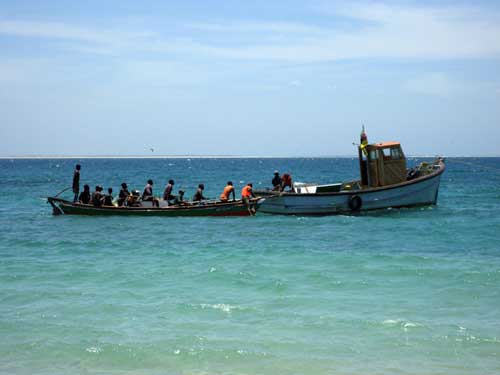
Nature Conservancy:
Piracy off the coast of Somalia may lack the romance of “Pirates of the Caribbean,” yet daily media reports still serve up a steady diet of adventure on the high seas — from rag-tag buccaneers wielding assault rifles and rocket launchers to captive sailors being rescued.
Some reports cite experts who trace today’s piracy to environmental causes. The first pirates, they say, originally were Somali fishermen who turned vigilante when their livelihoods were decimated by rampant toxic waste dumping and illegal fishing from foreign ships.
If nothing else, this point suggests layers of complexity that a mass of sensationalistic reporting routinely misses. One key issue that is barely being addressed is what will happen to Somalia’s marine environment, especially fisheries, as a consequence of this ongoing conflict.
To my mind, the two bottom-line questions are these:
Does the threat of piracy drive fishing elsewhere and, therefore, reduce pressure on the region’s fisheries?
Or does the piracy foster a lawless environment in which fisheries are wantonly plundered?
Two Nature Conservancy partnerships in eastern Africa — not to mention a wealth of historical lessons — suggest at least partial answers. In northern Kenya and in Mozambique, we know that a lack of security means greater peril to habitats and animals. That’s why our work in both places includes direct support to our partners’ security efforts.
Few places on Earth rival the richness of life you find in the rangelands of northern Kenya, where herds of elephant roam the savannas, along with endangered Grevy’s zebra and black rhino. Lack of security here leads to poaching, cattle raiding and tribal conflict over resources such as land, water, livestock and wildlife. Our local partners provide anti-poaching and law-enforcement patrols that both guard wildlife and bring peace and stability to communities.
In northern Mozambique, lack of security emboldens international trawlers that pillage no-fishing zones and poachers who rob eggs from turtle and sooty tern nests. Our work here includes supporting local communities’ efforts to control illegal and destructive fishing and poaching. Security, again, is central here to protecting some of Africa’s richest coral reefs and coastal habitats and ensuring sustainable fisheries.
If pirates were suddenly to appear in Mozambique, they would probably target commercial vessels and thus drastically reduce fishing pressure in the near term. The resulting security issues, however, would likely force us to reduce our investment — meaning no (or fewer) community fishing guards patrolling the waters. Even if we assume the pirates eventually would be vanquished, a conservation vacuum would remain and marine diversity could suffer indefinitely.
So while questions remain about the short-term vs. long-term consequences, it’s only logical that piracy will profoundly affect Somalia’s marine diversity. Some have said that security won’t return to the sea until a stable government returns to the land. And certainly any hopes we have for investing in conservation for the long haul and achieving ultimate goals such as sustainable fisheries depend on certain conditions. Chief among these are stable governance and some sense of law and order.
Still, does a period of insecurity deter, say, trawling and fishing enough to produce some benefit (however fleeting) to nature?
I can’t help but wonder.
Matt Brown is the director of conservation for The Nature Conservancy in Africa.
Time Magazine: How Somalia's Fishermen Became Pirates

Time:
Amid the current media frenzy about Somali pirates, it's hard not to imagine them as characters in some dystopian Horn of Africa version of Waterworld. We see wily corsairs in ragged clothing swarming out of their elusive mother ships, chewing narcotic khat while thumbing GPS phones and grappling hooks. They are not desperate bandits, experts say, rather savvy opportunists in the most lawless corner of the planet. But the pirates have never been the only ones exploiting the vulnerabilities of this troubled failed state — and are, in part, a product of the rest of the world's neglect. (Read "No Surrender to Thugs.")
Ever since a civil war brought down Somalia's last functional government in 1991, the country's 3,330 km (2,000 miles) of coastline — the longest in continental Africa — has been pillaged by foreign vessels. A United Nations report in 2006 said that, in the absence of the country's at one time serviceable coastguard, Somali waters have become the site of an international "free for all," with fishing fleets from around the world illegally plundering Somali stocks and freezing out the country's own rudimentarily-equipped fishermen. According to another U.N. report, an estimated $300 million worth of seafood is stolen from the country's coastline each year. "In any context," says Gustavo Carvalho, a London-based researcher with Global Witness, an environmental NGO, "that is a staggering sum."
In the face of this, impoverished Somalis living by the sea have been forced over the years to defend their own fishing expeditions out of ports such as Eyl, Kismayo and Harardhere — all now considered to be pirate dens. Somali fishermen, whose industry was always small-scale, lacked the advanced boats and technologies of their interloping competitors, and also complained of being shot at by foreign fishermen with water cannons and firearms. "The first pirate gangs emerged in the '90s to protect against foreign trawlers," says Peter Lehr, lecturer in terrorism studies at Scotland's University of St. Andrews and editor of Violence at Sea: Piracy in the Age of Global Terrorism. The names of existing pirate fleets, such as the National Volunteer Coastguard of Somalia or Somali Marines, are testament to the pirates' initial motivations.
The waters they sought to protect, says Lehr, were "an El Dorado for fishing fleets of many nations." A 2006 study published in the journal Science predicted that the current rate of commercial fishing would virtually empty the world's oceanic stocks by 2050. Yet, Somalia's seas still offer a particularly fertile patch for tuna, sardines and mackerel, and other lucrative species of seafood, including lobsters and sharks. In other parts of the Indian Ocean region, such as the Persian Gulf, fishermen resort to dynamite and other extreme measures to pull in the kinds of catches that are still in abundance off the Horn of Africa. (Read about illegal wildlife trade.)
High-seas trawlers from countries as far flung as South Korea, Japan and Spain have operated down the Somali coast, often illegally and without licenses, for the better part of two decades, the U.N. says. They often fly flags of convenience from sea-faring friendly nations like Belize and Bahrain, which further helps the ships skirt international regulations and evade censure from their home countries. Tsuma Charo of the Nairobi-based East African Seafarers Assistance Programme, which monitors Somali pirate attacks and liaises with the hostage takers and the captured crews, says "illegal trawling has fed the piracy problem." In the early days of Somali piracy, those who seized trawlers without licenses could count on a quick ransom payment, since the boat owners and companies backing those vessels didn't want to draw attention to their violation of international maritime law. This, Charo reckons, allowed the pirates to build up their tactical networks and whetted their appetite for bigger spoils.
Beyond illegal fishing, foreign ships have also long been accused by local fishermen of dumping toxic and nuclear waste off Somalia's shores. A 2005 United Nations Environmental Program report cited uranium radioactive and other hazardous deposits leading to a rash of respiratory ailments and skin diseases breaking out in villages along the Somali coast. According to the U.N., at the time of the report, it cost $2.50 per ton for a European company to dump these types of materials off the Horn of Africa, as opposed to $250 per ton to dispose of them cleanly in Europe.
Monitoring and combating any of these misdeeds is next to impossible — Somalia's current government can barely find its feet in the wake of the 2006 U.S.-backed Ethiopian invasion. And many Somalis, along with outside observers, suspect local officials in Mogadishu and in ports in semi-autonomous Puntland further north of accepting bribes from foreign fishermen as well as from pirate elders. U.N. monitors in 2005 and 2006 suggested an embargo on fish taken from Somali waters, but their proposals were shot down by members of the Security Council.
In the meantime, Somali piracy has metastasized into the country's only boom industry. Most of the pirates, observers say, are not former fishermen, but just poor folk seeking their fortune. Right now, they hold 18 cargo ships and some 300 sailors hostage — the work of a sophisticated and well-funded operation. A few pirates have offered testimony to the international press — a headline in Thursday's Times of London read, "They stole our lobsters: A Somali pirate tells his side of the story" — but Lehr and other Somali experts express their doubts. "Nowadays," Lehr says, "this sort of thing is just a cheap excuse." The legacy of nearly twenty years of inaction and abuse, though, is far more costly.
Subscribe to:
Posts (Atom)