Not as good as Stephen Colbert going after Bush, but Wanda Sykes is pretty damn funny:
Obama himself:
Monday, May 11, 2009


Did Mark Zuckerberg's Inspiration for Facebook Come Before Harvard?

I'm been telling this story for years:
By now, we are all familiar with Mark Zuckerberg's success story. The explosive international growth of Facebook to over 200 million users continues to land the young founder and CEO in top news stories worldwide. Recently, Time Magazine named Zuckerberg one of the world's most influential people of 2008, and Fast Company named Facebook number 15 in its list of the world's 50 most innovative companies of 2009. At just 23 years of age, Zuckerberg even briefly made Forbes' 400 richest Americans list, temporarily giving him the title of World's Youngest Billionaire.
However we have heard very few stories about Zuckerberg and the inspiration behind Facebook during the period prior to February 4th, 2004, the day he launched Facebook from his Harvard dorm room. In this post we tell that story.
The stories we hear these days about Zuckerberg in popular media tend to follow a common sensationalist pattern: "super-smart kid invents a tech phenomenon from his Harvard dorm room, drops out, and changes the world." It's a classically framed, Bill Gates-esque story of success driven by intelligence and ambition. What's most intriguing about the Zuckerberg story, however, isn't that he dropped out of Harvard and became a billionaire at 23.
The reason we hear so little about Zuckerberg's pre-launch vision for Facebook (which was originally called thefacebook.com) is likely because he has been a controversial target over the true origins of his business. In 2007, several of Zuckerberg's classmates came forward and claimed rights to the Facebook idea after reports surfaced that Yahoo had offered $900 million to purchase Facebook just two years after the founding of the company. Even though the suit against Zuckerberg was settled last year, given the nature of the proceedings, we'll likely never get an official answer from Zuckerberg himself about the true origins of his inspiration. But maybe we don't need one after all?
It turns out that Zuckerberg's academic history offers a great deal of insight into the inspiration for Facebook and why it was so wildly successful when it first launched. February 4th, 2004 may mark a major milestone in Facebook's history, but the story of Mark Zuckerberg's rise to fame in fact starts years before he stepped foot on the Harvard campus, and is much more complex and interesting than is usually portrayed.
Pre-Zuckerberg: Tracing the Roots of Facebook Culture
You may be surprised to hear that while Harvard was fertile ground for the launch of Facebook, the seed of the concept was likely planted in Zuckerberg in high school. You never hear about Zuckerberg's alma mater Phillips Exeter Academy in stories because Harvard was where the action really started (and the Harvard name, to some extent, validates Zuckerberg's smarts and makes for a more sensational story). But in fact, the time that Zuckerberg spent at the academy from 2000 to 2002 likely had more influence on the name and initial concept of Facebook than any of his classmates at Harvard.
Phillips Exeter Academy (or "Exeter") is a private boarding school for grades 9 to 12, located in Exeter, New Hampshire. The prestigious prep school is a member of the Ten Schools Admission Organization, which includes such famous boarding schools as Phillips Andover, Deerfield Academy, St. Paul's, and Choate Rosemary Hall. Like the other "Big Tens," Exeter has a tight-knit boarding community that lives on campus full time. Students refer to themselves as "Exonians" and have a strong group identity rooted in a rich culture of customs and tradition.
An Exonian for two years, Zuckerberg had plenty of time to observe and participate in the social culture and rhythms ingrained in Exeter's boarding lifestyle. Every year, the school says goodbye to a few hundred students and welcomes a few hundred more. Zuckerberg enrolled in the fall of his junior year and, like every new and returning student, received his own copy of Exeter's student directory, "The Photo Address Book," which students affectionately referred to as (you guessed it!) "The Facebook."
We interviewed several of Zuckerberg's peers this week, and they all confirmed what David W. Farrant (class of 2000) had to say:
"The front cover says "The Photo Address Book," but we all called it "The Facebook" all the time because "The Photo Address Book" was such a mouthful. Everybody called it that."
"Facebook" photo directories were (and still are) a huge part of the students' social experience and culture at prep schools such as Exeter. Every school in the Big Ten prints and distributes one for its students annually. When students arrive on campus each fall, the rhythm of their social lives is predominantly set by their dormitories, their class year (i.e. seniority), and their proximity to friends in other houses. Because students aren't allowed cell phones on campus and living accommodations are in such flux from year to year (they change houses and phone numbers annually), these "Facebooks" are a valuable resource for students.
Of course, not only do students need the directory to find and contact their peers, but the books become part of the culture of bonding between classmates and friends, as students use it to see where their peers live, who's hot and who's not, who lives with who, and who the new kids are. Sounds an awful lot like how people use Facebook online now, right? Of course, it also describes an early pre-Internet social culture, facilitated by photo directories, that students enjoyed long before Zuckerberg even made it to high school, a culture he happened upon and got to participate in by a stroke of pure luck and glorious opportunity.
But the story doesn't end there. In Zuckerberg's senior year, the student council, headed by student body president Kris Tillery, successfully lobbied the administration to have the school's IT department put the full contents of Exeter's Photo Address Book online. By the time Zuckerberg graduated, the website was put up at http://student.exeter.edu/facebook, with the URL directory (i.e. "facebook") named after the students' pet name for the physical book and effectively shortened to something useful. Tillery was unavailable for comment.
In our interviews, some of Zuckerberg's peers pointed us to this screenshot of the original website hosted on the school's .edu domain. The screenshot was posted in the public Facebook group "Exonians" in 2006 and is still there. Some of the comments about the screenshot (which date back to 2007) refer to it as "the original Facebook" and refer to the Photo Address Book as "the physical Facebook."
Of course, the school's student.exeter.edu/facebook website is no longer online, and none of our sources were able to confirm whether Zuckerberg himself was involved in, or responsible for, the student council initiative that got the directory online in the first place. All we know is that students were enthusiastic enough about an online version of the physical directory that the student council made an effort to lobby the administration, that the online directory was created during Zuckerberg's senior year, and that he was likely aware of its existence.
A More Complete Picture of the Facebook Success Story
Now that Facebook has graduated from its academic roots and been released to the world for free, its continued growth has many experts saying it will likely be the dominant social platform for the foreseeable future. At 200 million users (and counting), Facebook makes it hard to doubt that it will have considerable influence in the way we all connect and communicate in the future, both locally and across borders. While we may never know the true origins of Mark Zuckerberg's inspiration for Facebook, looking at the social culture of the prep school he attended and his experiences as a boarding student there offer us insight into where the explosion of global Facebook culture may have begun, why it was so successful when it launched at Harvard, and how luck and opportunity may have led one of the world's youngest visionaries to start coding in his college dorm room.
Steffan Antonas is a technology anthropologist, writer, and blogger who currently lives in San Diego, CA. He began studying human behavior in virtual communities as a graduate student in Georgetown University's Communication Culture and Technology (CCT) Program in 2003. He has worked in Southern California as an IT Professional for the past three years. You can contact Steffan at steffanantonas@gmail.com and on Twitter @steffanantonas.
FT: Question of Zoos

I think I had an inebriated conversation about the merit of zoos this weekend. While I do appreciate their worth, and understand that they provide an appreciation for nature that most people cannot gain through books, discovery channel, etc., every time I have visited a zoo and seen a depressed gorilla, it breaks my heart.
From the Financial Times:
Behind the rusting gates of Wroclaw Zoo, ivy is claiming the walls of the ramshackle gothic administration building. Inside, the best Radoslaw Ratajszczak can do to keep out the Polish winter is to point a bar heater at his desk. “You can see the challenge I face,” the zoo director says, gesturing at the peeling paintwork. From high on the wall, the head of a large black rhino watches Ratajszczak’s every move. He hates the thing and has tried to remove it, but it’s bolted through the brickwork. “I don’t like dead animals,” he explains.
Ratajszczak, a biologist who resembles a chain-smoking Santa, is jolly even in the face of the huge task before him. When he won his directorship two years ago, he took it upon himself to transform the worst zoo in Poland into a state-of-the-art conservation park. The mounted rhino is a reminder of the days when best practice in the acquisition of zoo animals was to shoot the mother to capture the offspring. Ratajszczak’s challenges are typical of those faced by dilapidated zoos across eastern Europe as they are forced to accept European Union rules on the humane treatment of animals.
However, while zookeepers can replace metal bars with moats, and cages with warm, eco-friendly enclosures, can they really change the fundamental nature of their enterprise: the display of captive wild animals for the entertainment and edification of humans? Why do we frown on wild animals in circuses but flock – in our millions – to see them in zoos?
After a slump in the late 1970s and 1980s, the zoo as family entertainment is back. Worldwide, as many as 600 million visits are made to zoos each year, according to the World Association of Zoos and Aquaria (Waza). In Europe, they are among the most visited of all tourist sites: the Berlin Zoo, to pick probably the most successful example, is a stock-market-listed – though non-profit-making – company that aggressively merchandises star animals such as Knut, the cute baby polar bear (now reputedly a maladjusted adult).
Still, the question of what zoos are for has not gone away. Most of the animals on display in the UK’s largest zoological gardens are at the very lowest risk of extinction in the wild, according to the Born Free Foundation, which campaigns to “keep wildlife in the wild”. Fewer than a quarter are classified as “threatened” on the International Union for the Conservation of Nature’s Red List. Yet it is species conservation that dominates zoos’ branding – and the spur behind their revival seems to be that they have convinced punters that the price of a ticket buys them, not entry to a show, but a stake in the preservation of the natural world. When Born Free conducted a survey to discover what percentage of UK zoo income people thought was spent on the conservation of threatened species in the wild, most answered: about a quarter. The true figure, Born Free believes, is between 4 and 7 per cent – in other words, of the average £10.30 cost of a ticket to a British charity-registered zoo, between 41p and 72p goes to in situ conservation. Even captive breeding programmes, Born Free estimates, account for less than 14 per cent of the 5,600-plus vertebrate species on the Red List. “The zoo model has largely remained the same, but the marketing model has had to adapt to meet changing public expectations,” argues Born Free’s chief executive, Will Travers.
Since 2005, Europe’s zoos have been required to implement an EU directive on minimum standards of animal welfare and engage in educational and conservation work. But the provisions of the directive are vague and implementation has been variable, according to the Eurogroup for Animals, a non-profit organisation that monitors animal welfare. The group’s forthcoming 2009 report will conclude that many member states are failing on both objectives.
The group has launched legal action against Spain and Portugal and also has concerns about Italy, says Véronique Schmit, the group’s executive officer for policy. It has so far held fire against two others, Bulgaria and Romania, which have only been bound by the directive since 2007 when they joined the EU. “We acknowledge that zoos will always exist,” says Schmit. “But we feel that the educational role of zoos is the only way they can be justified.”
Continued................
Friday, May 8, 2009

First Official Climate Change Refugees Evacuate Their Island Homes for Good

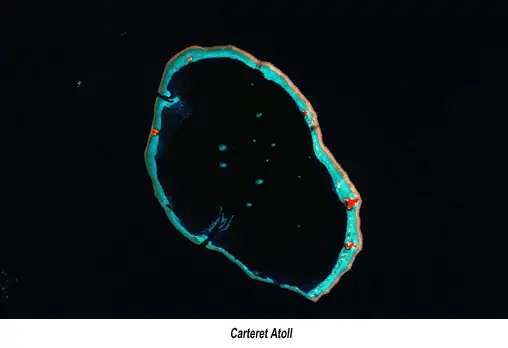
Yup, we're sinking. The day has finally come, and a critical landmark in the saga of global climate change is occurring as we speak—and hardly anyone has noticed. The Carteret Islanders of Papua New Guinea have become the world's first entire community to be displaced by climate change. They're the first official refugees of global warming - and they're packing up their lives to move out of the way of ever-rising waters that threaten to overtake their homes and crops. The island they call home will be completely underwater by 2015. The Ecologist:
The evacuation of the Carteret Islands have begun. This morning I stood on black volcanic sand, pressed up right against the jungle, and watched a small white boat powered by a single outboard engine run in against the shore. On board were five men from the Islands, the fathers of five families, who have come to finish building houses and gardens already begun in a cleared patch of jungle at Tinputz, on the east coast of Bougainville. When these homes are ready the five will return to the Carterets, to fetch their wives and children back. Life, they hope, will be better for them here. On the Carterets, king tides have washed away their crops and rising sea levels poisoned those that remain with salt. The people have been forced to move.
The men climbed silently from the boat and into the shallows. They splashed towards us, carrying almost nothing. From beside me, others who had come to meet them walked out quietly in welcome. The air was still, both sad and happy, which seemed to suit the moment. That single boat carrying these five men is the first wave in what is, as far as I can tell, the world’s first official evacuation of an entire people because of climate change. Some say they will be ready to bring their families here next month when the houses are completed. Others that it will be June, when the first crop of sweet potatoes will be ready to feed them.
It was a combination of a little planning and a lot of luck that allowed me to be among the very few to see this. I heard the evacuation was beginning only yesterday, a day after arriving in Buka. It has been on again and off again many times over the past year, but Papua New Guinea seems to like throwing surprises. Given the chance to be there when it finally began, I leapt and travelled to Tinputz this morning, first by boat across Buka passage, which separates the island on which I am staying from Bougainville, and then through the jungle in the back tray of a Toyota Hilux 4-wheel drive with a crowd of local people. Some were from the NGO the Carterets established to broker their own move. Others were from the Carterets themselves, who had travelled to Buka on trading boats and wanted to be at Tinputz to welcome their friends. There were also a Kiwi and an Aussie, Kim and Kirsten, who have spent months as volunteers working towards today. We arrived only minutes before the boat itself.
After the arrival, the men sat in the shade of two unfinished timber frame houses among the trees – the beginnings of the homes they are to complete. The women cooked; clams and corned beef sandwiches, greens, rice and cassava wrapped in palm leaves. After hours the two parties came together to eat, to pray and to formally welcome the newcomers to Tinputz. There were speeches in Tok Pisin, only a little of which I followed. The five fathers sat in a line and nodded their heads in silence.
On the ride home, hundreds of children streamed along the road, in bright white shirts above blood red skirts and trousers, proving completely false my first thought that the dense forest on either side must be uninhabited. The only bitter taste to today came also on this return journey, riding high on the tray of the Toyota. We hit and killed a pig and then a dog that scampered out into the jungle road; fortunately our driver had no licence plate, or the call for retribution would have been swift (this is a country that puts a pig on its 20 kina note). A full beer-bottle also came screaming at us from a passing truck, but shattered harmlessly on the road. Possibly it was aimed at me, the only white guy in sight. At least that is what the others with me in the Toyota thought. On the other hand, I saw a man carrying a stone-tipped spear along the road, which is also something you don’t see every day.
Cam'ron - Cookies-N-Apple Juice (Feat. Skitzo & Byrd Lady) / Silky (No Homo)
New Cam'ron "Cookies-N-Apple Juice" video...........there really aren't words. I don't expect much from most rappers, but while the song drops a catchy beat and will no doubt be a club hit, the level of blaxploitation in the video dates back to the 90s.
Okayplayer Review of Phil the Agony "Think Green"

On the surface, Phil The Agony’s latest album looks like it might be more about ideas than music; the first things you encounter are a title and cover art derived from a well-worn catch phrase and recycling icon, respectively. Listening to the album resolves these doubts favorably - although the environment is a topical undercurrent and genuine concern throughout, it is not the only subject, and when it is dealt with the subject is handled in a way that submits to the music, rather than vice versa. The title track and its accompanying remix are good songs, drawing in references to green in other forms (money, weed, the Great Gazoo) but essentially encouraging the listener to give some thought to the environmental impact of their actions. A broad handling of the topics works well in this context.
It’s important not to get too hung up on the title, since the album is at heart just good hip-hop music, not overly weighed down by messages. The same few collaborators turn up on multiple tracks, including Planet Asia, Krondon, and Chace Infinite, reflecting Phil’s West Coast base and the personal nature of the project, a friends and family affair. Talib Kweli makes an excellent appearance on one of the strongest pieces, “Hunters,” as well as on the title track, but this is not to undersell any of the others, as all of the guests seem to have been inspired and committed to bringing out solid performances.
Beat-wise, the music is effective; electronic hand claps, synth sounds, and piano samples are all heard at various times, set to laid-back tempos suited for late nights and slow driving. Darker pieces like “Turkey Bacon,” a story about trying to avoid the cops, find their compliment in these atmospheres, and all of the tracks seem appropriate to one degree or another for listening while smoking, consistent with one of the more obvious interpretations of the album title.
The album pulls off what it seems to want to accomplish, is edited well enough to keep from becoming boring, and the performances are all quality. Not every track can be equally strong, some may be a little more average-sounding and therefore forgettable, but there are strong enough pieces on here to render it a good release.
Mos Def - Casa Bey

Hot new single of The Ecstatic with drops June 9th. Guests include Talib Kweli and Slick Rick. Production from Oh No, Chad Hugo, Mad Lib, Mr. Flash, DJ Preservation, J Dilla and Georgia Anne Muldrow.
This song samples Banda Black Rio's "Casa Forte"
Eugene Robinson: Time for President Obama to Stand Up for Gay Marriage

While I'm all about Obama, there are a few things I have reservations with him about. I understand he is a shrewd politician, and you have to be to get this far in politics and DC. I understand that there are some issues that you have to straddle the isle on in order to gain political capital, and he is a representative of the people and their will. I know that he would not necessarily have been elected if he spoke out and told the world exactly what was on his mind. But there are three major things I take issue with:
1. Not punishing the previous administration for human rights abuses.
2. Supporting the exploration of CCS (Carbon Capture and Sequestration = Clean Coal) technology.
3. His support of civil unions and not full and equal same-sex marriage.
Maybe I am projecting, but I don't believe that Obama actually supports any of these three positions he has taken. I think he has taken these three stances for political capital, and is bidding his time to get the economy in check before he tackles them. It is completely inconsistent for his intelligent, informed, and logical stance on all other human rights and scientific issues for him to take these three stances.
Below is a really good editorial by my favorite Washington Post writer and recent Pulitzer Prize winner, Eugene Robinson. He talks about how same-sex marriage is a basic human right, and it is time for Obama to clarify his stance on the issue:
Believe it or not, often I can see the other side of an argument. I know that tough gun control laws save lives and make our communities safer, for example, but I also see clarity in the Second Amendment. I support affirmative action, but I realize that providing opportunity to some worthy individuals can mean denying opportunity to others. Thinking about some issues involves discerning among subtly graded shades of gray.
On some issues, though, I really don't see anything but black and white. Among them is the "question" of granting full equal rights to gay and lesbian Americans, which really isn't a question at all. It's a long-overdue imperative, one that the nation is finally beginning to acknowledge.
Before his inauguration, President Obama called himself a "fierce advocate of equality for gay and lesbian Americans." Now, with the same-sex marriage issue percolating in state after state and with the Pentagon's "don't ask, don't tell" policy ripe for repeal, it's time for Obama to put some of his political capital where his rhetoric is.
On Wednesday, Maine became the fifth state to legalize gay marriage; similar legislation in New Hampshire has been sent to the governor. Politicians in Washington who want to avoid what they see as a dangerous controversy have a convenient escape: They can say that the marriage issue should be left to the states and that the question of whether a legal gay marriage in one state should be recognized everywhere has already been addressed by Congress and ultimately will be settled by the courts.
But that's a dodge, not a stance. It certainly can't be confused with leadership.
Favoring "civil unions" that accord all the rights and benefits of marriage -- but that withhold the word marriage, and with it, I guess, society's approval -- amounts to another dodge. I'm concerned here with the way the law sees the relationship, not the way any particular church or religious leader sees it; that's for worshipers, clergy and the Almighty to work out. Marriage is not just a sacrament but also a contract, and the contractual aspect is a matter of statute, not scripture.
Obama took the "civil unions" route during last year's campaign and has stuck with it. While I see the political calculation -- that was basically the position of all the major Democratic candidates -- I never understood the logic. If semantics are the only difference between a civil union and a marriage, why go to the trouble of drawing a distinction? If there are genuine differences that the law should recognize, what are they?
It seems to me that equality means equality, and either you're for it or you're not. I believe gay marriage should be legal, and it's hard for me to imagine how any "fierce advocate of equality" could think otherwise.
Obama sensibly advocates the repeal of "don't ask, don't tell." He should press the case by publicly reminding opponents of letting gays serve openly in the military that their arguments -- it would hurt morale, damage cohesion and readiness, discourage reenlistment -- are often the same, almost word for word, as the arguments made 60 years ago against racial integration in the armed forces. It was bigotry then, and it's bigotry now.
Obama should also make the obvious case that forcibly discharging capable, fully trained servicemen and servicewomen for being gay, at a time when our overstretched military is fighting two big wars, can only be described as insane.
What the president shouldn't do is stay away from the marriage debate on the grounds that it's not a matter for the federal government. For one thing, he's on record as favoring repeal of the 1996 Defense of Marriage Act -- a law that blocked federal recognition of same-sex marriages and relieved states of any obligation to recognize out-of-state gay marriages.
Does Obama's stance in favor of repeal mean that he believes the federal government should recognize same-sex marriages? Does he also believe that, say, the state of Alabama should recognize a gay marriage performed in Iowa? If so, what is the practical difference between this position and just saying in plain language that gay marriages ought to be legal and recognized in all 50 states?
I'm not being unrealistic. I know that public acceptance of homosexuality in this country is still far from universal. But attitudes have changed dramatically -- more than enough for a popular, progressive president to speak loudly and clearly about a matter of fundamental human and civil rights.
Thursday, May 7, 2009
John F. Kerry and David Dreier: A Friend To Georgia And Russia
Craziness is still going on in the Republic of Georgia, and I don't mean my dad, his new Georgian wife, and my new five year old step-brother (who doesn't speak english) and neither of whom I have met. Here are some interesting thoughts by Mr. Heinz-Kerry and David Dreier.
Artist rendering of my dad's wedding?

Washington Post Editorial:
Artist rendering of my dad's wedding?
Washington Post Editorial:
As the Obama administration seeks a fresh start in our strained relationship with Russia, the case for cooperation with Moscow on everything from nuclear terrorism to global finance is clear and compelling. So, too, is the case for protecting the freedom and sovereignty of the fledgling democracies on Russia's borders. We must do both.
Part of the way we can continue to support allies such as Georgia even as we do more to pursue vital national interests alongside Russia is by focusing on areas that can deliver real benefits to one side without hurting ties to the other. That's why we believe we should sign a free-trade agreement with Georgia and why we plan to introduce a resolution to this end today.
While some mistakenly view constructive relations with these two countries as mutually exclusive, we see no inherent contradiction in offering Russia a fresh start while maintaining our commitment to ensuring that its neighbors have the right to choose their own destinies. Yes, sometimes Russia and its neighbors see the world in zero-sum terms -- and sometimes their interests collide violently, as when Russian tanks rolled into Georgia last August. But we need not define our relationships with these countries the same way.
Georgia, as the scene of recent tensions, is an important place to find better approaches. It is suffering from the economic impact of two catastrophes: Soon after Russian missiles stopped falling last summer, Georgia was hit by the global economic crisis. It is vital that we help Georgia weather the economic crisis -- and doing so should not be threatening to Russia. In the past year we have largely fulfilled our pledge of $1 billion in postwar reconstruction aid to Georgia, but in the long term, increased trade and foreign direct investment would have far greater and more sustainable benefits. In the year before the war, trade between the United States and Georgia amounted to $580 million -- a total with significant room to grow.
A trade agreement with a small country half a world away would not have negative consequences for workers here at home, but it could mean a great deal to Georgians far beyond the trade it directly sparks. First, even the act of launching negotiations may increase investor confidence in Georgia and attract badly needed foreign direct investment. Our pact with Jordan shows how an American trade agreement can attract international businesses, even in volatile regions and even before the deal takes force. An agreement between the United States and Georgia could also create momentum for a similar deal between Georgia and the European Union. Building economic ties between Georgia and the West, particularly the neighboring European Union, is the least strategically costly way to significantly bolster the Georgian people's democratic and economic aspirations.
Second, bilateral trade negotiations would provide impetus for greater economic and political reform in Georgia. The Georgian people have committed themselves wholeheartedly to democracy, but the path to stable, effective and fully representative democracy is not an easy one. Greater economic engagement would provide a tremendous opportunity to hold Tbilisi accountable in its efforts to enshrine the rule of law and build the institutions that are the foundation to both democratic governance and economic prosperity.
Geography cannot be denied; Georgia and Russia should eventually restore strong trade relations. Today's standoff hurts both nations. Even two years before the conflict last summer, Russia severed transportation links and blockaded Georgian exports of mineral water, fruits, vegetables and wine. It would be a positive step if Russia removed these restrictions. It is notable that despite the rising tensions before last summer's war, the Georgian government had accepted Russian investment in Georgia, even in its infrastructure, an area in which other countries are often reluctant to allow even their friendliest neighbors to invest. Russian and Western investment should ultimately co-exist in the healthy atmosphere of a democratic Georgia whose sovereignty is respected.
Of course there will be times when we must stand on principle in the face of real disagreement -- and we certainly will. The 2008 Russian-Georgian war was a tragedy that cannot be repeated. We have both been to Georgia and met with its leaders. Georgia's people deserve praise for their impressive democratic and economic accomplishments, and America should support Georgia's undeniable right to its territorial integrity and independence.
In addition, Russia should fully implement its cease-fire agreement and adopt a more constructive attitude toward the full deployment of international monitors to help preserve peace.
But the challenges of a new moment demand a commitment to creative solutions. Economic prosperity has a way of spreading throughout both sides of a trading relationship and may offer the best long-term solution to forging some form of reconciliation between Georgia and Russia. Over time, increased trade and a higher quality of life may also help to heal wounds between Georgia and its alienated separatist regions.
History has shown that, when done right, trade brings benefits to all sides. Diplomacy can do the same. We need to use both to build closer ties with Russia even as we continue to support our friend and ally Georgia.
Kanye West - Two Words (feat. Mos Def & Freeway)
Previoulsy unreleased video for Kanye West "Two Words" featuring Mos Def and Freeway.
"This video never got played because I refused to remove the titles on it. They said people will think a TV show is going off and I said that's the whole point. Wow... even only 3 videos in to the game.... I refused to compromise my vision." - Kanye West

U.N. climate deal to fail without aid money: adviser
NEW YORK (Reuters) - The world will fail to agree to control emissions of global warming pollution this year in Copenhagen unless rich countries fund billions of dollars in annual climate aid to poor nations, a U.N. adviser said.
"If there's no money on the table, no agreement," Jeffrey Sachs, an adviser to U.N. Secretary-General Ban Ki-moon and head of Columbia University's Earth Institute, told reporters on Wednesday.
Nearly 200 countries are set to meet in Copenhagen in December to reach a successor to the Kyoto Protocol on global warming, which runs out in 2012.
Sachs said rich countries need to come up with tens of billions of dollars per year in aid. This would help developing countries mitigate greenhouse gas pollution and adapt to consequences of global warming like more droughts, flooding, and heat waves predicted by the U.N.'s climate science panel.
African nations said last month that developing countries would need $267 billion a year by 2020 to cope with climate change.
Sachs said the tens of billions per year should go to programs to help industrializing countries develop renewable electricity such as concentrated solar energy. Water conservation programs and better irrigation would also help them adapt as warming is expected to shrink glaciers, reducing fresh-water supplies in coming decades.
The largest developing country, China, recently surpassed the United States as the top polluter of greenhouse gases. But its per capita emissions are less than a quarter of those from the United States.
Many developed countries believe rich countries should provide funds because they have enjoyed more than a century of industrialization while emitting billions of tons of greenhouse gases into the atmosphere.
Raising the financing during the recession will be no easy task, Sachs said, but some of the money could come from cap-and-trade programs in rich counties. Auctions of permits to pollute greenhouse gases also could provide funds, he said.
But auction funds may not materialize. U.S. Rep. Mike Doyle told reporters on Wednesday most industry permits to emit greenhouse gases under a climate change bill being negotiated in the House of Representatives will initially be given away to companies instead of sold to them.
Big day for WALE

DMV native WALE is releasing his debut album TODAY. The glorious period of free Wale mixtapes is over.
FLIER THAN THE REST OF 'EM
STILL GOT MY NIKES ON.
ThinkGreenTV: Phil explains "Think Green"
ThinkGreenTV: Phil explains "Think Green" from Blacksmith Music on Vimeo.
The "greening" of hip hop has always seemed like a logical step to me, once you have moved beyond the escalades, diamonds, private jets, etc.
Reflection Eternal is BACK
Reflection Eternal in the studio from Blacksmith Music on Vimeo.
Check out this video of Hi-Tek and Kweli in the studio crackin' jokes and telling stories in between recording (apparently crack heads don't make the best cab drivers lol). The bigger news from all this is that Reflection Eternal now has a name for their upcoming album... Revolutions Per Minute. I remember Train of Thought back in 2000. Bought that the day it came out.
Here is a cut of one of their new songs:
Wednesday, May 6, 2009
Am I becoming a fan of hockey? Maybe of DC having ONE winning team?

The Great Ones Get It
By Michael Wilbon
Ted Leonsis recalls the return trip from the NHL awards ceremony last June.
Alex Ovechkin had won the Hart Memorial Trophy as the league MVP, the Lester B. Pearson Award as the most outstanding player chosen by the NHL Players Association, the Art Ross Trophy as the league's top point scorer and the Maurice Richard Trophy as the league's top goal scorer. There was so much hardware, it nearly didn't fit on the plane.
As thrilled as Leonsis was that one of his team's players had been so decorated, Leonsis said to Ovechkin: "Do you want to be like Charles Barkley, a great player and a big personality who makes a lot of money and is loved by everybody? Or do you want to be like Michael Jordan and win championships?" Asked after Monday night's Game 2 victory over the Pittsburgh Penguins if he recalled Ovechkin's response, Leonsis said, "Alex knows that a place in history only comes with winning the Stanley Cup."
Ovechkin's real and more meaningful response to that question has come in recent playoff games, particularly Monday night's three-goal outburst that led the Washington Capitals to a 2-0 series lead over Pittsburgh. Sidney Crosby scored all three of the Penguins' goals, but there was a bodaciousness about Ovechkin's performance that right now separates him from every player in the game, including the gifted Crosby.
You can't expect Ovechkin to explain it in his still developing English, but there's something universally understandable about "give me the puck and get the hell out of my way." Or as Leonsis said late Monday night: "Sid is the best white wine the restaurant has to offer. Alex is a Denver Slammer, a shot of tequila in a glass of champagne. You whack the glass so that the fizz is coming up and you just shoot it."
Crosby is a wonderfully skilled player, technically superior.
Ovechkin is a beast. He explodes, like a tornado. Ovechkin is scary. His shot is scary. There's an aggression about him, a barely controlled fury that Crosby, great as he is, doesn't have. Nobody else has it. Watching Ovechkin on Monday night reminded me of watching Bobby Hull play for the Chicago Blackhawks when I was a kid.
He's the fastest, toughest guy with the biggest shot, the fewest teeth.
Every great player wants to win. Ovechkin wants to beat you down.
Continues............

WP: Opinion - The Cost of Climate Inaction
By Kristen Sheeran and Mindy Lubber in the Washington Post:
Robert J. Samuelson's April 27 op-ed, "Selling the Green Economy," was way off the mark on the economics of tackling climate change. It was a call to bury our collective heads in the sand simply because the future involves uncertainty -- exactly the opposite of what we need to do.
Samuelson argued that the cost of moving to a clean-energy economy is higher than advocates expect and that transition can't happen nearly fast enough to meet the ambitious goals proposed in the climate and energy bill sponsored by Reps. Henry Waxman (D-Calif.) and Edward Markey (D-Mass.).
But this assumes that all costs involved in mitigating climate change -- and there will be costs -- represent new costs, without acknowledging the massive error in our market system that equates the price of carbon emissions to zero. This fundamental error skews everything that follows, because if emitting carbon costs nothing on a balance sheet, all steps to reduce pollution count as "new costs."
The real cost of carbon emissions is far from zero. Each new scientific report brings proof of a changing climate that promises to disrupt agricultural patterns, set off a scramble for dwindling resources, raise sea levels, propel population shifts and require massive emergency spending as we try to react to the growing crises. These are the costs of inaction.
A smart climate policy can create a mechanism to put the right price on carbon, and rapid economic change will follow that firm price signal, along with reduced climate risks. Our work with more than 100 economists nationwide and at RealClimateEconomics.org demonstrates the weight of economic analysis supporting this point.
The failure to put a real price on carbon emissions also undermines Samuelson's second point, that we cannot switch to clean energy technologies quickly. Many claim that these technologies will not work, at least in a cost-effective way, because we would already be using them if they did.
But we are not using them enough now because we have set the price of carbon pollution at zero and have devoted most of our financial incentives to fossil fuel production to gas up our vehicles, heat our homes and power our factories. Acknowledging the climate crisis and pricing its risks correctly, instead of passing them on to our children, would produce an amazingly quick shift to new technologies and behaviors. We change habits when it makes economic sense to do so. Price matters.
Ultimately, households and businesses care more about their total energy bill than costs per gallon or per kilowatt hour. Gas at $4 per gallon is cheaper in a car that gets 40 miles per gallon than $3-a-gallon gas in a clunker that gets 20 mpg. American entrepreneurial and research genius can move us to far greater energy efficiency quickly, using mostly existing technologies, when a carbon price rewards the effort.
The economic impacts on households, then, may not be as dramatic as some warn. We can mobilize the political will for clean technologies and emissions reduction when, as economic research demonstrates, there is a visible payoff in jobs and strides in international competitiveness from these technologies.
And none of this is in conflict with the business community. Quite the contrary. Consider Business for Innovative Climate and Energy Policy (BICEP), a coalition of nationally and globally known companies including Nike, Starbucks, Sun Microsystems, Timberland and Levi Strauss that the investor coalition Ceres coordinates. The heads of these companies believe that passing strong climate and energy legislation this year is in the interests of both the planet and their businesses.
Some BICEP businesses already see climate change affecting their supply chains, manufacturing and international markets. Those are costs. These companies see strong climate and energy policy as pro-business because increased energy efficiency saves them money and clear price signals on carbon help them plan competitive strategies on a more level playing field.
The cost of inaction is high and could be catastrophic. But, contrary to claims, the cost of switching to cleaner energy and dramatically lower emissions will spur competitive gains, cost far less and come much more quickly once we have set our goals, adjusted our incentives and corrected the market's false signals.
History shows that big changes often come in a rush, unforeseen by the critics of the day. We believe that honest accounting for the reality of climate change will bring a convergence of effort and interests, triggering change on a scale that will, once again, alter the course of history.
Kristen Sheeran is executive director of the Economics for Equity and the Environment Network, a nationwide group of economists focused on environmental policy. Mindy Lubber is president of Ceres, a national coalition of investors, environmentalists and public interest groups working with companies to address sustainability challenges.
Tuesday, May 5, 2009
First Great Pacific Garbage Patch Clean-Up Effort to Begin

TimesOnline:
A high-seas mission departs from San Francisco next month to map and explore a sinister and shifting 21st-century continent: one twice the size of Texas and created from six million tonnes of discarded plastic.
Scientists and conservationists on the expedition will begin attempts to retrieve and recycle a monument to throwaway living in the middle of the North Pacific.
The toxic soup of refuse was discovered in 1997 when Charles Moore, an oceanographer, decided to travel through the centre of the North Pacific gyre (a vortex or circular ocean current). Navigators usually avoid oceanic gyres because persistent high-pressure systems — also known as the doldrums — lack the winds and currents to benefit sailors.
Mr Moore found bottle caps, plastic bags and polystyrene floating with tiny plastic chips. Worn down by sunlight and waves, discarded plastic disintegrates into smaller pieces. Suspended under the surface, these tiny fragments are invisible to ships and satellites trying to map the plastic continent, but in subsequent trawls Mr Moore discovered that the chips outnumbered plankton by six to one.
The damage caused by these tiny fragments is more insidious than strangulation, entrapment and choking by larger plastic refuse. The fragments act as sponges for heavy metals and pollutants until mistaken for food by small fish. The toxins then become more concentrated as they move up the food chain through larger fish, birds and marine mammals.
“You can buy certified organic farm produce, but no fishmonger on earth can sell you a certified organic wild-caught fish. This is our legacy,” said Mr Moore.
Because of their tiny size and the scale of the problem, he believes that nothing can be solved at sea. “Trying to clean up the Pacific gyre would bankrupt any country and kill wildlife in the nets as it went.”
In June the 151ft brigantine Kaisei (Japanese for Planet Ocean) will unfurl its sails in San Francisco to try to prove Mr Moore wrong. Project Kaisei’s flagship will be joined by a decommissioned fishing trawler armed with specialised nets.
“The trick is collecting the plastic while minimising the catch of sea life. We can’t catch the tiny pieces. But the net benefit of getting the rest out is very likely to be better than leaving it in,” says Doug Woodring, the leader of the project.
With a crew of 30, the expedition, supported by the Scripps Institution of Oceanography and Brita, the water company, will use unmanned aircraft and robotic surface explorers to map the extent and depth of the plastic continent while collecting 40 tonnes of the refuse for trial recycling.
“We have a few technologies that can turn thin plastics into diesel fuel. Other technologies are much more hardcore, to deal with the hard plastics,” says Mr Woodring, who hopes to run his vessels on the recycled fuel.
Plastics bags, food wrappers and containers are the second and third most common items in marine debris around the world, according to the Ocean Conservancy, which is based in Washington. The proportion of tiny fragments, known as mermaid’s tears, are less easily quantified.
The UN’s environmental programme estimates that 18,000 pieces of plastic have ended up in every square kilometre of the sea, totalling more than 100 million tonnes. The North Pacific gyre — officially called the northern subtropical convergence zone — is thought to contain the biggest concentration. Ideal conditions for shifting slicks of plastic also exist in the South Pacific, the Indian Ocean and the North and South Atlantic, but no research vessel has investigated those areas. If this exploratory mission is successful, a bigger fleet will depart in 2010.
Mr Woodring admits that Project Kaisei has limitations. “We won’t be able to clean up the entire ocean. The solution really lies on land. We have to treat plastics in a totally different way, and stop them ever reaching the ocean.”
D.C. Gay Marriage Measure Set for Mayor's Signature

This an important first step for DC, and for a Federal protection of same-sex marriage. This isn't about defining marriage, this is about civil and human rights.
Washington Post:
An overwhelming majority on the D.C. Council voted today to recognize same-sex marriages performed in other states, sending the District deeper into the national debate and galvanizing supporters on both sides of the issue.
The measure, approved by a vote 12 to 1, now goes to Mayor Arian M. Fenty (D), a supporter of gay marriage.
If Fenty signs it, the District will put the same-sex marriage issue directly before the Congress. Under Home Rule, the District's laws are subject to a 30-day congressional review period.
After the vote, a large crowd of opponents, led by local ministers, began yelling "Get them off the council!" referring to the members who supported the measure. After the vote, a large crowd of opponents, led by local ministers, began yelling "Get them off the council!" referring to the members who supported the measure. The crowd caused such a ruckus that security guards and D.C. police officers had to be called in to restore order.
"We need a new Council. They are destroying our youth," shouted Paul Trantham, who lives in Southeast. "Every minister who fears God should be here. This is disrespectful to the nation's Capitol. There is nothing equal about same-sex marriage."
Another protester, C.T. Riley, added: "This is not over. We are going to the hill with this issue." Continues......
Causes 2: An Album to Aid Darfur
The war in Darfur is an ongoing crisis in Sudan (Northeastern Africa) that seems to be a popular talking point for those attempting to sound up to date in current events, but a forgotten issue when it comes time to help. No civil injustice anywhere in the world should be swept under the rug. Here is your chance to not only support a good cause, but get some great music as well. Causes 2 is the second album from Waxploitation’s ongoing benefit series for Darfur. 100% of the profits from the album go to Human Rights Watch, Doctors Without Borders, and Oxfam America. Making this purchase is basically making a $10 donation and getting a free CD featuring exclusive music form Gnarls Barkley, Diplo, RJD2, Sharon Jones & the Dap-Kings, The Decemberists, Richard Swift, and more. Click here for more info on the album and other merchandise.
Monday, May 4, 2009
Don Cannon Presents The Cool Kids - Gone Fishing [Mixtape]

The new The Cool Kids x Don Cannon Gone Fishing mixtape has arrived.... When Fish Ride Bicycles album coming soon..
Download the Mixtape
Saturday, May 2, 2009
Sierra Nevada Installs Electric Car Chargers at its Brewery in Chico, California

If you know me, you've probably seen me drinking Sierra Nevada. I do it not just because of its full flavor and "drinkability."
America’s oldest micro brewery is also one of the greenest and it doesn’t hurt that they produce some killer beer. In February Matthew wrote about Sierra Nevada and E-Fuel Corp partnering to make ethanol from discarded beer yeast. And a few years before that the brewery went almost entirely off the grid as a result of its fuel cell technology and solar panels. Now the company is taking it to the next level by becoming the first corporate customer of ChargePoint networked charging stations.
Sierra Nevada has installed ChargePoint™ Networked Charging Stations at its Chico, Calif. Brewery. The two charging stations are available for patrons and employees of the brewery with electric or hybrid vehicles. Though this is the first Chargepoint to be installed at a corporation, these handy charging stations are already popping up all over the San Francisco area. Three charging stations were installed in February across the street from City Hall in San Francisco. Its producer, Coulomb Technologies is building a network of 40 charging stations along California highways in 2009.
Electric cars may not be commercially available yet in the US, and aren’t expected to be widely available much before 2012, but when they are California will be ready. Consumers simply subscribe to the ChargePoint Network and receive a ChargePoint Smart Card that allows them to charge their car at any ChargePoint station worldwide.
Friday, May 1, 2009
Busta Rhymes feat. Lil Wayne & Jadakiss - Respect My Conglomerate
Long day, no time to make posts. Interesting environmental shit on the UNFCCC Clean Technology Fund to be public soon.
Subscribe to:
Posts (Atom)